Choosing a halogen car lamp sounds straightforward. You find your fitment code, pick a reputable brand, and install it. That is the theory. In practice, the same H4 or H11 designation can hide wildly different performance, and the upgrade path from halogen car lights to LED is littered with expensive disappointments. This guide exists for one reason: to help you spend money once, correctly.
The Halogen Car Lamp Market Is Not What It Seems
Two halogen car headlight bulbs with identical fitment codes can differ by 40 percent in usable output, 300 percent in lifespan, and enough color temperature spread to make one look yellow and the other almost white. The code tells you the base shape. Nothing else.
Here is what actually varies inside that glass envelope. Filament design determines where light originates and how precisely the reflector can focus it. Gas fill pressure affects how efficiently the tungsten cycle operates—higher pressure can mean brighter output, but often at the cost of filament life. Coating on the glass changes color temperature, but coatings also block light. A “whiter” halogen car bulb frequently produces fewer lumens than the standard bulb it replaced .
This is why the halogen car headlight market rewards careful reading and punishes impulse buying. The most expensive bulb on the shelf is not automatically the best. The brightest specification on the box is not automatically usable. What matters is whether the bulb’s output matches the housing’s optical design and your actual driving conditions.
Halogen vs LED vs HID: The Comparison That Actually Helps
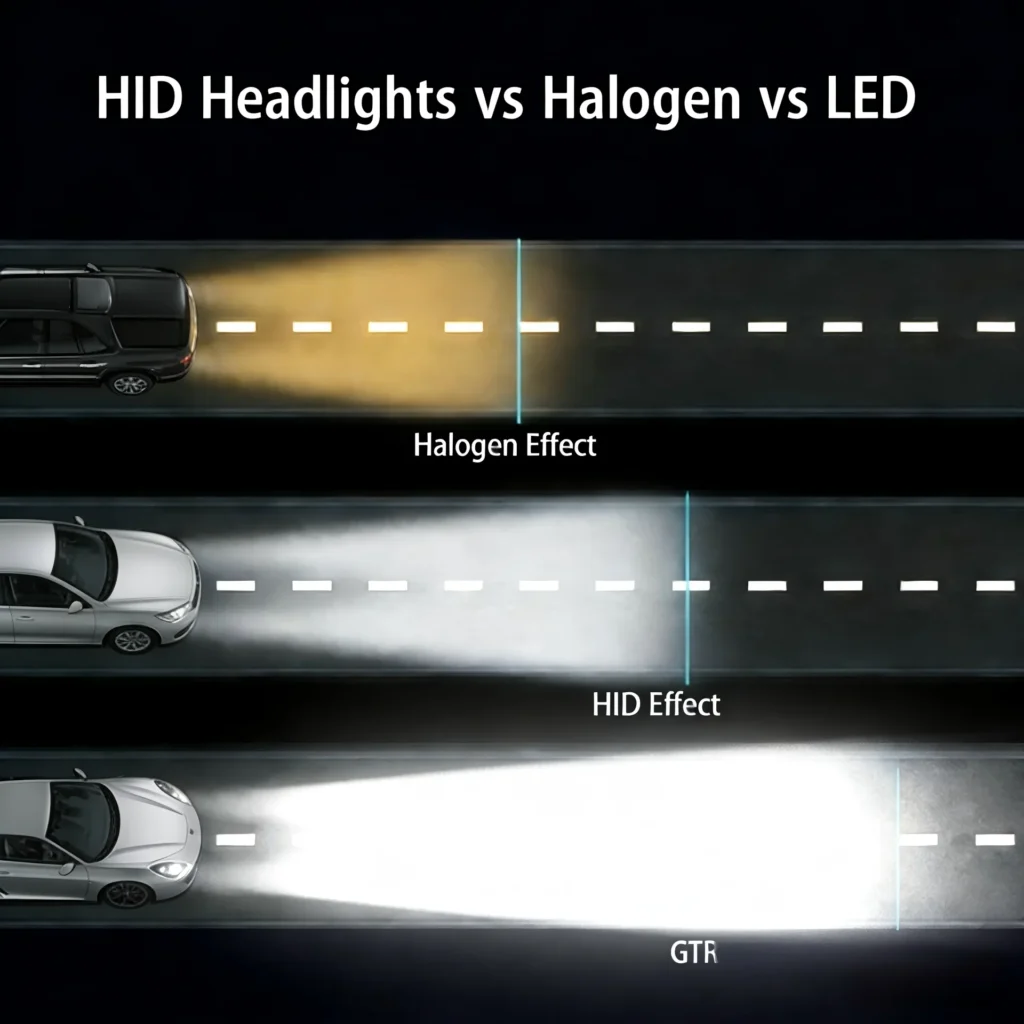
Most comparison tables stack raw numbers and call it a day. Raw numbers matter, but they mislead when taken out of context. Here is the comparison that reflects real-world use:
| Factor | Halogen | LED | HID |
|---|---|---|---|
| Usable output (typical) | 1,000–1,500 lm | 2,000–4,000 lm | 2,500–3,500 lm |
| Lifespan | 450–1,000 hrs | 15,000–50,000 hrs | 2,000–3,000 hrs |
| Color temperature | 3,000–4,300K | 5,000–6,500K | 4,300–6,000K |
| Warm-up time | Instant | Instant | 2–5 seconds |
| Housing compatibility | Universal | Fitment-critical | Projector preferred |
| Efficiency | ~20% | ~90% | ~70–80% |
| Best for | Stock replacement, budget | Long-term value, output | Projector-equipped vehicles |
The critical row is housing compatibility. A halogen car lamp is designed around a filament that emits light from a predictable point in space. The reflector or projector housing is engineered to focus that point. An LED emitter that does not occupy the same focal position will scatter light. An HID arc does not match either. This is why a technically brighter bulb can perform worse on the road .
The Decision Framework: Match the Bulb to the Housing, Then the Driver
Before comparing brands or prices, answer two questions. What housing do you have? How do you actually drive?
Reflector Housings
If your vehicle came with a reflector housing designed for a halogen car headlight bulb, the safest path is a quality halogen replacement. A well-designed LED retrofit can work, but only if the emitter geometry is specifically engineered to mimic the original filament position. Cheap LED kits in reflector housings produce glare and poor beam distribution more often than not.
Projector Housings
Projectors are more forgiving. They can focus halogen, LED, and HID sources reasonably well, though the best results still come from a source designed for the projector’s optics. If you have projectors and want maximum output, a quality HID or LED system is viable—but verify local regulations first .
Vibration-Heavy Applications
Motorcycles, off-road vehicles, and commercial fleets subject bulbs to constant shock. Halogen filaments are fragile. This is one area where a robustly built LED has a genuine structural advantage, provided the housing can focus it .
Five Mistakes That Cost Drivers Money
- Buying by brightness alone. A 2,000-lumen halogen car bulb that scatters light is worse than a 1,200-lumen bulb with a precise beam. Usable light matters more than raw output.
- Touching the glass during installation. Skin oils create hot spots. The bulb overheats and fails early. Use nitrile gloves or hold only the metal base .
- Replacing one bulb instead of two. Mismatched output is distracting and looks neglected. Replace in pairs.
- Ignoring the lens. A cloudy headlight lens can waste 30 percent or more of your bulb’s output. Restoration costs less than repeated bulb upgrades.
- Installing HID in a halogen housing. The arc geometry does not match the reflector’s focal point. The result is glare, poor cutoff, and often illegal output .
What the Forums and Fleets Actually Say
In owner forums, the consensus on halogen car light bulbs has shifted. Five years ago, the advice was “buy the most expensive halogen you can find.” Today, experienced drivers talk about voltage, lens condition, and housing compatibility before they mention brand names.
A commercial fleet operator we supply runs a mixed fleet of vans and light trucks. His previous approach was buying bulk halogen car bulbs from a local parts chain. Replacement rate was high, and drivers complained about dim output within months. After we tested his housings and recommended a matched halogen with consistent filament geometry, his annual bulb spend dropped by roughly half. The bulbs were not radically more expensive. They were simply matched to the application.
Another data point from independent testing: 24V halogen lamps can achieve higher absolute lux values than some LED competitors in laboratory conditions, but LED systems maintain output more consistently over time. Halogen dominates in peak initial brightness for certain configurations; LED wins on stability and degradation resistance . Neither fact makes one universally superior. Context decides.
Frequently Asked Questions
Are halogen car lights legal everywhere?
Halogen headlights are universally accepted for on-road use. LED and HID conversions are regulated differently by jurisdiction. Some regions require projector housings, automatic leveling, or washers for HID. Check local rules before upgrading.
Can I upgrade my halogen car lamp to LED without changing the housing?
Sometimes. The LED must mimic the halogen filament’s focal position and the housing must be able to focus it. If the beam pattern degrades or produces glare, the conversion is not appropriate for that housing, regardless of what the product listing claims.
Why do premium halogen car bulbs last less time than cheap ones?
Higher output often comes from a thinner filament running at a higher temperature. That design produces more light but burns out faster. It is a deliberate tradeoff, not a defect. If lifespan matters more than peak brightness, choose a standard-output halogen.
What is the best color temperature for a halogen car headlight?
For maximum usable light in a halogen bulb, stay close to the stock range: 3,000 to 3,600K. Coatings that push color temperature higher into the 4,000K+ range typically reduce lumen output. Whiter does not mean more visible.
How often should I replace halogen car headlight bulbs?
Every 500 to 1,000 hours of use, or whenever you notice meaningful dimming. Do not wait for failure. Lumen depreciation begins immediately and accumulates silently.
Why GTR Belongs in This Conversation
We manufacture lighting for buyers who read specifications and expect them to mean something. Our halogen car lamp line is built around filament consistency and gas-fill control, because those are the variables that determine whether a bulb performs the same in month twelve as it did in week one. For drivers moving to LED, we engineer around beam pattern before brightness, because a scattered beam is not an upgrade regardless of its lumen rating.
We also know that the best bulb in the world cannot fix a cloudy lens or a corroded connector. That is why our technical resources focus on diagnosis first, product second. If you are not sure what your housing can handle, ask. We would rather sell you the right part once than the wrong part twice.
Stop guessing. Stop replacing. Start with a system that was engineered for your housing, your driving, and your expectations. Visit https://www.rhgtr.com and tell us what you drive. We will tell you what actually fits.