You flick on the switch, and the road ahead barely changes. The beam is yellow, narrow, and full of dark spots. You lean forward, squint, and hope nothing darts out from the shoulder. If that sounds familiar, your motorbike headlight is not just underperforming—it is quietly raising your risk every time you ride after sunset.
I have spent years working with riders and workshop owners who describe this exact scene. They try a brighter bulb, maybe a cheap LED drop-in, and end up with more glare than usable light. The problem is rarely the bulb alone. The problem is a mismatch between the light source and the housing designed around it.
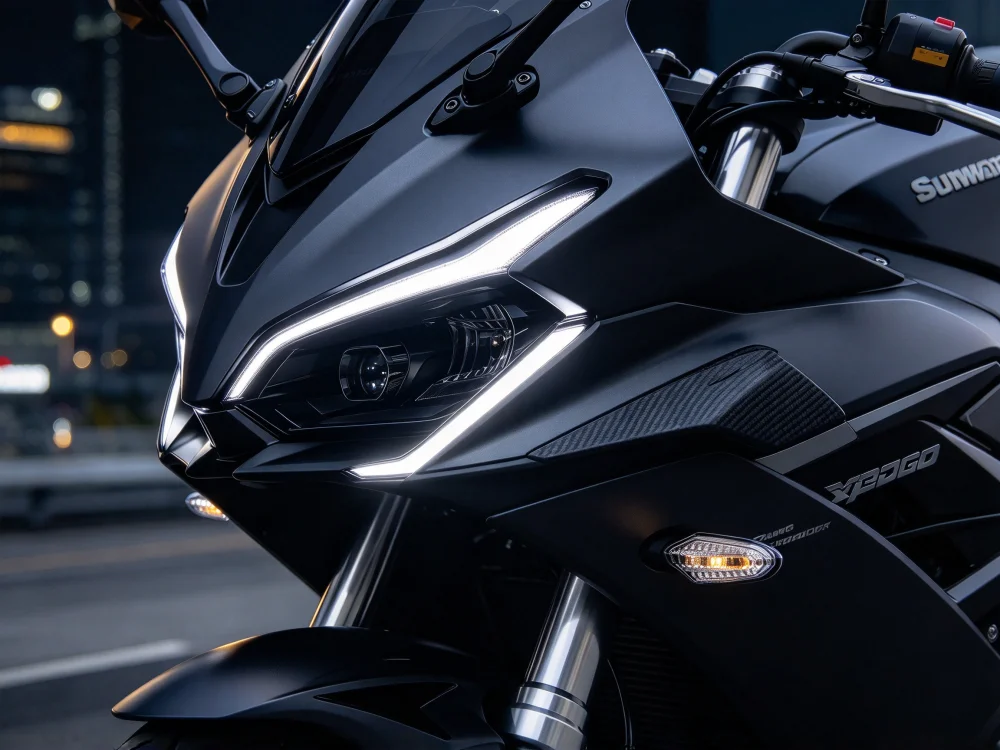
The Real Reason Your Stock Headlight Fails You
A halogen filament emits light from a tiny linear point. Your reflector is shaped around that exact point. When you install an LED chip that sits even a few millimeters off that focal point, the beam pattern breaks apart. Light scatters upward into oncoming eyes and sideways into trees, instead of landing on the asphalt where you need it.
Most riders never hear this explanation. They buy a 6,000-lumen LED bulb expecting a night-and-day transformation. What they get is a floodlight that blinds everyone else while leaving the road ahead patchy and dim. The reflector is doing its best, but the geometry is wrong. No amount of extra lumens fixes an optical mismatch.
There is a second layer to this problem: heat. LEDs produce intense heat at the chip junction, and that heat must travel somewhere. A halogen bulb radiates heat forward through the glass. An LED dumps heat backward into its base. Cheap drop-in bulbs cram a tiny heatsink and a low-quality fan into a space that was never designed for thermal management. The fan spins in dust and vibration. Eventually it stops. The chip cooks. Output fades to a dull blue glow, and one night the light simply does not turn on.
What You Actually Lose When the Beam Is Wrong
Poor lighting is not a cosmetic inconvenience. In the UK, poor visibility contributes to over 25% of motorcycle collisions at night or in low-light conditions. When your beam pattern is scattered, you are not just seeing less—you are processing more visual noise. Shadows become ambiguous. Wet patches look like potholes. A piece of debris at the edge of your low beam stays invisible until it is too late to react.
And then there is the social cost. Riders with badly aimed LED drop-ins get flashed constantly. Oncoming drivers assume you are running high beams. Some riders angle their lights down to avoid the complaints, which makes their own visibility worse. The whole point of upgrading was to see better and be seen. Instead, the upgrade created a new problem.
In our engineering testing, we have measured beam patterns from dozens of drop-in configurations. The results are consistent: when the light source does not match the reflector’s focal point, the cutoff line blurs, the hotspot drifts upward, and usable lux on the road drops even as raw lumens climb. A 10,000-lumen bulb can put less light on the asphalt than a properly aimed 3,000-lumen system.
The Solution Is Not a Brighter Bulb. It Is a Matched System.
A full LED assembly solves this problem at its root. The reflector or projector is designed around the LED source from the beginning. The optics and the light source are calibrated as a pair. The cutoff is sharp. The hotspot lands where you need it. Glare stays controlled because the light is aimed, not spilled.
This is the principle behind every GTR motorbike headlight system. We do not sell a bulb and hope your housing cooperates. We build the housing and the light source together, then verify the beam pattern on a wall and on the road before anything leaves the factory. When you install a GTR assembly, you are not gambling on compatibility. You are replacing the entire optical system with one that was engineered to work as a unit.
Here is what that means in practice:
- A usable cutoff line. Light stops where it should, so oncoming traffic is not blinded and your low beam stays legal and respectful.
- A hotspot centered on the road. The brightest part of the beam lands 20 to 40 meters ahead, giving you reaction time at highway speeds.
- Thermal design that survives real riding. Copper heat pipes and die-cast aluminum heatsinks move heat away from the chip. Sealed fans, where used, are rated for dust and vibration.
- Consistent color temperature. A 4300K to 5000K range gives you contrast on wet asphalt without the blue-rich glare that reflects off water droplets and reduces your own visibility.
Choosing the Right Upgrade for Your Bike
Not every rider needs the same solution. A commuter in a well-lit city has different needs than a touring rider crossing mountain passes at night. Before you spend money, identify which problem you are actually solving.
Scenario One: You ride mostly in urban traffic
Your stock halogen may be adequate for streetlights, but you still want to be seen. A full LED assembly with a clean cutoff and a modest daytime running light signature gives you presence without blinding pedestrians. Look for a system with documented beam pattern photos, not just a lumen claim.
Scenario Two: You ride at night on unlit roads
This is where optical quality matters most. You need reach and width, but you also need a sharp cutoff so you do not dazzle oncoming traffic when you meet a car. A projector-style LED assembly with a verified beam pattern outperforms any drop-in bulb in a stock reflector.
Scenario Three: You ride in rain and fog
Color temperature becomes critical. 6000K looks white and modern in a garage. On wet asphalt at night, that blue-rich spectrum reflects off water droplets and creates glare that hurts your own vision. A 4300K to 5000K system gives you better contrast and penetration in poor weather. Some premium GTR configurations offer switchable color temperature for exactly this reason.
What to Check Before You Buy Any Motorbike Headlight
Most product pages tell you lumens and color temperature. Those numbers are easy to print and almost meaningless on their own. Here is what actually predicts whether an upgrade will work.
| Specification | Why It Matters | What to Look For |
|---|---|---|
| Beam pattern documentation | Lumens measure total output in all directions. Only beam pattern shows where light lands. | Wall shot and road shot from the manufacturer. If they cannot provide one, walk away. |
| Effective lux on road | Lux measures intensity at a specific point. It tells you how bright the asphalt actually is. | A number measured at 10m or 25m, not a raw lumen figure. |
| Thermal design | LEDs degrade when heat cannot escape. A dead fan means a dead light. | Copper heat pipe, die-cast aluminum heatsink, sealed fan bearings. |
| Color temperature | Too blue reduces contrast in rain and fog. Too yellow feels dim at speed. | 4300K–5000K for real-world riding. Switchable is a bonus. |
| Housing compatibility | A drop-in LED in a halogen reflector scatters light. A matched assembly does not. | Full assembly designed for LED, or a projector-style system with documented cutoff. |
One more thing: ignore the “CANbus ready” sticker unless it comes with a real explanation. Many modern motorcycles monitor current draw. An LED draws a fraction of what the system expects, so the bike may think the bulb is burned out and throw a warning or cut power. A quality system addresses this natively or includes the correct resistor, not a generic add-on.
What Riders Actually Say After Switching to a Proper Assembly
Forum threads about cheap LED drop-ins follow a predictable arc. The first post is excitement about brightness. The second post is a complaint about being flashed. The third post is a question about why the beam looks patchy. The fourth post is a request for recommendations on something better.
Riders who move to a matched assembly describe the change differently. They talk about the cutoff line. They mention that they can see the shoulder without lighting up the trees. They say the light feels “calm” or “controlled” rather than dramatic. One touring rider in a GTR customer feedback thread put it simply: “I did not realize how much I was straining before. The road is just there now, ahead of me, where it should be.”
That is the difference between more light and better light. More light is easy to sell. Better light is what keeps you upright.
Questions Riders Ask Before Upgrading
Can I just put an LED bulb in my existing motorbike headlight?
You can, and many riders do. The result depends entirely on whether the LED chip sits at the same focal point as the halogen filament it replaces. Most drop-in bulbs sit a few millimeters off, which scatters the beam and increases glare. A projector-style LED bulb can improve the cutoff compared to a bare LED board, but it is still a compromise inside a housing designed for a different light source.
Why does my new LED headlight get flashed by other drivers?
Glare usually comes from a beam pattern that sends light upward instead of onto the road. This happens when the light source does not match the reflector’s optics. The fix is not to aim the light lower—that reduces your own visibility. The fix is a matched system or a projector assembly with a verified cutoff.
What color temperature is best for a motorbike headlight?
For real-world riding, 4300K to 5000K offers the best balance. It provides good contrast on dry asphalt and better penetration in rain and fog than 6000K or higher. Very blue light looks modern in photos but performs poorly on wet roads at night.
How long do LED motorbike headlights last?
A quality LED system with proper thermal management can last thousands of hours, far longer than a halogen bulb’s typical 300 to 500 hours. The weak point is almost always cooling. If the heatsink is undersized or the fan fails, the chip degrades quickly. Look for a design where the thermal path is treated as a core engineering feature, not an afterthought.
Are LED headlights legal on motorcycles?
Legality varies by market. In many regions, a complete LED assembly with documented compliance (DOT, ECE, or local equivalent) is legal, while a drop-in LED bulb in a halogen housing occupies a gray area. Check your local regulations before upgrading, and choose a system with clear certification if compliance matters for your inspection or insurance.
What is the motorbike headlight price for a proper LED system?
Drop-in bulbs typically cost $30 to $80. Full LED assemblies with matched optics and thermal engineering generally run $100 to $300 or more, depending on the bike model and features. The price difference reflects the engineering behind the beam pattern, not just the light source. For riders who spend significant time at night or in poor weather, that difference shows up every time they ride.
Stop Riding with a Light That Fights You
You know the feeling. The road ahead is a suggestion rather than a clear path. Your shoulders are tight. You are reacting to shadows instead of reading the surface. That is not how riding should feel.
A motorbike headlight is not an accessory. It is the first line of defense between you and everything the road throws at you after dark. If your current light is leaving you squinting, flashing oncoming traffic, or fading to blue after twenty minutes, it is time to fix the system, not just the bulb.
GTR builds complete LED headlight assemblies engineered around the way light actually behaves on the road. We publish beam pattern documentation. We design thermal management for sustained output, not a spec sheet. And we stand behind the systems we ship.
Browse the GTR motorbike headlight range at https://www.rhgtr.com and see what a properly engineered beam looks like. Your next night ride should not be a gamble.