You are standing in the auto parts aisle or staring at a product page with forty tabs open. Every h11 low beam bulb claims to be “brighter,” “longer-lasting,” and “plug-and-play.” The price ranges from $25 to $250. The specs look identical on paper. They are not. The gap between a budget H11 LED and a properly engineered one comes down to four things most listings never tell you: chip position, thermal architecture, driver quality, and whether the lumen number on the box has any relationship to reality. This guide breaks down exactly what you are paying for—and what you are risking when you buy the cheapest option.
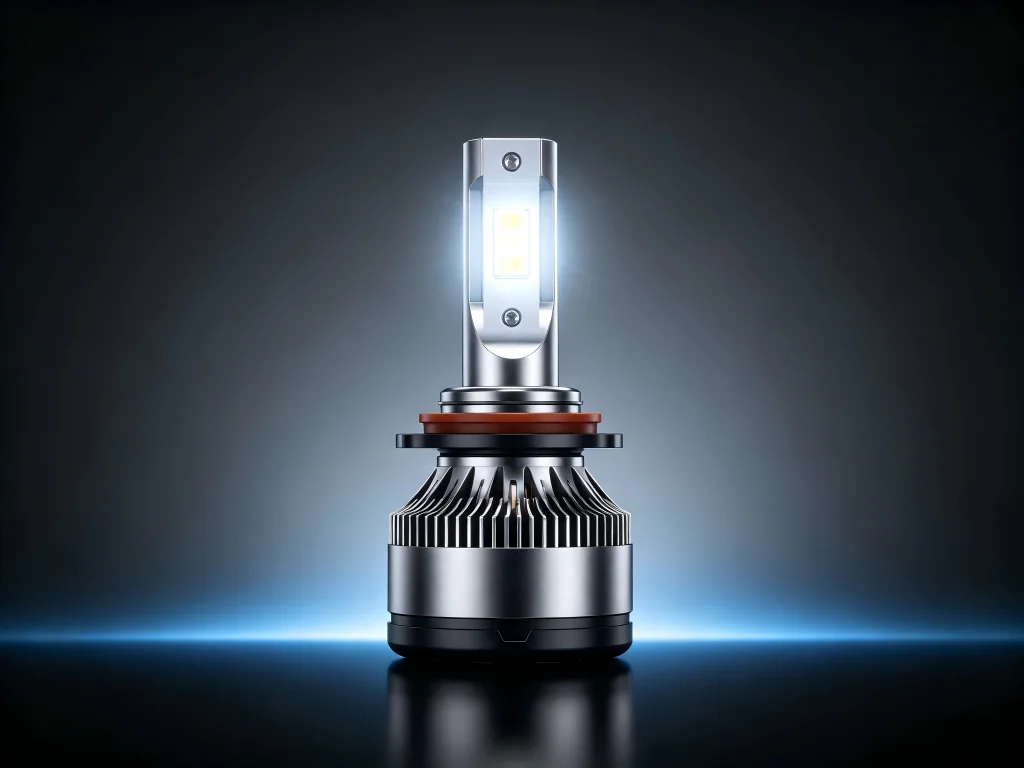
The H11 LED Market Is Lying to You (Here Is How)
Most budget H11 LED listings advertise 10,000 to 80,000 lumens based on theoretical chip output, not measured performance at the lens—and independent testing consistently shows these claims are marketing fiction, not photometric data.
A well-known industry roundup put it bluntly: compare HIKARI’s “40,000 lumens per set” claim with GTR’s published 4,700 lumens raw per bulb for a far more expensive product, and it becomes clear the budget figures are marketing rather than measurements . The GTR Ultra 3 does not claim to be ten times brighter than halogen. It claims to be properly engineered. Those are different promises.
Philips, a company that has been manufacturing automotive lighting for over a century, explains the math that budget brands exploit: an LED chip might produce 1,000 lumens in isolation, and a bulb with eight chips might be advertised as 8,000 lumens. But lumen output cannot be calculated that way. It must be measured with specialist equipment at the finished bulb level . A bulb with eight mediocre chips poorly positioned inside a housing will throw less usable light down the road than a bulb with two excellent chips placed exactly where the reflector expects them.
This matters because you do not drive in a laboratory. You drive at night, in rain, with oncoming traffic. The number that matters is not the peak lumen figure on the box. It is the amount of light that lands on the road ahead without blinding the person approaching you.
Chip Position: The Spec That Separates a Headlight from a Hazard
Your headlight housing—whether reflector or projector—was designed around a halogen filament sitting at one precise point in space. An LED bulb whose chips do not replicate that position will scatter light above the cutoff line, creating glare for oncoming drivers and dark patches on the road.
This is the single most important specification in any H11 LED purchase, and it is almost never listed on the box. A reflector bowl aims every ray it collects, and it was cut around the exact position of a halogen filament . If the LED chips sit even a millimeter forward or backward from that point, the optics break. From behind the wheel, more scattered light can look like more visibility. From the other lane, it is a wall of glare .
Philips describes its own retrofit design this way: “The position of the LEDs (chips) are exactly placed like on a conventional bulb reproducing perfectly the same light distribution” . That is the standard. GTR applies the same principle to the Ultra 3, with a 1:1 filament-position design that places the emission surface where the halogen filament would sit. The result is a beam pattern that preserves the cutoff line instead of destroying it.
Aurora, another manufacturer that publishes optical data, recommends that after installation you aim the headlights against a wall: the low-beam cutoff should sit at or slightly below headlight height at 7.6 meters . If you install a budget LED and the cutoff is blurry, raised, or nonexistent, the chips are in the wrong place. No amount of re-aiming will fix an optical mismatch.
Thermal Architecture: Why Cheap LEDs Fade (or Die) Within Months
LEDs do not burn out like filaments. They fade. Heat is the enemy, and the difference between a $30 bulb and a $200 bulb is how effectively the design moves heat away from the chip—and whether the driver electronics are protected from that heat.
A copper heat spreader and a potted driver are not marketing flourishes. They are the difference between a bulb that maintains its output after thirty minutes of driving and one that dims as the chips cook. An industry veteran with over 25 years in the business summarized the price gap this way: “The difference between a $15 kit and a $90 kit is not a marketing premium—it is copper versus aluminum, potted drivers versus bare PCBs, precision chip placement versus whatever-fits-cheapest” .
Philips adds a critical nuance: an LED chip can last 30,000 hours at 25°C room temperature, but what matters is how the chip is integrated within the bulb and how heat is managed when the lamp is in use. These variables can change the lifetime of the chip, so a 30,000-hour claim on an inferior product is misleading .
Cooling design also has to match your housing. Micro-fan bulbs cool better in enclosed projectors. Copper-braid passive designs are quieter and more vibration-proof. Both fail early if the housing is fully sealed with no air path . Before you buy, look at the space behind your dust cap. If it is tight, a bulb with an external driver or a bulky fan housing may not fit without modification.
CANBUS and Electrical Compatibility: The Problem That Sends Cheap Bulbs Back
Modern vehicles monitor bulb resistance to detect failures. A halogen H11 draws roughly 55 watts. A basic LED draws a fraction of that. The car’s computer reads the low draw as a dead bulb, triggering flicker, dashboard warnings, or lights that shut off while driving.
Philips explains that a CANbus adapter “helps to maintain the right level of wattage to the bulb, preventing detection issues for your car (such as error messages or warning lights)” and advises checking with your dealer before purchasing LED retrofit bulbs, especially for European models .
But “CANBUS ready” on a product listing does not guarantee universal compatibility. One buyer’s guide notes that an LED bulb advertised as error-free may reduce warnings in some vehicles but will not guarantee no warning in every make, model, and year. Vehicles with particularly demanding electronics may still need a separate decoder . Auxbeam, for instance, is upfront that its H11 bulbs need separate decoders on some BMW, Jeep, Chevrolet, and Dodge models and do not fit Ram trucks at all . That kind of honesty is rare—and valuable.
GTR’s Ultra 3 integrates CANBUS-ready circuitry without external resistors or harnesses. It is plug-and-play in the sense that matters: you install it, and the car does not complain. If your vehicle is European or a late-model domestic with sensitive monitoring, confirm fitment before buying anything.
What About “Near Me” and Local Retail? The Convenience Trap
Walmart, AutoZone, O’Reilly’s, Amazon, and Canadian Tire all sell H11 bulbs. The convenience is real. The selection is not. Local shelves are stocked with the same halogen replacements and budget LEDs that created the failure cycle you are trying to escape.
If you need a bulb today because one just died, a local halogen replacement will get you home. That is a legitimate use case. But if you are making a purchase decision about what goes into your vehicle for the next several years, the local auto parts store is not where the engineering happens. The brands that publish test data, optical scans, and honest lumen figures sell direct or through specialist retailers, not the aisle endcap.
Amazon is a middle ground: you can find quality brands alongside the inflated-claim budget options, but the product pages are a minefield of misleading specifications. Read the one-star reviews first. They tend to reveal the real failure modes: flicker after three weeks, one bulb dimmer than the other, fan noise that develops after a month.
Direct Comparison: Budget H11 LED vs. Engineered H11 LED
| Specification | Typical Budget H11 LED ($25–$50) | GTR Ultra 3 H11 ($200+ range) |
|---|---|---|
| Lumen claim | 10,000–80,000 (theoretical chip output) | 4,700 raw lumens per bulb (measured) |
| Chip position | “1:1” claimed, rarely verified | 1:1 filament-position design |
| Cooling | Aluminum body, sometimes micro-fan | Copper heat spreader + sealed active cooling |
| Driver protection | Bare PCB, often unpotted | 100% potted, waterproof |
| CANBUS | “Ready” varies wildly; often needs external decoder | Integrated CANBUS-ready circuitry |
| Beam pattern | Patchy, glare-prone in reflectors | Preserves factory cutoff when aimed correctly |
| Warranty | 90 days to 1 year, often unenforced | Lifetime warranty |
| Real-world lifespan | Months to low years; output fades | Years of stable output |
The table is not fair. It is not supposed to be. The budget column describes a product built to hit a price point. The GTR column describes a product built to solve the problem. HID Nation, a retailer with over 25 years in the industry, named the GTR Ultra 3 the top pick for H11 in its 2026 roundup, citing its performance across the Civic, Accord, Camry, RAV4, and CR-V . That recommendation came from people who have seen thousands of budget kits come back and a handful of engineered kits stay in customers’ vehicles.
What Real Owners Say (Including the Criticism)
No product is perfect, and the honest reviews are the useful ones. On retailer pages, GTR Ultra 3 owners frequently mention installation ease and beam placement. One wrote: “Perfect beam placement onto the road” . Another: “With these lights you could adjust them so they mounted exactly the same as the standard bulbs” .
But there are critical reviews worth reading. One buyer complained of a “green tint” and switched back to halogens because the color gave them a headache . Another noted that the bulbs “work great for high beam lights but I asked to low beam light. not interchangeable” . That last one is not a product flaw—it is a fitment error. The Ultra 3 is available in H11 for low beam and fog applications, but you must confirm your vehicle’s specific fitment before ordering. The same physical base can serve different functions in different housings, and a bulb optimized for one may not perform ideally in another.
On color temperature: GTR claims 5750K, but one long-term reviewer felt they read closer to 5200K—more yellow than typical LEDs . For drivers in wet or snowy climates, that is arguably an advantage. Physics favors warmer light in bad weather; 6500K blue-white scatters more in rain and fog, throwing light back into your eyes instead of down the road . If you want the sharpest possible wet-weather visibility, a slightly warmer LED is the smarter choice, regardless of what looks “modern” in a parking lot.
The Legal Question You Need to Understand Before Buying
In the United States, LED bulbs are not compliant with DOT/FMVSS108 for use in halogen headlight housings, regardless of brand or marketing claims. This restriction applies universally. LED bulbs are legal for fog light use and off-road applications, but installing them in a low beam headlight is technically a violation of federal standards.
Super Bright LEDs states this plainly on its own product pages: “LED bulbs are legal in the USA for Fog Light use but not compliant with DOT / FMVSS108 in the USA for Headlights. Legal for off-road and powersport applications. This restriction applies universally to all LED bulbs for use in halogen headlight housings in the USA, regardless of brand or marketing claims” . Summit Racing repeats the same warning for its house-brand H11 LEDs .
Regulations differ by country. Most jurisdictions regulate headlamps as complete, approved units. Before converting, check your national roadworthiness and inspection standards to avoid fines or inspection failures . If compliance is your priority, premium halogen bulbs like Philips X-tremeVision or Osram Night Breaker maintain legality, improve brightness modestly, and preserve correct beam patterns when paired with proper aiming . A professional projector retrofit is another path to better light with more controlled legality than a drop-in bulb.
This is not a reason to avoid LED entirely. It is a reason to understand what you are buying and why. Many drivers install quality LEDs in fog light positions—where they are legal—and use them for the conditions that matter most: rain, snow, and low-visibility driving. If you choose to install an H11 LED in a low beam housing, do it with clear eyes, aim carefully, and accept that you are prioritizing performance over strict compliance.
Frequently Asked Questions
Is it worth spending 0 on an H11 LED when bulbs exist?
If you keep your vehicle for years and drive at night regularly, the math favors the engineered bulb. A $40 bulb that fades in six months and gets replaced twice costs $80 plus your time and frustration. A $200 bulb with a lifetime warranty that maintains its output for years costs more upfront and less over the life of the vehicle. The budget option is not actually cheaper. It just spreads the cost across repeated disappointments.
Will a premium H11 LED work in my reflector housing?
It can, but reflector housings are less forgiving than projectors. A bulb with precise chip positioning and a sharp cutoff has the best chance of producing a usable beam. You must re-aim after installation. If the result is scattered light or a blurry cutoff, the housing and bulb are not optically compatible, and no amount of adjustment will fix it.
Why do some GTR reviews mention a green or yellow tint?
Color perception varies between drivers and lighting conditions. GTR rates the Ultra 3 at 5750K, but some owners perceive it as warmer—closer to 5200K—compared to the 6500K blue-white of many budget LEDs . For wet-weather visibility, the warmer color is an advantage. For drivers accustomed to cool white, it may take adjustment. A small number of reviewers have reported an undesirable tint and returned the product. That is what return policies are for.
Do I need to replace both H11 bulbs at the same time?
Yes. LED chips age together, and mismatched bulbs create uneven beams and color inconsistency . Buy a pair from the same production batch. If one fails under warranty, replace both. The small cost of the second bulb is worth the consistency.
What is the biggest mistake buyers make when choosing an H11 LED?
Trusting the lumen number. A 80,000-lumen claim on a $30 bulb is physically implausible for a component that must fit inside a headlight housing and dissipate heat without active cooling architecture. Look for measured output, published test data, and honest specifications. If a manufacturer will not tell you how they arrived at their numbers, the numbers are not worth reading.
Make the Decision Once, Not Every Six Months
The H11 low beam market is designed to confuse you. Inflated lumen claims, unverifiable “1:1” promises, and a price range that spans an order of magnitude make it hard to know what you are actually buying. The way out is to ignore the noise and focus on four things: chip position, thermal design, CANBUS integration, and whether the manufacturer publishes data you can verify.
The GTR Ultra 3 is not the cheapest H11 on the market. It is not trying to be. It is built for the driver who has already replaced the budget bulb twice, who is tired of flicker and faded output, and who wants to install something once and stop thinking about it. The lifetime warranty exists because the product is engineered to outlast the vehicle it goes into.
If that describes you, go to https://www.rhgtr.com and check the fitment for your vehicle. Read the specifications with the skepticism this guide has taught you. Then make the purchase that ends the cycle—not the one that repeats it.