If you are shopping for an h11 headlight upgrade, you have probably noticed something frustrating: the specifications on the box tell you almost nothing useful. Lumen numbers are inflated. “Plug and play” claims fall apart at installation. And the difference between a bulb that illuminates the road and one that blinds oncoming traffic comes down to details the marketing never mentions.
This guide is for drivers who are past the impulse-buy stage. You are comparing options, reading reviews, and trying to understand why two H11 LED bulbs that look identical on a screen can perform so differently in a housing. We build automotive lighting for a living. Here is what actually matters when you are deciding what to put in your low beams.
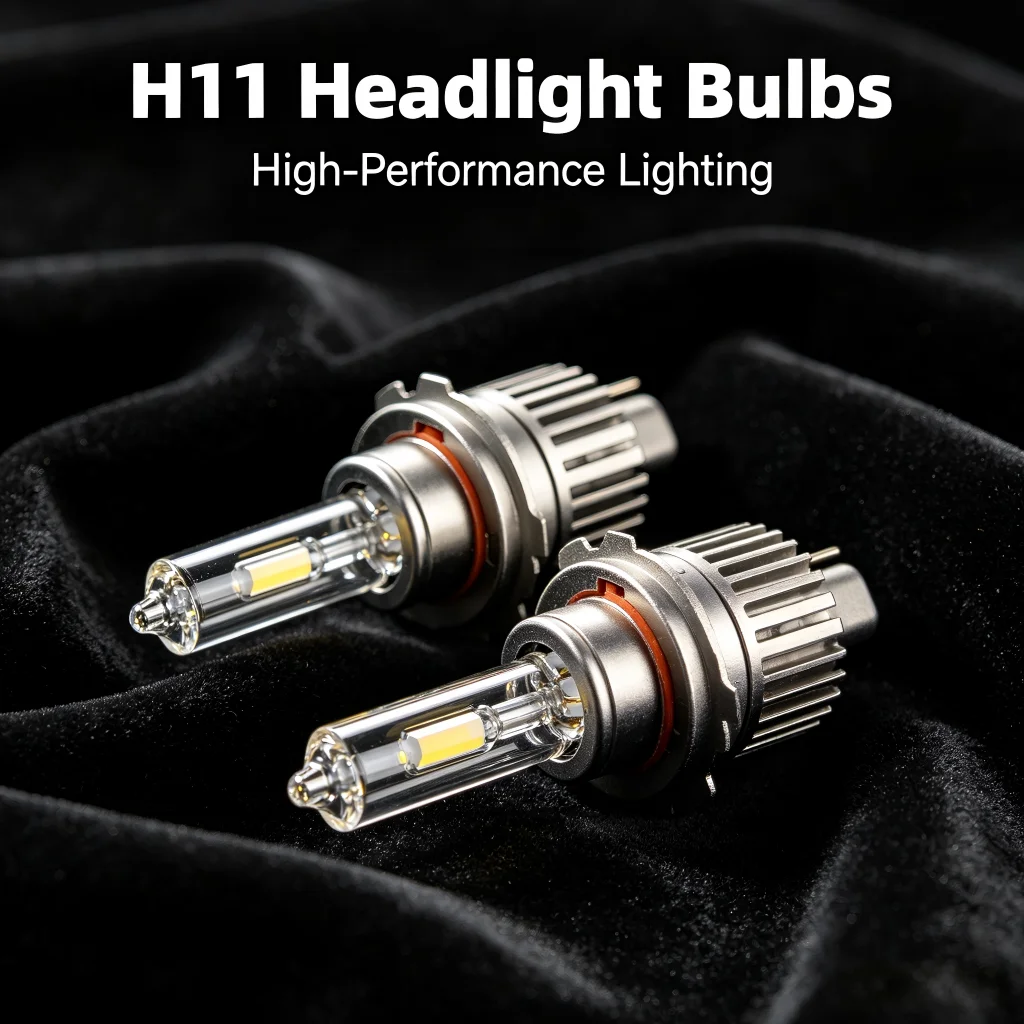
Halogen, LED, or HID: What Actually Fits an H11 Housing
Halogen H11 bulbs are the reference standard your headlight was designed around. LED replacements can work well if the emitter position is correct. HID “kits” in a halogen H11 housing are the option most likely to produce glare and legal problems.
The H11 base is a standardized physical interface. Any bulb with that base will fit into the socket. That is where the compatibility guarantee ends.
Your headlight housing—whether reflector or projector—was engineered around the light-emitting geometry of a halogen filament. The filament is a small, roughly cylindrical source positioned at a precise distance from the reflector or lens. When you change the light source, you change the geometry. A halogen filament emits light in all directions from a thin wire. An LED chip emits light from a flat surface in a more directed pattern. An HID arc emits from a tiny point but requires a high-voltage ballast and takes several seconds to reach full brightness.
If the replacement light source does not approximate the size, shape, and position of the original filament, the housing cannot focus the light correctly. This is not a matter of brand loyalty or price. It is optics.
Why HID Kits Are the Riskiest Choice for an H11 Housing
HID bulbs produce more light than halogen, but the arc is not a drop-in replacement for a filament. The arc is smaller and more intense, and the bulb requires a ballast that draws significant current at startup. In a housing designed for halogen, an HID arc often sits in the wrong position, producing a beam with a hot center and excessive upward glare. Many jurisdictions prohibit HID retrofits in halogen housings for this reason. If legality and road courtesy matter to you, HID is the option to approach with the most caution.
The Specifications That Actually Predict Performance
Walk through any H11 bulb listing and you will see numbers: lumens, watts, color temperature, “CSP chips,” “aviation aluminum.” Most of them are noise. A small set of specifications actually tells you how the bulb will behave.
Emitter Position (Not Lumen Count)
The single most important specification is not printed on most boxes. It is the distance from the H11 base flange to the center of the LED emitting surface. This distance must match the corresponding dimension of the halogen filament the housing was designed for. A difference of a millimeter or two is enough to blur the cutoff line, scatter light upward, and create dark spots in the beam.
In our engineering testing, we have measured this dimension across dozens of bulbs. The variance is wider than you would expect. Bulbs that look identical externally can differ significantly in emitter position. This is why two LED bulbs with the same lumen rating can produce completely different beam patterns in the same vehicle.
Thermal Design: Heat Pipe vs. “Aluminum Body”
Every LED bulb claims “aluminum construction” or “advanced cooling.” These phrases mean nothing without specifics. The question is whether there is a continuous thermal path from the LED junction to a surface with enough area and airflow to dissipate the heat.
A solid aluminum base with no heat pipe relies on conduction through the base material. It works for low-power bulbs but struggles with higher output. A copper heat pipe moves heat more efficiently from the small junction area to a larger heatsink. A fan helps only if the heatsink fins are designed to use the airflow. A large fan blowing across a tiny, poorly designed heatsink is marketing, not engineering.
Driver Quality and CANBUS Behavior
The external driver is where budget bulbs cut the deepest. It contains the current regulation, voltage protection, and load compensation circuitry. A cheap driver may work on a bench test and fail in a vehicle with a smart charging system or sensitive CANBUS monitoring.
Signs of an inadequate driver include flickering at idle, error messages on the dashboard, or the bulb refusing to turn on after the vehicle has been running for a while. These are not random glitches. They are symptoms of a driver that cannot handle the electrical environment of a modern vehicle.
Direct Comparison: What You Get at Each Price Point
| Feature | Budget LED (under $40) | Mid-Range LED ($40–$90) | GTR Ultra 3 H11 |
|---|---|---|---|
| Emitter positioning | Often approximate | Closer to halogen spec | Engineered to replicate filament focal point |
| Cooling | Small heatsink, noisy fan, or fanless | Heat pipe with basic fan | Copper heat pipe + finned body + tuned fan |
| Driver / CANBUS | Minimal; flicker common | Basic load compensation | Full regulation with built-in load stability |
| Dust cap fit | Often requires modification | Usually fits, sometimes tight | Compact rear profile for verified fitment |
| Beam pattern quality | Unpredictable | Acceptable in some housings | Consistent and focused in projector/reflector |
| Realistic lifespan | Months | 1–2 years | Years with stable output |
Five Mistakes That Ruin an Otherwise Good H11 Purchase
- Buying based on lumen claims alone. A bulb advertising 20,000 lumens is almost certainly exaggerating, and even if it were accurate, raw output without focus is glare, not visibility. A well-positioned 3,000-lumen bulb will outperform a poorly positioned “10,000-lumen” bulb on the road.
- Ignoring the dust cap clearance. The rear of an LED bulb is larger than a halogen base because of the heatsink and fan. In some vehicles—certain BMWs, Toyotas, and others with tight engine bays—the factory dust cap will not seat over the LED. A bulb with a compact rear profile avoids this. If you have to leave the dust cap off, moisture will kill the bulb.
- Assuming “plug and play” means no research. The H11 base is standard, but the electrical interface is not. Check whether your vehicle is known to be sensitive to LED load changes. If it is, a bulb with proven CANBUS compatibility is not optional.
- Replacing only one side. Bulbs age and color-shift together. A new bulb on one side and an old one on the other creates uneven lighting and an inconsistent look. Replace in pairs unless the bulbs are genuinely new.
- Touching the glass or emitter during installation. Halogen bulbs are destroyed by skin oils. LED emitters are less fragile in this regard, but the thermal interface and seal can still be compromised. Handle with clean gloves and verify that the bulb is fully seated and locked before restoring power.
What to Check Before You Buy Any H11 LED Bulb
- Verify your housing type. Projector housings are more sensitive to emitter position than reflector housings. If you have projectors, the chip placement matters even more.
- Check the return policy. A reputable seller should accept returns if the bulb does not fit or produces a beam pattern you are not satisfied with. Test the bulb on a wall or in a dark lot before you commit to it.
- Look for real installation photos from your vehicle model. A bulb that fits a 2015 Camry may not fit a 2020 RAV4 with the same H11 designation. Vehicle-specific feedback is more valuable than generic compatibility charts.
- Confirm the driver is included and integrated. External drivers that dangle loose or require splicing are a sign of a kit designed for universal use rather than a specific application. An integrated or properly sealed driver is safer and more reliable.
Why GTR Builds H11 Bulbs Differently
GTR exists because the aftermarket needed a manufacturer that actually tests beam patterns, not just lumen output. We do not sell bulbs that look good on a spec sheet and fail in a housing. We sell bulbs that we have verified in projectors, reflectors, sealed dust caps, and CANBUS-monitored vehicles.
The Ultra 3 H11 is the result of that process. Its emitter position is set to match the halogen focal point. Its thermal path uses a copper heat pipe and a finned body that fits where the original bulb fit. Its driver is built to keep modern vehicles happy without flicker or error codes. It costs more than a budget bulb. It also does not need to be replaced every six months.
If you are comparing options and want the shortest path to a decision: buy a bulb that prioritizes emitter position and thermal design over lumen numbers. If you want that decision already made for you, with fitment support and a track record in demanding applications, the Ultra 3 is what we would put in our own vehicles.
Stop guessing whether your new bulbs will work with your housing. Get the H11 that was engineered for it at https://www.rhgtr.com.