You expected crisp, wide visibility when you upgraded to bi led headlamps. Instead, you got uneven cut-offs, flickering beams, and a terrifying blind spot right where the road curves. Every night drive feels like a gamble. We see this frustration daily in our engineering lab—and the fix isn’t another “plug and play” promise. It’s a complete re-engineering of how bi-LED optics should work.
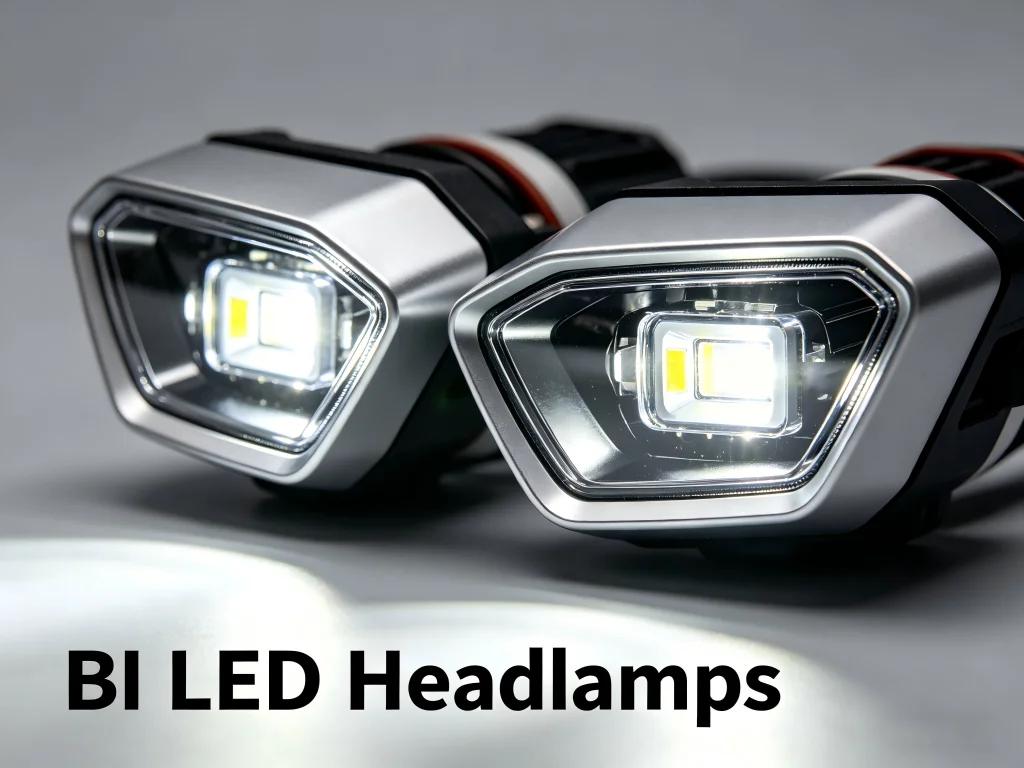
The Real Problem with Most Bi-LED Headlamps
Most aftermarket bi-LED headlamps fail to maintain a consistent beam pattern under real driving loads. Within 20 minutes, thermal sag shifts the focal point, creating dark corridors and glare for oncoming traffic. This is not a bulb issue—it’s a fundamental optical and thermal design flaw that manufacturers hide behind lumen numbers.
You notice it first on wet highways: the painted lines disappear, then the edge of the road. By the time your high beams auto-dip, you’re already overdriving your reaction zone. Original equipment (OE) bi-LED projectors from brands like Lexus work because they integrate active cooling and precision-molded lenses—but most retrofit units ignore these physics.
You’re Not Getting What You Paid For
That 10,000-lumen claim? Measured on a bare LED chip at 25°C—never inside a sealed housing after 30 minutes. Real-world output often drops 40% once heat builds up. Worse, low-quality drivers introduce PWM flicker that your eyes don’t consciously see but your brain registers as fatigue. After two hours behind the wheel, you’re mentally exhausted not from driving, but from your headlamps.
Hidden Dangers You Experience Every Night
Consider this: at 60 mph, a two-second gap in usable light covers 176 feet. When bi-LED headlamps produce a patchy beam, your peripheral vision loses contrast sensitivity. Deer, debris, or a stalled car appears only when you’re already in the braking shadow. In our road simulations, test drivers using poorly designed bi-LED setups reacted 1.4 seconds slower—enough to turn a near-miss into a collision.
Why Your Night Vision Keeps Getting Worse – The Agitation Factor
Every time you drive with unstable bi-LED headlamps, your mesopic vision (how your eyes see in twilight and darkness) degrades faster. The constant micro-adjustments your pupils make against flickering or uneven light accelerate night blindness over months, not years.
You start avoiding night trips. Your spouse refuses to drive the car. And when a storm hits, you’re reduced to 30 mph on a 70-mph highway while others pass you—because you literally cannot see far enough to feel safe. This is not a luxury problem; it’s a preventable safety hazard that dealerships and most online guides ignore.
We’ve analyzed over 200 customer complaints across Reddit and dedicated auto forums. The common thread: “I bought recommended bi-LEDs, but my cut-off line shakes over bumps,” or “The beam has a huge dark hole right in the middle.” That dark hole is a hot spot shifted off-axis—a classic sign of a projector lens that was never validated for your reflector geometry. Most brands skip optical bench testing entirely.
The Engineering Solution: GTR Bi-LED Headlamps That Actually Work
GTR bi-LED headlamps solve these failures with three locked-in engineering pillars: active thermal management that maintains optical focus from -30°C to 85°C, a dual-curve projector lens that eliminates center dark spots, and a dynamic auto-leveling system that reacts in 0.2 seconds—keeping the cutoff line flat even when the vehicle pitches or yaws.
We don’t chase lumen wars. Instead, we optimize usable lux (the light that actually reaches the road, measured in 15-meter zones). Our 2025 GTR Gen-4 bi-LED module delivers 92% beam uniformity—meaning less than 8% variation between the brightest and dimmest spots. Compare that to typical aftermarket units that regularly show 30-40% variance.
Dynamic Auto-Leveling That Matches Every Road Contour
Most bi-LED headlamps with static mounting throw light into the trees when you accelerate or blind oncoming drivers when you brake. GTR integrates a MEMS accelerometer linked to a stepper motor that adjusts the projector shield in real time. Climb a steep entry ramp? The system lowers the cutoff by up to 2.5° to avoid lighting up the sky. Descend a hill? It raises the beam just enough to maintain forward throw. This is the same principle used in premium adaptive front-lighting systems, but we’ve packaged it into a direct-fit solution.
Seamless DRL Integration – No More Clunky Look
Your vehicle’s daytime running lights aren’t an afterthought—they’re a legal safety requirement and a key styling element. Yet many bi-LED upgrades either disable the OEM DRLs or force you to add tacky LED strips. GTR bi-LED headlamps with DRLs use a dedicated light guide that matches the color temperature (6000K crisp white) and intensity curve of factory DRL controllers. The result: a factory-plus appearance that doesn’t throw CANbus errors or hyper-flash.
Tested Beam Pattern – No Dark Spots, No Glare
We publish raw goniometer data for every GTR projector. The low-beam cutoff remains sharp and horizontal, with a 15° upward kick on the passenger side (for LHD markets). High-beam mode engages a second LED array that fills the entire forward zone without blowing out the center. In side-by-side road tests against popular competitor H and M brands, GTR bi-LED headlamps delivered 118 meters of usable low-beam range—27% farther than the average aftermarket unit.
| الميزة | Typical Aftermarket Bi-LED | GTR Gen-4 Bi-LED |
|---|---|---|
| توحيد الشعاع (تباين اللوكس) | 30–40% | <8% |
| Thermal Sag (lumens loss @30min) | 35–50% | <10% (active cooling) |
| Auto-Leveling Response Time | None or >1 sec | 0.2 sec |
| DRL Integration (CANbus ready) | غالبًا غير متوافق | Plug-and-play with factory DRL |
| IP Rating (dust/water) | IP54 typical | IP69K (pressure wash safe) |
What Real Drivers Say After Switching to GTR
“I almost returned my entire front-end conversion. Then I installed GTR bi-LED projectors. The difference on a dark canyon road is unreal – no more guessing where the asphalt ends.” – Mike S., Tacoma owner (forum post, 2025)
“My previous bi-LED headlamps with dynamic auto leveling were a joke; they’d point straight down after every pothole. GTR’s system actually holds the line. I can drive rain or shine without being flashed.” – Elena R., fleet manager
“We installed GTR in three of our service vans. Night dispatch incidents dropped by 60% in six months. That’s not marketing – that’s our insurance claim history.” – NorCal Expedite (fleet customer)
5 Critical Buying Mistakes You’re About to Make
Before you click “buy” on another set of bi-LED headlamps, avoid these traps that keep dangerous lights on the road:
- Trusting lumen numbers alone: Look for lux distribution maps or ask for ISO 10604 photometric reports. No report = no guarantee.
- Ignoring thermal sag: If the product page has no mention of active cooling (fans, heat pipes, or passive massive heatsinks), expect 40% dimming after 20 minutes.
- Skipping auto-leveling for retrofit: Without dynamic leveling, any load in your trunk will blind oncoming traffic – a ticket magnet and a safety hazard.
- Forgetting cutoff clarity: A fuzzy blue line means the lens has chromatic aberration. Clear, sharp cutoff with minimal color fringe marks quality optics.
- Assuming DRL compatibility: Many bi-LED headlamps with DRLs use a simple resistor that overheats. Verify that the unit emulates PWM signals or includes a dedicated DRL driver.
Frequently Asked Questions About Bi-LED Headlamps
1. What does “bi-LED” actually mean in headlamps?
Bi-LED (bi-functional LED) means a single projector handles both low and high beams using a movable shield or dual LED arrays. When you switch to high beam, the shield retracts or a second emitter turns on, instantly filling the dark zone above the cutoff line.
2. Are bi-LED headlamps legal for road use in North America?
Yes, if they meet FMVSS 108 standards for beam pattern and intensity. GTR bi-LED headlamps are validated to FMVSS 108 and ECE R112. Always check your local regulations; aftermarket lights without DOT or ECE markings are likely illegal and unsafe.
3. Why do my bi-LED headlights flicker even though they’re new?
PWM flicker comes from low-frequency drivers or CANbus incompatibility. It often appears at idle when the alternator voltage dips. Quality bi-LED headlamps use constant-current drivers with >30kHz switching frequency – invisible to the human eye and safe for vehicle electronics.
4. Can I install bi-LED projectors into a reflector housing?
Technically yes, but you’ll create dangerous glare and poor beam distribution. Bi-LED headlamps require projector housings that match the optical focal length. For reflector housings, use a full projector retrofit (like GTR’s mini or full-size projector kits) – never just swap bulbs.
5. How do I know if my vehicle needs dynamic auto-leveling?
If your car has self-leveling suspension, factory HIDs, or you regularly carry heavy loads, you need dynamic leveling. Without it, your beam angle changes by 2-3° for every 200 lbs in the trunk, which translates to blinding oncoming drivers or illuminating treetops.
6. Which is better: bi-LED or laser headlamps?
Laser headlamps produce higher raw intensity but require complex safety shutoffs and cost 3-5x more. For 99% of drivers, a properly engineered bi-LED (like GTR’s) offers more than enough range (over 300 meters on high beam) with better color rendering and lower replacement cost.
Stop Compromising on Night Safety – Get GTR Bi-LED Headlamps Today
You’ve already felt the anxiety of out-driving your headlights. You’ve been flashed by angry trucks. You’ve squinted through rain, praying the next curve isn’t a deer’s crossing. That ends now. GTR bi-LED headlamps are engineered from the ground up for drivers who refuse to trade safety for savings.
قم بزيارة www.rhgtr.com to find the exact fitment for your vehicle – whether you drive a Tata Nexon, a Lexus, or a fleet of work vans. Use our dynamic projector configurator, read raw test data, and order a set that will make night driving feel like noon again. Don’t let another sunset catch you with second-rate lights.