You pull out of the parking lot at 8:30 PM on a rainy Tuesday. The road ahead looks like a watercolor painting — shapes, reflections, no definition. You squint. Then you lean forward. By the time you reach the highway, your eyes are already tired.
This is not a minor inconvenience.
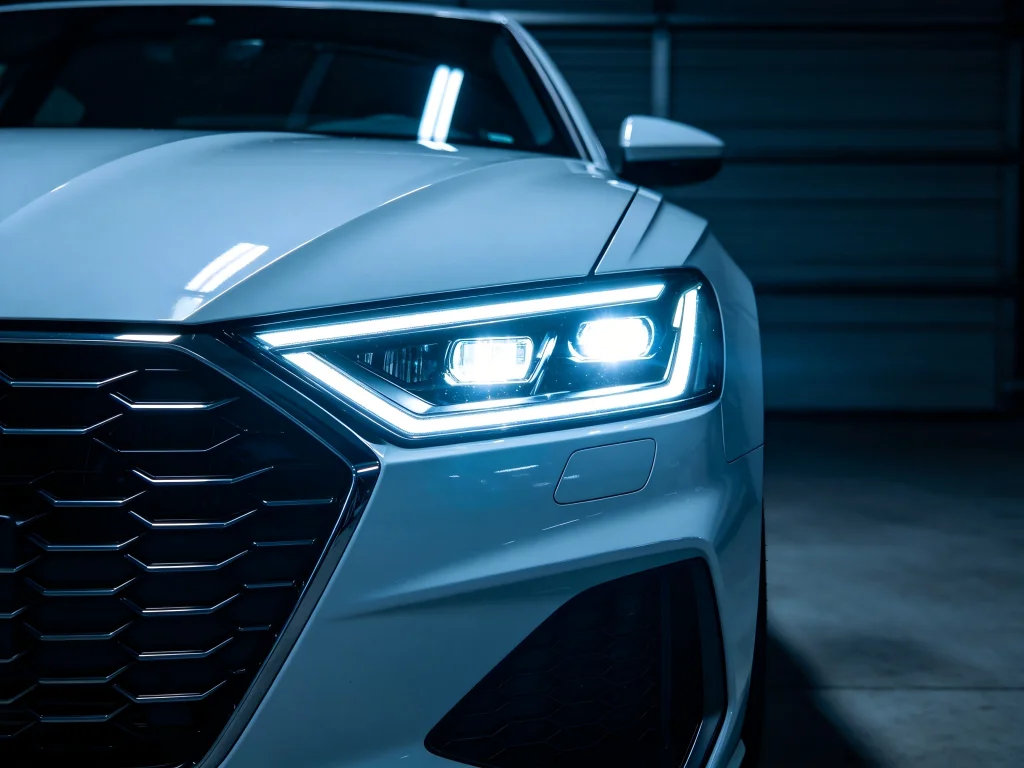
Auto car LED lights exist for a reason: because halogen bulbs were never designed for how we drive today. A proper LED upgrade can deliver 4,000 to 6,000 lumens per bulb, compared to halogen’s 700 to 1,200 lumens — a difference that literally shows you the deer before it shows itself.
The Real Problem: Your Headlights Are Working Against You
Most drivers don’t realize their stock halogen bulbs lose up to 20% of their output within the first year. By the time you notice, your night vision has been compromised for months — and you’ve been driving with less light than legal minimums require.
Halogen filaments burn at roughly 2,500°C. Over time, tungsten evaporates, glass darkens, and light output drops steadily. At 60 mph, your total stopping distance averages 240 feet. Halogen low beams illuminate roughly 130 meters (426 feet) — but only when brand new. After one year, that range shrinks dangerously. You aren’t just uncomfortable; you are under-lit.
Why “Just Brighter” Bulbs Often Make Things Worse
A poor-quality LED may produce high raw lumens but scatter light everywhere, creating glare while leaving the road edges dark. Proper beam pattern requires 1:1 emitter-to-filament geometry — something most cheap bulbs completely ignore.
The core engineering challenge: halogen housings are designed around a specific focal point. An LED with incorrect geometry destroys the beam pattern. Then there’s the electrical problem. Modern cars use CANBUS systems to monitor bulb function. Without proper compatibility, you get flickering, dashboard errors, or lights that won’t turn on at all.
The Agitation Phase: What Poor Lighting Is Costing You
- Financial cost — Cheap LEDs fail in 6-12 months. You buy three sets at $50 each while a premium set for $180 lasts a decade. You pay more for less.
- Safety cost — The difference between 130 meters and 170 meters is 1.5 seconds of reaction time at 60 mph. That margin prevents collisions.
- Convenience cost — Flickering lights, dashboard warnings, constant doubt every time you drive at night.
- Legal risk — Glaring, poorly aimed LEDs can attract penalties and cause oncoming accidents.
The Solution: What To Look For In Quality Auto Car LED Lights
Quality LED retrofits must solve three problems: emitter placement precision (1:1 filament matching), thermal management that prevents output rollback, and built-in CANBUS compatibility to eliminate flickering and errors.
Here is a comparison of what you typically find at different price points:
| 特點 | Cheap LEDs ($30-60) | Mid-Range LEDs ($80-120) | Premium LEDs ($150-250) |
|---|---|---|---|
| LED Chip Type | Generic CSP no-brand | Branded CSP (Seoul, Osram) | Philips ZES / Premium CSP |
| Emitter-to-Filament Matching | Poor (scattered beam) | Fair (acceptable in projectors) | Excellent (1:1 geometry) |
| CANBUS 相容性 | None (flickering guaranteed) | Resistor-based (works partially) | Built-in intelligent driver |
| 散熱管理 | 被動式散熱器 | Heat sink + basic fan | Advanced thermal separation |
| 使用壽命(小時) | 5,000-10,000 | 15,000-25,000 | 30,000-50,000+ |
| Typical Real Lumens | 2,000-3,000 | 4,000-5,000 | 5,000-7,000 |
GTR Lighting solves all three problems. Their 1:1 filament matching positions LED emitters exactly where halogen filaments sit — your factory optics work as designed. Thermal separation technology keeps bulbs cooler and output consistent. Built-in CANBUS electronics eliminate flickering and errors without external resistors or coding.
Real Drivers, Real Results — What The Community Is Saying
HID Nation — after 25+ years and 50,000+ orders — names GTR Lighting Ultra 3 as the best H11 LED headlight on the market, praising its beam control and cooler temperatures. A Toyota owner on a lighting forum confirms: “The low beam cutoff is razor-sharp, no flicker, no errors.” The consensus from industry veterans: judge LEDs by beam pattern and compatibility, not advertised lumens.
Frequently Asked Questions About Auto Car LED Lights
Can I leave my car lights on auto without draining the battery? Yes. Automatic lights turn off when the engine is off and ambient light is sufficient. A quality LED upgrade draws less power than halogens, reducing battery drain risk even further.
How do auto car lights work? A light sensor monitors ambient light. The Body Control Module (BCM) evaluates sensor data. When light drops below a threshold, the BCM automatically switches to low beams. Some systems also integrate rain sensors.
為什麼我的LED車頭燈安裝後會閃爍? Flickering typically indicates CANBUS incompatibility. The car’s computer sends pulsed power to test a “burned out” bulb. Solution: use CANBUS-compatible LEDs with built-in electronics, like GTR’s design.
我實際上需要多少流明? 3,000 to 6,000 real lumens per bulb provides optimal road-safe visibility. Claims of 50,000+ lumens are marketing exaggeration — beam pattern matters more than raw numbers.
我應該選擇什麼色溫? 5,000K to 6,000K pure white improves contrast. Avoid 6,500K+ blue-white — it reduces visibility in rain and fog and creates glare.
Can I add automatic lights to a car that doesn’t have them? Yes. Aftermarket automatic light modules with a light sensor and control module install inline with your headlight wiring. Professional installation recommended.
Where The Industry Is Headed: LED As The New Standard
The global automotive LED market is projected to reach $33 billion. LED efficiency ranges from 40 to 50% luminous efficacy, compared to halogen’s 2-4%. A typical LED operates for 50,000-75,000 hours — you will likely sell the car before replacing the bulbs.
Your Next Step: Stop Compromising On Night Safety
You now know what to look for: emitter placement precision, CANBUS compatibility, active thermal management, and real beam pattern control. The question is not whether to upgrade — but whether to upgrade correctly the first time.
GTR Lighting builds bulbs that solve every problem we’ve discussed. 1:1 filament geometry. CANBUS compatibility built in. Thermal separation that keeps bulbs cool and consistent. A beam pattern that illuminates the road — not the trees, not the sky, not oncoming drivers’ eyes.
Check your bulb size at GTR Lighting’s official website and find the exact fit for your vehicle. Installation takes minutes. The peace of mind lasts for years.