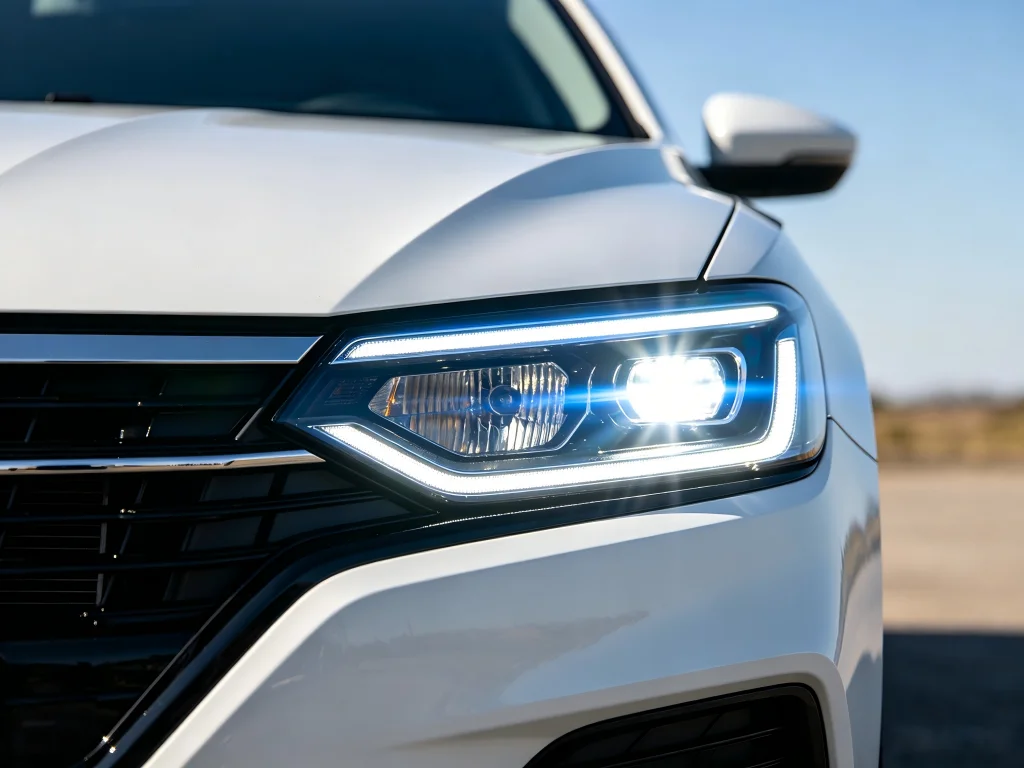
If your headlights look bright from the outside but still leave you straining to see at night, the problem may not be a lack of power. It may be poor beam control, aging bulbs, overheating, or an LED retrofit that simply does not match your headlight optics. The right automotive LED bulbs can improve usable road illumination, but choosing the wrong ones can create glare, dark zones, flicker, or disappointing performance.
After reviewing the major topics repeatedly appearing across current automotive LED bulb buying guides, one pattern is clear: buyers often focus on advertised lumens first and beam quality last. That is backwards. Current guidance consistently emphasizes fitment, beam pattern, thermal management, electrical compatibility, and road legality as critical decision factors.

The Real Problem With Weak Automotive Lighting
Automotive LED bulbs can solve several common lighting problems, but only when the LED source, optical position, electrical system, and cooling design work together. A good retrofit should produce controlled road illumination rather than simply creating more raw light. Correct fitment and beam geometry should therefore come before headline lumen numbers.
You may recognize the symptoms immediately.
- Your original halogen bulbs have become noticeably dimmer.
- Road signs are difficult to read until you are already close to them.
- Rain makes your existing headlights feel almost useless.
- Your high beams look bright, but the road directly ahead still has dark areas.
- After installing cheap auto LED bulbs, the dashboard reports a lighting error.
- Other drivers flash their headlights because your retrofit produces excessive glare.
- The bulbs appear powerful for the first few minutes but become less impressive after prolonged driving.
These problems are related. Automotive lighting is not simply a competition to produce the highest possible number of lumens.
The light has to leave the LED, enter the existing reflector or projector, and arrive on the road in a useful pattern. If the light source sits in the wrong location, increasing output may simply increase scattered light.
Why “Brighter” Can Still Mean Worse
Imagine driving at 70 mph on an unfamiliar rural road. There is no street lighting. The pavement is wet. A pedestrian, animal, pothole, or broken-down vehicle may appear with very little warning.
You need usable forward illumination.
You do not need a bulb that looks spectacular when pointed at a garage wall.
This distinction explains why some extremely cheap car LED bulbs receive impressive online reviews at first but disappoint experienced installers.
A high-output LED source can create a bright foreground while failing to project enough controlled light down the road. It may also send excessive light above the intended cutoff.
That creates a dangerous paradox:
The road may not become meaningfully easier to see even though the headlights appear dramatically brighter.
Modern automotive lighting guidance makes the same fundamental distinction between raw light output and controlled illumination. Philips, for example, specifically emphasizes controlled beam distribution rather than simply maximizing brightness.
What Actually Makes Good Car LED Bulbs Work?
The most important characteristics of quality car LED bulbs are correct bulb fitment, precise LED positioning, controlled beam geometry, stable thermal performance, reliable drivers, and compatibility with the vehicle’s electrical system. These factors determine whether the light remains useful on the road instead of becoming scattered, unstable, or unreliable.
1. Start With the Correct Bulb Type
H4, H7, H11, H1, HB3, HB4, 9005, 9006 and other designations are not interchangeable product names.
They identify different mechanical and electrical configurations.
An H4 LED bulb, for example, is commonly designed for a dual-beam application, while an H7 is generally a single-beam configuration. That means an H7 LED bulb cannot simply replace an H4 because both happen to be LED products.
Before purchasing, verify:
- The original bulb number.
- Low-beam and high-beam configuration.
- Projector or reflector housing.
- Available rear clearance.
- Connector and driver requirements.
- Vehicle electrical compatibility.
2. LED Position Matters More Than Most Buyers Realize
A traditional halogen bulb has a defined filament position. The headlamp optic was engineered around that light source.
When replacing it with an LED, the LED chips need to approximate the original light-source geometry closely enough for the reflector or projector to form a controlled beam.
This is why two automotive light bulbs with similar wattage can produce radically different road performance.
One may create a sharp and useful beam.
The other may produce bright spots, scattered light and poor distance visibility.
Industry buying guides increasingly identify optical geometry and filament positioning as critical factors rather than secondary specifications.
3. Heat Is the Silent Performance Killer
LED technology is efficient, but efficient does not mean heat-free.
Some electrical energy still becomes heat at the LED junction and driver. That heat has to leave the bulb.
If it cannot, junction temperature rises. Output stability can suffer, component stress increases, and long-term reliability may decline.
This is why the cooling system deserves as much attention as the LED chip itself.
| Cooling approach | Typical advantage | Potential drawback | Best consideration |
|---|---|---|---|
| Passive heat sink | No moving fan | Requires sufficient physical space and thermal mass | Simple, quiet installations |
| Active fan cooling | Can move heat rapidly from compact assemblies | Introduces a moving component | High-output applications with suitable airflow |
| 混合散熱設計 | Balances compact packaging and heat transfer | More engineering complexity | Performance-oriented retrofit systems |
Current LED headlight guidance also emphasizes that thermal management influences sustained brightness rather than simply theoretical peak output.
Why Cheap Auto LED Bulbs Often Disappoint
The cheapest bulb may look like the best deal when you compare product pages.
Then reality starts.
The fan becomes noisy. The bulb flickers. The beam is uneven. The dust cap no longer fits. The dashboard displays an error. Output falls after extended driving. Or the bulb simply fails months earlier than expected.
The problem is not that every inexpensive automotive LED bulb is bad.
The problem is that price alone tells you very little about engineering quality.
A reliable product contains several systems:
- LED chips.
- Thermal interface materials.
- Heat sink or cooling system.
- Constant-current driver.
- EMI control.
- Mechanical mounting structure.
- Connector and wiring.
- Optical positioning system.
Saving a few dollars by reducing the quality of one of these components can affect the entire system.
What About H7 LED and H4 LED Bulbs?
Car LED Bulbs H7
H7 LED bulbs are widely used for applications where low and high beams are separated. Their relatively compact single-beam configuration can make them attractive for retrofit applications.
However, H7 compatibility should never be judged only by the base.
The LED emitter position, locking mechanism, rear clearance and headlight optical design all matter.
Car LED Bulbs H4
H4 applications are more demanding because one bulb is responsible for both low- and high-beam functions.
A good H4 design therefore has to maintain appropriate positioning for both beam states.
This is one reason why simply choosing the product with the largest advertised lumen number may produce disappointing results.
CANbus Problems: When Your New Bulbs Trigger Errors
Modern vehicles increasingly monitor electrical loads. A traditional halogen bulb and an LED retrofit may consume different amounts of power.
The vehicle can interpret that difference as a failed bulb.
Depending on the vehicle, symptoms may include:
- Dashboard bulb warnings.
- Flickering.
- Rapid flashing.
- Intermittent operation.
- Lighting-system fault messages.
Some automotive LED bulbs include integrated compatibility electronics. Others require an additional CANbus decoder or load solution.
Do not assume that “CANbus compatible” means compatible with every vehicle. Vehicle-specific testing is still the safer approach.
What About the Color Temperature?
Many buyers automatically choose the highest Kelvin number available because the light appears whiter or bluer.
That is not necessarily better.
For real driving, the objective should be a useful balance between color appearance, contrast, weather performance and visual comfort.
Very cool light can look attractive in dry conditions, while rain, fog and wet pavement may make excessive blue content less appealing.
For everyday driving, a neutral white output is generally a more sensible target than choosing a color temperature simply because the packaging describes it as “ultra white.”
Can Automotive LED Bulbs Be Used in Every Car?
No. An LED replacement is not automatically suitable for every headlamp.
Vehicle compatibility depends on the original bulb type, housing design, electrical system, available space and local regulations.
Projector and reflector headlights can also respond differently to retrofit bulbs. Philips’ automotive lighting guidance specifically highlights the importance of understanding the optical differences between reflector and projector systems before retrofitting.
For road use, buyers should also verify the requirements applicable to their market rather than assuming that an aftermarket LED bulb is automatically road legal.
How GTR Approaches Automotive LED Bulb Engineering
At GTR, we approach an automotive LED bulb as a complete lighting system rather than a collection of headline specifications.
That means paying attention to the relationship between the LED emitter, thermal structure, driver, mounting geometry and vehicle application.
Based on our manufacturing experience, the most useful product conversation often starts with a simple question:
What vehicle and headlight are you trying to improve?
Once the application is understood, the correct bulb type, optical architecture, thermal solution and electrical configuration can be evaluated together.
That approach is especially valuable for wholesalers, distributors, retrofit shops and automotive lighting specialists. Instead of buying a generic product and discovering compatibility problems after inventory arrives, buyers can evaluate the application before committing to a product range.
Automotive LED Bulbs Near Me: What Should You Ask?
Searching for “car led bulbs near me” or “automotive light bulbs near me” can find plenty of retailers. But proximity does not guarantee product quality.
Before buying locally, ask:
- What exact bulb type does my vehicle use?
- Is the product designed for projector, reflector or both?
- Can you provide beam-pattern evidence?
- How is the LED cooled?
- Does it require a CANbus decoder?
- What happens if the bulb does not fit the headlight housing?
- What warranty and replacement support are provided?
What About Car LED Bulbs Price in Kenya?
Searches such as “car LED bulbs price in Kenya” show that price-sensitive buyers are often comparing products from very different quality levels.
A better comparison is total value rather than purchase price.
A low-cost bulb that needs replacement twice may cost more than a properly engineered product that delivers stable performance over a much longer period.
For distributors and wholesalers, the calculation becomes even more important because warranty claims, returns, customer complaints and installation failures can quickly erase a small purchasing-price advantage.
Five Questions to Answer Before You Buy
Are LED bulbs brighter than halogen?
They can produce substantially more usable light, but brightness alone does not determine road visibility. Beam distribution, optical positioning and thermal stability are equally important.
Do more lumens always mean better headlights?
No. Lumens describe total light output, while useful road illumination depends on where that light goes. A poorly controlled high-output bulb can perform worse than a lower-output bulb with a better beam pattern.
Are H4 and H7 LED bulbs interchangeable?
No. They have different mechanical and functional configurations. Always match the replacement to the vehicle’s original bulb specification.
Why do LED bulbs flicker after installation?
Possible causes include electrical compatibility issues, PWM systems, CANbus monitoring, driver design or insufficient voltage stability. The vehicle and bulb should be evaluated as a system.
Should I choose fan-cooled or fanless LED bulbs?
Neither design is automatically superior. The better choice depends on output requirements, available space, thermal design, environmental conditions and product engineering.
Can LED retrofits cause glare?
Yes. Incorrect emitter positioning or unsuitable optics can send light outside the intended beam. A properly designed retrofit should prioritize controlled illumination and correct adjustment.
Stop Chasing Brightness. Start Chasing Useful Light.
The most frustrating automotive lighting problems are rarely solved by buying the bulb with the biggest number printed on the box.
The solution begins with understanding the vehicle.
Find the correct bulb type. Check the housing. Evaluate beam geometry. Confirm thermal management. Consider electrical compatibility. Then judge output.
That sequence may take a few more minutes before purchase, but it can save you from poor visibility, glare, repeated replacements and unnecessary installation work.
If your customers are complaining about weak halogen performance, inconsistent aftermarket bulbs or unreliable lighting upgrades, GTR can help you move from generic replacement bulbs toward application-focused automotive LED solutions.
在以下位置探索 GTR 汽車照明解決方案 https://www.rhgtr.com. If you are a distributor, retrofit shop or automotive lighting buyer looking for a stable product range, start with the vehicle applications that are creating the most customer complaints. Solve those first, then build the range around proven demand.
Authority references: 飛利浦汽車照明 and applicable SAE/ECE lighting requirements should be checked for the destination market.