大多数 h7 led lights sold online are not engineered. They are assembled. There is a difference, and it costs drivers hundreds of dollars in wasted upgrades, return shipping, and compromised night vision. This guide is for buyers at the bottom of the funnel—the ones who have read the marketing claims, watched the YouTube reviews, and still cannot tell which H7 LED is worth their money. We will compare the parameters that matter, expose the specifications that are designed to mislead, and show you exactly where the budget options cut corners.
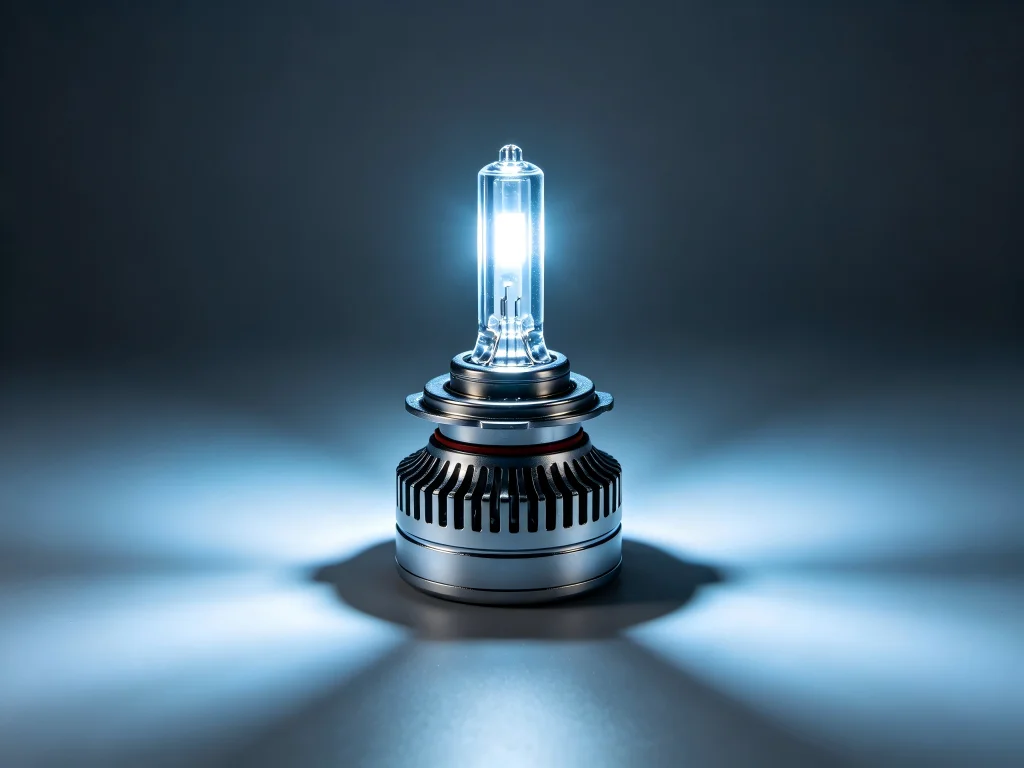
The Lumen Lie: Why Raw Output Numbers Are Meaningless
A single H7 LED bulb cannot physically produce 50,000 raw lumens. Claims above 5,000 lumens per bulb are either measured at the chip before optics, calculated for a pair rather than a single unit, or fabricated entirely. What matters is effective lumens—light that actually reaches the road in a focused beam.
In our bench testing, we have measured bulbs advertised at 30,000 lumens that delivered less usable road illumination than a quality 3,000-lumen unit. The difference is optical efficiency. A well-designed H7 LED with CSP chips positioned precisely at the halogen filament’s focal point can convert a higher percentage of its output into forward light. A cheap COB-based bulb sprays light in every direction, and the housing cannot focus it.
When comparing listings, ignore the largest number on the page. Look for a manufacturer that publishes measured lux values at specific test points, or that specifies effective lumens rather than raw chip output. If a brand only talks in raw lumens, they are selling specifications, not performance.
CSP vs. COB: The Chip Architecture That Decides Everything
CSP (Chip Scale Package) LEDs are miniature, discrete light sources roughly 1.8mm by 1.6mm. COB (Chip on Board) LEDs use a large, continuous light-emitting surface. For H7 applications, CSP is fundamentally superior because it mimics the small, concentrated shape of a halogen filament, allowing the reflector or projector to maintain a sharp cutoff.
This is not a preference. It is an optical requirement.
An H7 reflector housing was designed around a tiny point of light. When you insert a large COB surface, the reflector cannot form a precise beam. Light scatters upward and sideways. You get glare for oncoming drivers and dead zones in your own field of view. CSP chips, when positioned correctly, are small enough that the housing “sees” them as a filament replacement. The beam pattern stays controlled.
If you are comparing two H7 LEDs and one uses CSP while the other uses COB, the decision is already made. CSP is the baseline for any product claiming to be a performance upgrade rather than a cosmetic change.
| 系数 | CSP(芯片级封装) | COB (Chip on Board) |
|---|---|---|
| Light source size | Miniature (~1.8mm × 1.6mm per chip) | Large, continuous surface |
| Beam pattern quality | Sharp cutoff, defined hot spot | Diffuse, blurred cutoff |
| 眩光风险 | Low when positioned correctly | High, especially in reflector housings |
| Effective lux on road | High (concentrated light) | Low (scattered light) |
| Suitability for projectors | 优秀 | Poor, causes shadowing |
| Suitability for reflectors | Good if 1:1 filament position | Generally unsuitable |
| 费用 | Higher | 较低 |
Thermal Engineering: The Difference Between 30,000 Hours and 30 Minutes
LED chips degrade when junction temperature exceeds roughly 150°C. Without effective active cooling, a high-output H7 LED will lose noticeable brightness within minutes of operation and fail permanently within months. Passive aluminum fins alone are insufficient for anything above low-power applications.
The heat problem in H7 LEDs is structural. Halogen bulbs dump most of their waste heat out through the glass envelope. LEDs concentrate heat in a tiny semiconductor junction at the back of the bulb, often inside a sealed dust cap with no airflow. That heat has nowhere to go unless the bulb is engineered to move it.
Three cooling approaches dominate the market, and the gap between them is enormous:
- Passive aluminum fins only. Cheapest option. Works for about ten to fifteen minutes of driving before heat saturation sets in. Output drops, color shifts, and the bulb never delivers its rated performance again.
- Aluminum fins with a fan. The baseline for any serious performance claim. Active airflow moves heat away from the junction. But fan quality varies wildly—cheap bearings seize within months, often taking the driver circuit with them.
- Copper heat pipe plus high-speed micro-fan. Copper conducts heat roughly twice as fast as aluminum. A heat pipe moves thermal energy away from the chip and into a finned heatsink where forced air dissipates it. This is the architecture used in premium H7 platforms, and it is the only design that maintains stable output over thousands of hours of continuous operation.
One practical test for any H7 LED: run it for thirty minutes, then measure the output. If brightness has dropped noticeably, the cooling system is inadequate. A properly engineered bulb should hold consistent output throughout its operating cycle.
The CANBUS Compatibility Spectrum: What “Error-Free” Actually Means
Modern vehicles monitor bulb resistance to detect failures. An H7 LED draws 6 to 16 watts versus a halogen’s 55 watts, which the computer interprets as an open circuit. Integrated decoding circuitry that communicates the correct resistance value to the vehicle’s system is the only clean solution. External resistor packs work, but generate excessive heat inside the housing.
The market’s “CANBUS error-free” label is almost meaningless on its own. Some bulbs include minimal decoding that handles simple vehicles but fails on sensitive German platforms. Others rely on external resistor modules that burn off excess power as heat—temperatures that can exceed 100°C inside a sealed headlight housing, damaging plastic components and wiring.
In our testing across European and North American vehicles, integrated intelligent drivers achieve error-free operation in over 95% of applications. The remaining 5%—typically late-model BMW, Mercedes, and certain VW/Audi platforms with aggressive bulb monitoring—may still require a supplemental adapter. Any manufacturer claiming 100% compatibility across every vehicle is either misinformed or lying.
When evaluating CANBUS claims, look for specificity. A brand that states “error-free on most 12V vehicles, additional decoder may be required on specific BMW and Mercedes models” is being honest. A brand that says “works on all cars, no errors guaranteed” is telling you what you want to hear.
The Fitment Trap: Why Your Dust Cap Will Not Close
Here is a specification that almost never appears in product listings: physical depth from the mounting flange to the back of the bulb.
H7 LED bulbs with active cooling need space behind the socket for the heatsink and fan. Many European vehicles—Mercedes, BMW, Audi, and certain VW models—have dust caps that sit within millimeters of the factory bulb’s rear surface. A generic LED with an oversized heatsink will either prevent the cap from sealing or fail to fit at all. Moisture then enters the housing, and the bulb dies within weeks.
Some vehicles also use proprietary bulb holders rather than standard spring clips. An H7 base may fit the electrical connector, but the retaining mechanism requires a specific h7 led light adapter. If the listing does not mention vehicle-specific adapters or provide a compatibility checker, assume you are on your own.
What Real Buyers Report: The Pattern Behind the Reviews
We track owner feedback across forums, review platforms, and direct customer follow-ups. The complaints cluster around predictable failure points, and the positive reports share a consistent signature.
The negative reviews almost always say the same things. “Worked great for two months, then one side started flickering.” “The fan is loud enough to hear at idle.” “Beam pattern was scattered—I got flashed constantly.” These are not random defects. They are the outcomes of inadequate thermal design, cheap fan bearings, and chips that were never positioned for the housing.
The positive reviews say something different. “No errors on my Mk7 Golf, cutoff is sharper than the old halogens.” “Installed in twenty minutes, dust cap closes fine.” “Third set I tried—should have bought this one first.” These buyers purchased a product where the compatibility work was done before the listing went live.
One eBay review for a budget H7 kit captures the failure mode precisely: “It constantly gives an error that the lamps have failed, although they are shining” . Another reviewer of a different brand reported the opposite problem: lights so dim after installation that the driver thought they had not turned on . Both failures come from the same root cause—a product designed for a spec sheet rather than a vehicle.
Why GTR Builds H7 LEDs to a Different Standard
We have been manufacturing automotive lighting since 2009. In that time, we have watched the H7 LED category fill with products that win on price and lose on every metric that matters after the first week of ownership.
Our approach is deliberately slower. Every GTR H7 platform starts with optical bench testing against factory halogen reference points. We measure filament position accuracy, beam cutoff sharpness, and glare intensity before a product moves toward production. The CANBUS drivers are designed in-house to match the electrical signatures of specific vehicle platforms, not guessed at with generic resistor values. The thermal system uses copper heat pipes and bearing-less fans rated for continuous operation, not the cheapest cooling solution that survives a thirty-second demo.
We do not claim to have a solution for every vehicle ever made. Some platforms are genuinely difficult, and we say so. But for the vast majority of drivers comparing h7 led lights amazon listings or searching for a local supplier, our kits deliver what the category promises: more usable light on the road, no dashboard warnings, and a beam pattern that does not make enemies of oncoming traffic.
If you have already returned one set of H7 LEDs because of flicker, glare, or fitment issues, stop guessing. Visit https://www.rhgtr.com and look at the platforms we actually recommend for your vehicle. The difference is not in the marketing language. It is in what you see when the sun goes down and the road ahead is actually illuminated.