For automotive lighting distributors, retrofit shops, and procurement managers searching for a reliable 3.0 inch bi LED projector lens supplier, the market offers hundreds of options at wildly different price points. But raw brightness numbers tell you almost nothing about real-world performance.
This guide gives you the exact technical criteria our engineering team uses when evaluating Bi-LED projector lenses. We’ll walk through beam optics, thermal management, build quality, and the key questions most buyers overlook until it‘s too late.
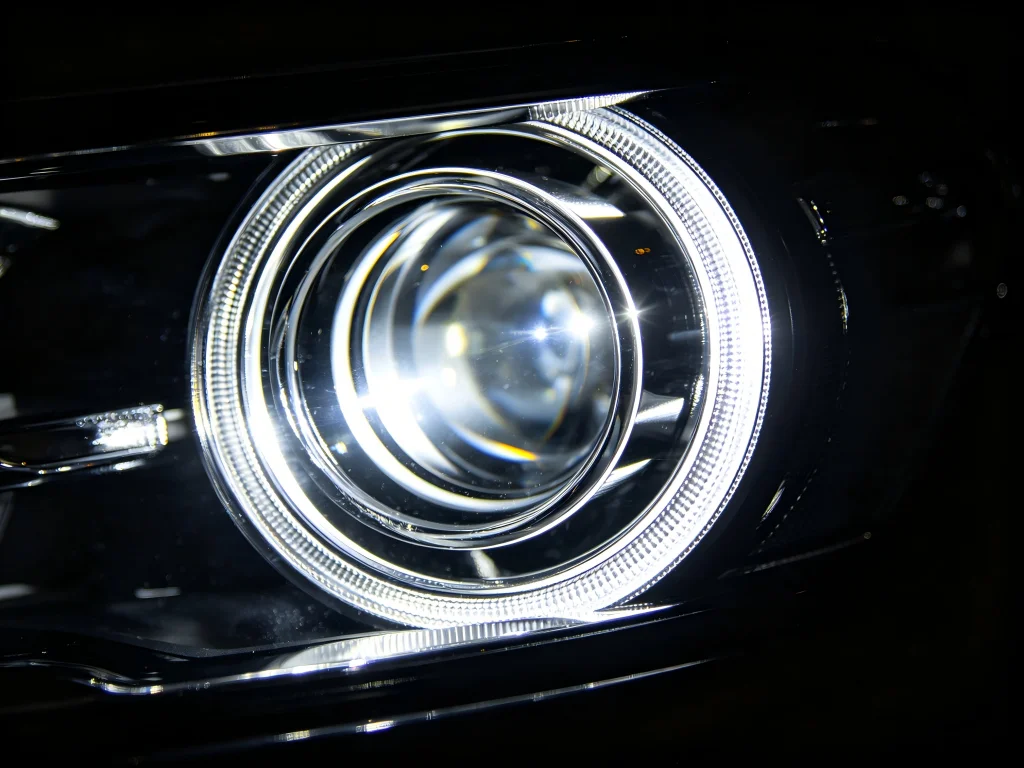
Why 3.0 Inch Has Become the Industry’s Sweet Spot
A 3.0-inch projector lens diameter delivers the optimal balance between light output and retrofit compatibility. Smaller 2.5-inch units produce narrower beam patterns with less total illumination. Larger 3.5-inch lenses demand significant housing modifications and often won‘t fit in compact headlight assemblies. The 3.0-inch format works across most sedans, SUVs, pickup trucks, and off-road vehicles without major surgery.
From our manufacturing data, roughly 80% of automotive retrofit applications now specify 3.0-inch as the preferred format. The size delivers superior light gathering from the LED chips while maintaining a compact enough profile for universal mounting brackets (H4, H7, 9005, 9006 compatibility).
Critical Evaluation Criteria That Distinguish Quality
1. Lux Over Lumens — The Misunderstood Metric
Most brands advertise lumens. Smart buyers ask for lux measurements at distance. Lumens measure total light output in all directions—like water coming out of a sprinkler. Lux measures intensity hitting a specific surface at a given distance—the amount of water actually landing on a single leaf.
For a Bi-LED projector whose job is to focus light down the road, lux is the more critical metric. High lumens with poor optics create scattered light that blinds oncoming traffic instead of illuminating the road ahead.
In our controlled testing, an 8,000-lux projector easily outperforms a 15,000-lux unit with inferior optics. Always request lux values measured at a standard distance (manufacturers using 3-meter or 5-meter test distances), along with the raw lumen spec.
2. Cutoff Line Clarity and Glare Control
The sharpness of a Bi-LED projector‘s low-beam cutoff line directly determines glare reduction for oncoming drivers. A quality 3.0 inch bi LED projector lens uses a precision-machined metal shield positioned between the LED emitter and the projection lens. This physical cutoff block creates a crisp boundary between light and darkness—no light bleeds above the horizon line.
Poor-quality projectors use plastic or loosely fitted shields. The result is light scatter above the cutoff, which translates to glare complaints, failed inspections, and potential liability for your customers.
3. Thermal Management Architecture
Heat kills LED performance. Every 10°C increase above optimal operating temperature reduces LED lifespan by roughly 50%. Quality Bi-LED projectors integrate either passive cooling (aluminum heatsinks with large surface area) or active cooling (precision fans).
For high-wattage units (100W+ per pair), active cooling is non-negotiable. Look for:
- Full aluminum alloy housing (not plastic components)
- Rated operating temperature range of -40°C to +110°C
- Fan RPM specifications (12,000 RPM indicates serious engineering)
- Heat dissipation testing data for sustained operation
Comparison Table: Bi-LED Projector vs. Other Options
| 特点 | Bi-LED Projector Lens | Standard LED Bulb in Reflector Housing | 卤素投影灯 |
|---|---|---|---|
| Low-beam Cutoff | Sharp, controlled, glare-free | Scattered, unpredictable | Poor control, significant glare |
| High-beam Throw | Focused, long-distance (400-500m+) | Diffused, limited range | Very limited range |
| 安装复杂性 | Requires professional retrofit work | Plug-and-play (but performs poorly) | Direct replacement |
| 寿命 | 30,000+小时 | 15,000-25,000 hours | 500-1,000小时 |
| 能源效率 | 40-70W per unit (high efficiency) | 30-50W per unit (variable) | 55-65W per unit (low efficiency) |
Manufacturer Checklist — What to Verify Before Ordering
- Certification status: Does the factory hold CE, RoHS, and DOT compliance certifications for relevant markets?
- Minimum order quantities: Can the manufacturer accommodate your initial test orders (50-100 sets) before scaling up?
- Customization capability: Does the factory offer OEM branding, custom packaging, or specialized color temperatures?
- Warranty terms: Quality manufacturers provide 18-24 month warranties covering defects and premature failure.
- Lead times: Confirm both production lead times (typically 15-30 days for smaller batches) and shipping durations from factory to your warehouse.
- After-sales support: Does the supplier provide technical documentation, installation guides, and prompt response for troubleshooting?
GTR LS11 MAX — Engineered for Professional Applications
Based in Guangdong, China, GTR Lighting has specialized in automotive LED lighting since 2009. The company emerged in a market flooded with cheap alternatives and has built its reputation on engineering precision rather than price-cutting.
The GTR LS11 MAX 3.0 inch bi LED projector lens exemplifies this engineering-first approach:
- 58W total power — Low beam: 12 chips, high beam: additional Osram single-chip integration
- 9V–16V DC operating voltage — Stable across all vehicle electrical systems
- 18-month warranty — Backed by full CE and RoHS certifications
- Dual-ball silent fan cooling — Rated -20°C to +100°C operating temperature range
- Universal fitment — H4 base with broad vehicle compatibility
Unlike suppliers that push extreme lumens without regard for optical control, GTR delivers beam patterns that put light precisely where drivers need it—on the road, not in the eyes of oncoming traffic.
Installation and Compatibility Requirements
Most 3.0-inch Bi-LED projector lenses require professional installation. The retrofit process typically involves:
- Opening the factory headlight housing (oven or heat-gun method)
- Removing the original reflector bowl or projector assembly
- Mounting the Bi-LED projector using threaded-shaft brackets
- Re-sealing the headlight with butyl glue or sealant
- Re-aiming the beams for proper road alignment
For distributors stocking these products, we strongly recommend partnering with or referring customers to qualified retrofit workshops. Proper installation directly impacts performance and customer satisfaction.
常见问题
Q: How do I verify lumen/lux claims from manufacturers?
A: Request integrating sphere test reports for lumens and lux measurement data at standardized distances. Legitimate factories maintain testing equipment and share results transparently.
Q: What is the difference between Bi-LED and Bi-Xenon projectors?
A: Bi-LED uses integrated LED chips with electromagnetic shutter switching between high and low beams. Bi-Xenon requires separate xenon bulbs and ballasts. Bi-LED offers instant full brightness, longer lifespan, and simpler installation.
Q: Can 3.0-inch projectors fit in all vehicles?
A: Most sedans, SUVs, and trucks accommodate 3.0-inch lenses. Compact vehicles with tight headlight housings may require 2.5-inch units. Always verify physical clearance before ordering.
Q: Are these projectors street legal in North America and Europe?
A: Compliance depends on specific market regulations (FMVSS 108 for US, ECE for Europe). Products must be professionally installed and properly aimed. Some markets require auto-leveling or lens cleaning systems for high-intensity lights.
Q: What is the typical wholesale pricing range?
A: B2B pricing varies by order volume. Entry-level units range from $30–50 per set. Mid-range quality projectors (with proper optics and cooling) typically run $50–80 per set at wholesale. Premium units exceed $100 per set.
Q: How long should a quality Bi-LED projector last?
A: With proper thermal management, expect 30,000+ hours of operation—roughly the life of the vehicle itself.
Final Recommendation for B2B Buyers
When sourcing a 3.0 inch bi LED projector lens supplier, prioritize optical engineering over raw brightness numbers. Request photometric testing data, verify cooling system specifications, and establish a small initial order to validate quality before scaling up.
For professional-grade Bi-LED projectors with proven optical performance and reliable support, explore GTR Lighting‘s catalog at https://www.rhgtr.com. Contact the sales team directly to discuss sample orders, wholesale pricing, and customization options for your market.