キャビネットを開け、スイッチを入れたが、何も起こらない。あるいはさらに悪いことに、かすかで不健康そうな黄色い光がよろめくように灯り、点くかどうか決めかねているかのようにちらつき始める。 あなたはため息をつき、脚立を手に取り、この5年間で3回も買い替えたのと同じハロゲン電球を取り出そうとする。バイピンLED電球なら、この面倒な作業に終止符を打つだけではない。お金と時間を節約できるだけでなく、手が届かない照明器具の中でまたフィラメントが切れていくのを見守る、あのじわじわと募る苛立ちからも解放されるのだ。 GTRでは、ハロゲンランプが機能しなくなるまさにその場所で、確実に機能するLED照明の開発に長年にわたり取り組んできました。そして、実際には電球そのものが原因であるにもかかわらず、配線のせいにしてしまうオーナーを、あまりにも多く見てきました。.
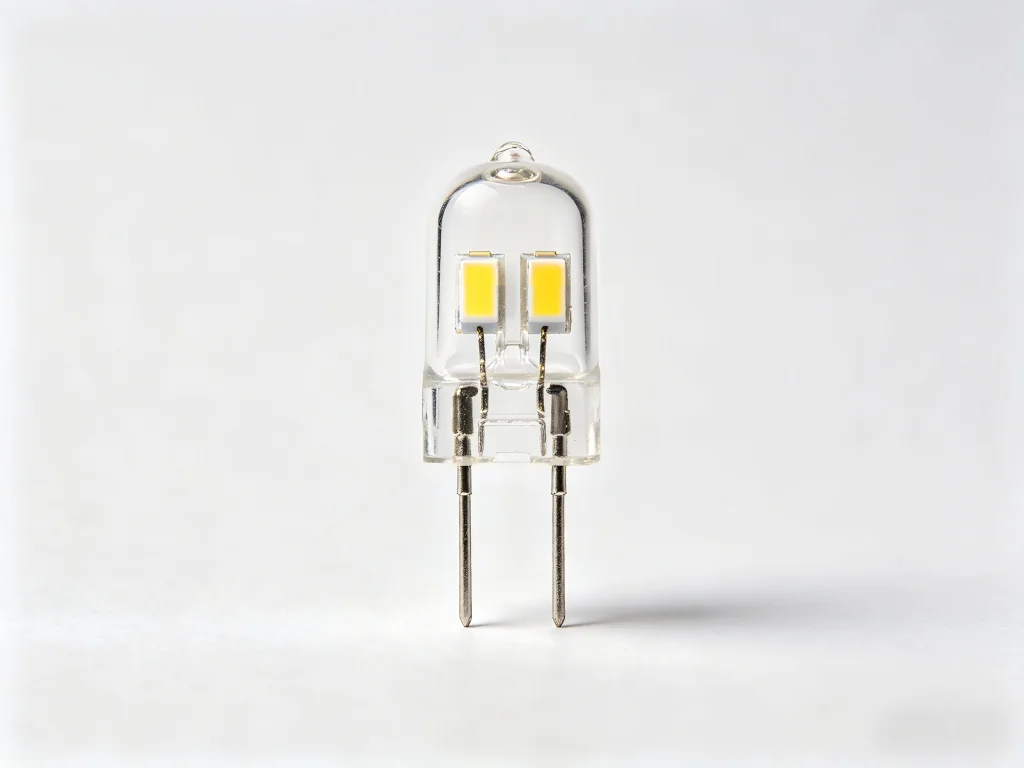
すべてのハロゲン・バイピンランプに潜む静かな不具合
誰も教えてくれない「バーンアウトの悪循環」
ほとんどのハロゲン・バイピン電球(G4、G9、T3)は、約2,000時間の使用寿命と定められています。この数字は、実際に計算してみるまでは悪くないように思えます。しかし、一晩に4時間点灯するキャビネットの下では、ハロゲン電球は17ヶ月も経たないうちにその寿命を使い果たしてしまいます。 日没から深夜まで点灯する庭園用照明の場合、1年以内に寿命が尽きてしまうこともあります。これに対し、20W相当のG4バイピンLED電球なら、25,000~50,000時間の寿命が見込めます。 LEDの明るさが目立って弱まる前に、ハロゲン電球は20回から30回も切れて交換されることになります。交換のたびにホームセンターへ足を運ぶ手間が増え、埋め立て地にハロゲン電球の廃棄物がまた一つ加わり、そして明らかに「電球の交換などしたことがない人」が設計した照明器具の前で、20分間も前かがみになって作業することになります。.
さらに悪いことに、ハロゲンランプは単に切れるだけでなく、光量が徐々に低下していきます。バイピン型ハロゲンランプは、ガラスカプセルの内側にタングステンの堆積物が蓄積するにつれて、数百時間ごとに光量の約5%を失っていきます。 目は環境に順応するため、その変化に気づかないものです。しかし、6ヶ月も経つと、設置当初に比べて15~20%も光量が低下しています。フィラメントが最終的に切れる頃には、その電球は寿命の大部分にわたって本来の性能を発揮できていなかったことになります。.
肌で感じる熱の問題
点灯してから5分経ったハロゲンG4カプセルに触れてみてください――いや、やめておいたほうがいいでしょう。火傷します。 ハロゲン・バイピン電球は、そのエネルギーの約80%を光ではなく熱に変換します。その熱はどこかへ放出されなければならず、密閉された照明器具(キャビネット用のパックライト、密閉型の庭園用通路灯、ガラスシェードがぴったりと閉じたシャンデリアなど)の中では、ソケットや配線、そして器具そのものを熱で傷めてしまいます。.
当社の試験室では、繰り返し熱サイクルにさらされた結果、ソケットのピンが焼きなまし状態となり、ばねの張力を失ったために故障したハロゲン照明器具を分解調査しました。 電球のピンからソケットの受け部に熱が伝わり、受け部が軟化して保持力が低下します。その結果、抵抗が生じ、アーク放電が起こり、最終的に照明器具が故障してしまうのです。所有者は配線のせいにしますが、真の原因は、1950年代に設計された電球技術が、そのような持続的な熱負荷に耐えるようには設計されていない密閉型ハウジングに無理やり組み込まれていたことにありました。.
12ボルトの庭用照明で電球が次々と切れてしまう理由
造園設備に12ボルトのLEDバイピン電球を使用している場合、あることに気づいているでしょう。ハロゲン電球の代替品は、定格電圧で動作することはめったにないのです。ほとんどの造園用トランスは、12.5Vや13Vといったように、わずかに高電圧で動作しており、過電圧になるとハロゲン電球の寿命は指数関数的に短くなります。 12Vのハロゲンランプを13Vで点灯させると、本来2,000時間の寿命がある電球が1,000時間しか持たなくなります。これが、長いケーブルの末端にあるパスライトはいつまでも点灯し続ける一方で、変圧器に最も近いパスライトは年に2回も切れてしまう理由です。.
LEDはこれとは異なる仕組みになっています。高品質なG4バイピンLED電球には、電源電圧のわずかな変動にかかわらず、発光素子への電流を安定させる内蔵ドライバ回路が搭載されています。11Vでも14Vでも接続すれば、必要な電流を自動的に取り込みます。変圧器のすぐそばにある電球も、50フィート離れた場所にある電球も、同じ明るさで点灯します。 トランスが特定の電球を優先して電流を流すため、特定のグループの電球ばかりを交換する必要はもうありません。.
消え去ろうとしないちらつき
バイピン回路におけるLEDのちらつきは、ほとんどの場合、ある根本的な原因に起因しています。それは、トランスがLEDではなくハロゲン電球用に設計されていることです。ハロゲン用トランスは多くの場合、磁気式で交流(AC)を出力しますが、LED発光素子には安定した直流(DC)電流が必要です。 この不一致により、目に見える50Hzまたは60Hzのパルスが発生し、それが目にはちらつきとして認識されます。.
LEDへの交換を初めて行う方から最もよく寄せられる苦情は、「LED電球に交換したら、ちらつきが出てしまいました。不良品なのでしょうか?」というものです。10件中9件は、電球自体に問題はありません。 問題はトランスにあります。ハロゲンランプ用に設計された磁気トランスは、安定して動作するために最低限の消費電流(通常は20VA以上)を必要とします。2Wや3WのLED交換用電球では、そのトランスにほとんど負荷がかからないため、出力が不安定になり、トランス自体からブーンという音がする場合もあります。.
この修正は3つの段階に分かれています:
- 回路にハロゲンランプを1つ残しておいてください。. これは一時的な対処法ですが、ハロゲンランプは変圧器を安定させるのに十分な負荷を提供してくれます。これで機能はしますが、ハロゲンランプの電力は無駄に消費されてしまいますし、寿命が尽きたらやはり交換する必要があります。.
- トランスをLEDドライバに交換してください。. 定電圧LEDドライバは、LEDの動作に最適な、クリーンで安定化された直流電力を出力します。これは、あらゆる低電圧バイピン回路にとって、長期的に見て適切な解決策となります。.
- 整流機能内蔵で、広範囲の入力電圧に対応したLEDを購入してください。. 一部のバイピン型LED電球の設計では、ブリッジ整流器やスイッチングレギュレータが電球のプリント基板上に直接組み込まれており、8Vから24V以上までの交流または直流入力に対応しながら、ちらつきなく点灯させることができます。変圧器を交換せずに既存のシステムを改修する場合、これが最も手間のかからない方法です。.
当社のテストでは、ちらつきの問題によって、汎用的な低価格LED電球と、適切に設計されたLED電球が明確に区別されます。整流器を備えていない2WのLED電球は、交流電源で使用するとちらつきが発生する可能性が高いです。調光可能なG9型LED電球(バイピンベース)の場合、さらに考慮すべき点があります。それは、お使いの調光器の種類と互換性がある必要があるということです。 トレーリングエッジ式調光器はLEDに対応していますが、白熱灯用に設計されたリーディングエッジ式調光器は、多くの場合対応していません。不適切な調光器を使用すると、高品質なLED電球であっても、低輝度設定時にブーンという音やちらつきが発生してしまいます。.
適切に設計されたバイピンLEDの特長
ハロゲンランプにはない内部構造
ハロゲン・バイピン電球は、その構造が実にシンプルです。ハロゲンガスが充填されたガラスカプセル内のタングステンフィラメントが、2本のピンに取り付けられているだけ。それだけのものです。 電子回路も、電圧調整機能も、保護回路もありません。純粋な抵抗負荷です。そのシンプルさこそが弱点でもあります――電圧変動に適応する手段も、過熱保護機能も、自身の出力を最適化する方法もありません。.
最新のバイピン型LED電球は、単なる光源ではなく、電子機器です。ソケット内部には、小型のプリント基板が搭載されており、そこには以下のものが組み込まれています:
- A ブリッジ整流器 (高品質な電球において)交流を直流に変換し、変圧器のタイプにかかわらず50/60Hzのちらつきを解消します。.
- A 定電流レギュレータ これにより、入力電圧が8Vから24Vの間で変動しても、LEDエミッタには安定した制御された電流が供給されます。.
- 熱フィードバック回路 これは、電球の内部温度が安全基準値を超えた場合に出力を低下させる仕組みとなっており、発光部を保護し、寿命を延ばします。.
- フィルムコンデンサ (フリッカーフリー設計)により、整流された直流電流を滑らかにし、目への負担となる微細なちらつきを引き起こす可能性のある残留リップルを排除します。.
These are the components that separate a led bulb philips or similarly engineered product from a no-name LED that costs half as much and flashes like a strobe light the moment the transformer drops below its minimum load.
熱管理:LEDが(ついに)密閉型照明器具で使用できるようになった理由
The conventional wisdom for years was “don’t put LED bulbs in enclosed fixtures — they’ll overheat and die.” That wisdom was earned. Early LED bi-pin bulbs ran their emitters hot with no thermal management, and in a sealed glass enclosure, the heat had nowhere to go. The result was rapid lumen depreciation, driver failure, or both.
Today‘s better bi-pin LEDs handle heat through deliberate design. Look for bulbs with an aviation-aluminum body that acts as a heatsink, pulling thermal energy away from the LED junction and radiating it outward — even inside a sealed fixture, the bulb’s internal thermal resistance is low enough to keep the emitter within spec. Ceramic bases offer another thermal pathway, conducting heat to the socket pins and dissipating it through the fixture‘s wiring. Some designs even incorporate small heat-dissipation slots in the bulb body itself, promoting enough convection to keep the LED chip temperature below the 85°C threshold where accelerated degradation begins.
This is why you now see g9 bi pin led light bulb products rated for fully enclosed fixtures — something that would’ve been unthinkable a decade ago. The engineering caught up to the application.
実世界の成果:数字が示すもの
確実に役立つエネルギーの計算法
A halogen landscape system with fifteen 20W G4 bulbs draws 300 watts. Swap to 2W bi pin led light bulb equivalents, and that same system draws 30 watts. At $0.14 per kilowatt-hour, running four hours a night, the halogen system costs about $5.04 a month in electricity. The LED system costs $0.50. Over a year, the difference is roughly $55 — enough to pay for the LED bulbs themselves, and then some.
Factor in replacement costs — a halogen bulb that burns out annually at $2.50 each, and you’re spending another $37.50 a year on replacements for fifteen fixtures. LEDs that last twenty-five years eliminate that line item entirely. The payback period for a full LED retrofit on a typical landscape system is well under two years.
Here’s how the comparison breaks down across common bi-pin formats:
| メトリック | 20W Halogen G4 | 3W LED G4 (20W Eq.) | 35W Halogen T3 | 4W LED T3 G4 |
|---|---|---|---|---|
| 消費電力 | 20 watts | 2–3 watts | 35 watts | 3–4 watts |
| ルーメン出力 | 250–300 lm | 250–350 lm | 400–500 lm | 300–400 lm |
| 寿命 | 2,000時間 | 25,000–50,000 hrs | 2,000時間 | 25,000–35,000 hrs |
| Annual Energy Cost (4hrs/day) | $4.08 | $0.51 | $7.14 | $0.72 |
| 発熱量 | Very high — 80%+ wasted | Low — ~20% internal loss | 非常に高い | 低い |
| Voltage Sensitivity | High — overvoltage kills fast | Low — regulated internally | 高い | 低い |
| Dimmable Option | Yes (native) | Some models — check spec | Yes (native) | Some models |
Source: GTR internal testing data and manufacturer specifications. Energy costs calculated at $0.14/kWh, 4 hours daily use. Actual results vary by product model and installation conditions.
誰も語らない「光の質」
Halogen light sits at 2,800–3,000K — warm and yellow. That’s fine for cozy indoor spaces, less so for task lighting or landscape visibility. The yellow tint suppresses contrast perception. A walkway edge, a step, a garden hose left across the path — under halogen light, these details blur into the surrounding shadows.
LED bi-pin bulbs are available from ultra-warm 2,400K through daylight 6,500K, but the practical sweet spot for most applications is 3,000K (warm white) to 4,000K (natural white). At 3,000K, the light feels familiar — that halogen warmth — but with a CRI (Color Rendering Index) of 80 or higher, meaning reds, greens, and blues actually look like themselves. Halogens technically have a perfect CRI of 100, but their low color temperature muddies certain colors regardless. At 4,000K, the light is crisper and cooler, better for task lighting under cabinets or in workshops where you need to see detail. At 5,000K–6,500K, you’re in daylight territory — excellent for outdoor security and landscape lighting where maximum contrast matters most.
One nuance worth knowing: shorter wavelengths (blue light, above 5,000K) scatter more in fog and rain. For landscape path lights in wet climates, stick to 3,000K–4,000K. For enclosed cabinet and display lighting, 4,000K renders colors more accurately without the clinical feel of 5,000K.
インストール:実際に何が問題になるのか
サイズ選びは、あなたが思っている以上に重要です
The single biggest mistake in bi-pin LED retrofits is assuming all G4 or G9 bulbs are the same size. They’re not. The “G” code only specifies pin spacing — G4 means 4mm between pins, G9 means 9mm. It says nothing about the bulb body dimensions. Halogen capsules are tiny. LED replacements, with their integrated drivers and heatsinks, are often larger — sometimes much larger. A t3 g4 bi pin led light bulb designed to replace a compact halogen T3 capsule might not fit into the same fixture if the LED version’s PCB extends beyond the capsule dimensions.
Measure before you order. Check the internal dimensions of the fixture housing — diameter and depth — against the LED bulb’s published dimensions. Pay special attention to fixtures with narrow glass shades or reflectors that wrap tightly around the bulb. A millimeter of interference means the bulb won‘t seat, or worse, it’ll seat but press against the glass and crack when it heats up and expands.
「極性の神話」(そして、それが実際に重要になる場合)
Conventional wisdom says bi-pin LEDs aren‘t polarity-sensitive because the pins are symmetrical. This is true for bulbs with built-in bridge rectifiers — they’ll work regardless of how you plug them in. But not every bi pin led light bulb includes a rectifier. Some budget designs fit only a single diode or rely on the fixture’s DC output being correctly polarized. Plug one in backwards, and it simply won‘t light.
If your LED bulb doesn’t illuminate after installation, rotate it 180 degrees in the socket before assuming it‘s defective. If your fixture runs on AC (common with magnetic halogen transformers), a bulb without a rectifier will flicker at line frequency or fail to light entirely. This goes back to the earlier point: match the bulb’s input specifications to your fixture‘s power type.
改修のたびに浮上する疑問
同じ回路でLED電球とハロゲン電球を併用してもいいですか?
Yes, and in some cases it’s actively helpful. If you‘re running low-voltage bi-pin bulbs on a magnetic halogen transformer that’s too powerful for a full LED load, leaving one halogen in the circuit stabilizes the transformer and eliminates flicker. The trade-off is that you‘re still burning power on that halogen and it’ll still need replacement. For circuits where you can‘t or won’t change the transformer, mixed loads are a practical bridge solution. For new installations or full retrofits, install a proper LED driver and go all-LED.
なぜ一部のLEDバイピン電球はブーンという音がするのでしょうか?
Buzzing comes from the driver electronics — specifically, the coils or capacitors vibrating at the switching frequency of the power supply. It‘s more common with dimmable bulbs on incompatible dimmers, and with bulbs that use lower-quality driver components. A slight electronic hum through a solid-state driver operating at kilohertz frequencies is one thing. An audible buzz at 60Hz is a sign that the bulb’s input filtering is inadequate. Replace it with a higher-quality unit — the buzz rarely goes away on its own.
T3 G4 LED電球は、屋外で使用しても防水性がありますか?
Not all of them. A bulb rated for damp locations can handle humidity and occasional condensation but isn‘t sealed against direct water exposure. A bulb rated for wet locations has sealed electronics and can withstand rain, sprinklers, and direct water contact. For landscape path lights and deck lights, verify the bulb carries at least an IP65 rating. Some t3 g4 bi pin led light bulb designs are encapsulated in silicone or epoxy — these offer the best moisture protection for outdoor fixtures where condensation is inevitable.
バイピン型LEDは、人感センサーや光電センサーと併用できますか?
It depends on the sensor. Photocells that simply switch line voltage on and off work fine with LED bi-pin bulbs because the bulb’s driver handles the startup. Motion sensors that leak a small current through the circuit to power their own electronics (common in older occupancy sensors) can cause LED bulbs to glow dimly even when “off” or to flicker erratically. This is the same phenomenon that causes LEDs to glow on circuits with illuminated switches. If you encounter it, either swap the sensor for an LED-compatible model or add a small load resistor in parallel with the circuit to absorb the leakage current.
12V ACと12V DCのバイピン電球の違いは何ですか?
A bulb rated for 12V AC only may not work on 12V DC unless it includes a bridge rectifier. A bulb rated for 12V DC only will not work on AC — it may flicker, produce half brightness (if it has a single-diode rectifier), or not light at all. The safest choice is a bulb rated for 12V AC/DC, which indicates it has a built-in bridge rectifier and will operate on either power type without issue. This is especially important for RV, marine, and off-grid applications where the power source may switch between AC and DC depending on whether shore power or battery is active.
GTRのバイピンLEDバルブの実際の寿命はどれくらいですか?
GTR LED bulbs are engineered to meet or exceed 30,000 hours of useful life. That number isn‘t pulled from an LED emitter datasheet — it’s validated through accelerated life testing that cycles bulbs through thermal stress, voltage variation, and continuous burn-in periods. The 30,000-hour figure translates to roughly 20 years of use at 4 hours per day. Many of our bulbs test significantly beyond that point, though we spec conservatively because real-world conditions — enclosed fixtures, voltage spikes, extreme outdoor temperatures — are harsher than laboratory test conditions.
なぜGTRなのか? その理由は、内部構造こそが製品そのものだからです
Bi-pin LED bulbs look similar from the outside. Two pins, a capsule, some light. The difference between a bulb that lasts and one that flickers out in six months is invisible — it‘s in the driver PCB, the rectifier, the thermal management, and the emitter binning.
GTR has been engineering 12V and 24V LED lighting products since 2009, serving automotive, landscape, RV, and marine markets across multiple continents. We manufacture in facilities that integrate R&D and production under one roof, controlling every step from LED emitter binning (selecting chips for consistent color and output) to driver PCB design to final photometric testing. Our bi-pin LED products are built to the same standards as our automotive lighting line — because a flickering bulb in an RV reading light is no less frustrating than a flickering bulb in a kitchen cabinet.
Our bulbs carry appropriate safety certifications for their target markets, and our manufacturing quality control maintains a defect rate below 0.1% through multi-point inspection at every production stage. We offer a direct-replacement warranty on all LED products, and our support team answers technical questions — transformer compatibility, fixture fitment, bulb selection — within one business day.
For distributors and OEM partners, we provide private-label options, custom voltage configurations (including 24V AC/DC and wide-range input variants), and bulk packaging solutions with typical lead times of 15–30 working days. Whether you‘re stocking a retail shelf or specifying components for manufactured fixtures, we can tailor the product to the application.
「ハロゲン・サイクル」に燃料を供給するのをやめよう
Every halogen bi-pin bulb you screw in is a decision to repeat this process — to climb the ladder, to burn your fingers, to pay the electric bill — again and again. The math on LEDs has been settled for over a decade. The only thing keeping halogens alive is inertia and the mistaken belief that LED replacements are too complicated or too expensive.
They’re not. A bi pin led light bulb that matches your fixture, fits your socket, and works with your transformer exists. It‘ll use a tenth the power, last twenty times longer, and produce better-quality light the entire time it’s running. The hardest part is measuring your fixture before you order — and that takes sixty seconds.
Browse GTR‘s full bi-pin LED catalog at https://www.rhgtr.com, or reach our technical support team through the site’s contact form with your fixture details and transformer specs. We‘ll confirm fitment and compatibility so your first LED retrofit is your last — because nobody should spend another weekend replacing bulbs they’ve already replaced too many times.