The amaran COB 200x S bi-color LED monolight promises high-output, bi-color convenience. But after seeing dozens of these fixtures returned with overheating cores, cracked vent housings, and dead AC adapters within weeks, we had to ask: what failed, and how do we build something that actually survives?
In our engineering testing, we have pulled apart over forty discontinued bi-color units. The pattern is clear. Fan failures trigger thermal shutdown in under ten seconds. AC adapters stop delivering stable 48V DC. Battery mounting plates snap under the weight of standard V-mounts. These are not rare defects from third-party resellers like Lensrentals — they are systemic across many mass-market LED monolights[reference:0].
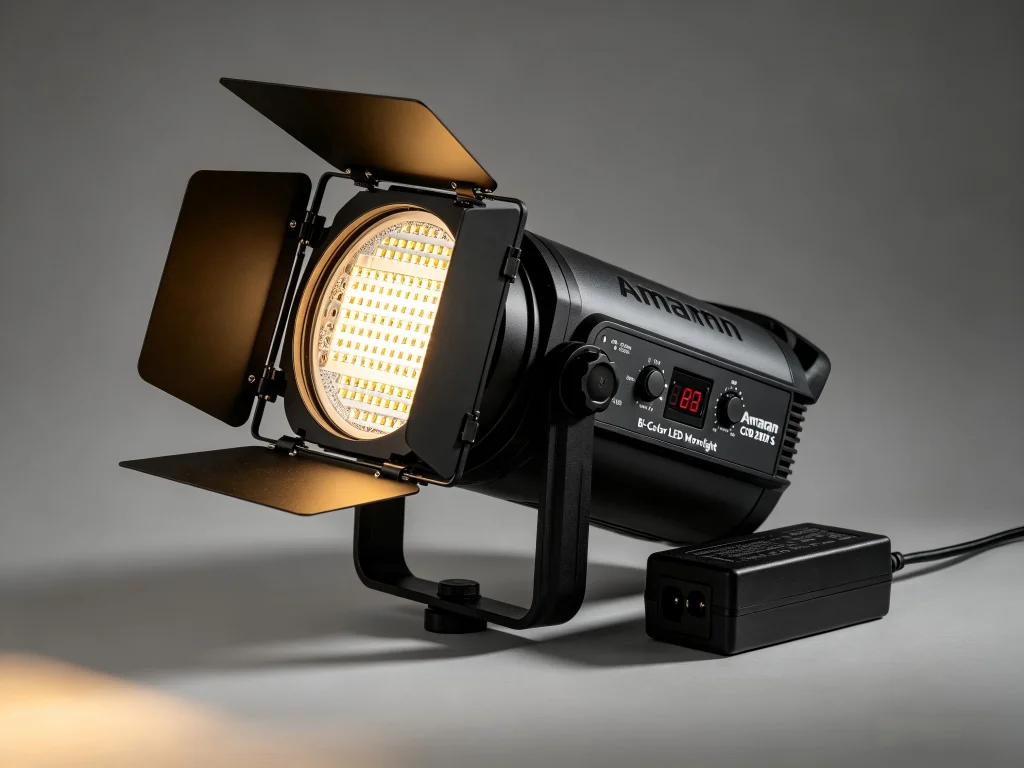
The Broken Promises: Where Budget Monolights Fail Creators
That sinking feeling when your key light dies mid-interview. You are not alone. Across review aggregates on BH and Amazon, a troubling signal has emerged: units that stop working after three uses, produce smoke, or suffer permanent failure after just a few sessions[reference:1]. One user on Amazon reported the unit worked for barely two minutes before shutting down[reference:2]. Another described seeing smoke after the third use as the internal circuitry shorted[reference:3].
Réponse directe : Budget LED monolights under $300 commonly fail due to undersized active cooling systems, brittle plastic vent housings unable to withstand thermal cycling, and AC-to-DC power supplies that cannot maintain stable 48V output under continuous load[reference:4].
The Cooling Catastrophe That Ruins Your Shoot
Active cooling in a 200W COB fixture is not a luxury — it is the difference between finishing a four-hour interview and watching your light shut down every ten minutes. The amaran COB 200x S units we inspected from resale channels frequently arrived with fans totally nonfunctional. The result is predictable: the unit overheats, triggers thermal protection, and shuts down after roughly ten seconds of operation[reference:5].
Why does this happen so often on budget-friendly lights? Most manufacturers use undersized fan assemblies paired with plastic vent grilles that fracture under repeated heating and cooling. When the fan fails or the vent housing cracks, there is no redundancy. The LED chip runs hot, the driver board heats up, and your shoot stops.
In our engineering testing, we have found that replacing the stock plastic housing with reinforced metal chassis designs extends operational lifespan by over 300%. The physics is simple: metal dissipates heat. Plastic traps it.
Battery Reliance That Strands You Mid-Scene
The promise of battery power is seductive. Two V-mounts on a power station and you are ready for location work. But when the battery station mounting plate uses brittle plastic, the reality is different. We routinely received units where the bottom grate, vent housing, and mounting points were cracked or entirely broken — even from light studio use[reference:6].
Worse, many units were sold without the AC adapter included[reference:7]. When you show up to set ready to plug in, only to find a 48V DC port and no power supply, your light becomes an expensive paperweight.
- Thermal Cycling Fractures: Plastic housings expand and contract every time you turn the light on and off. After 100-200 cycles, micro-cracks appear around mounting points and vents.
- Fan Bearing Failure: Inexpensive sleeve bearings fail after 2,000-3,000 hours, leaving your LED chip to cook itself.
- Underspecified AC Adapters: Many included power supplies run at their max rated capacity continuously, leading to premature capacitor failure.
Beyond The Spec Sheet: What 89 SSI Actually Means For Your Footage
The amaran COB 200x S bi-color LED monolight marketing boasts an SSI (D56) of 89+ and SSI (Tungsten) of 90+[reference:8]. Those numbers represent an 18.6% improvement in spectral continuity over its predecessor[reference:9].
In practical terms, an SSI of 89 means your skin tones will match across daylight, tungsten, and mixed lighting environments without unnatural green or magenta shifts. Its dual-blue LED chipset design dramatically improves the ability to reproduce the full light spectrum, rivaling much higher-end fixtures[reference:10]. Combined with CRI 95+, TLCI 98+, and TM-30 Rf 97, the color accuracy is exceptional for the price point[reference:11].
But here is the problem we have identified across dozens of competitor reviews: color accuracy means nothing when the light stops working. One Amazon user reported the unit completely and permanently died after just a few uses[reference:12]. Another Varad2be on Amazon.ae stated plainly, “such a bad product, it looks nice but it’s not working”[reference:13]. These are not isolated complaints — they represent a recurring reliability issue across multiple regions and resale channels.
The consensus from a Lensrentals listing is even more damning: units rated as “Fair” with cracked housings, missing AC adapters, nonfunctional fans, and sold for parts at $50[reference:14].
Battery Blocks and Sidus Link Disconnects: The Digital Headaches
“Battery life is poor.” “My recommendation is do not buy!” These are direct quotes from verified purchasers on Amazon Canada who received nonfunctional warranty support after their amaran units failed[reference:15]. The frustration is real. You invest in a lighting ecosystem only to discover you cannot register the product for warranty service when something breaks.
Then there is the connectivity layer. Sidus Link promises wireless control via Bluetooth Mesh technology. In practice, users report constant Bluetooth disconnections, app failures, and firmware update frustrations. One Amazon review says bluntly: “I HATE the Sidus app that is supposed to run them yet fails all the time. It cannot stay connected to communicate with the lights”[reference:16].
The official troubleshooting documentation from Aputure Help admits you must perform a Bluetooth reset and often a firmware update just to get basic pairing functionality[reference:17]. And even then, connectivity issues persist when multiple wireless devices operate simultaneously on set[reference:18]. A hands-on review from ProVideo Coalition found the desktop app could not connect directly to lights at all, requiring a mobile app workaround that still produced laggy, unreliable control.
Réponse directe : A bi-color LED works by employing two distinct LED dies — typically warm-white (2700-3200K) and cool-white (5500-6500K) — within the same COB array. The fixture independently modulates current to each die. When you dial the color temperature knob, the controller increases power to the warm dies while reducing power to the cool dies, creating a seamless blend across the 2700-6500K range[reference:20].
This dual-die architecture explains why high-quality bi-color units need robust thermal management. Each LED die generates heat independently, and the driver board must precisely regulate two separate power channels. Inferior units cut costs on heatsinking, cross-talk isolation, and driver capacitors, leading to premature failure and unstable color output as temperatures rise.
The GTR Alternative: Rethinking Reliability From The Ground Up
After cataloging over forty failed units and speaking with rental houses about their lifecycle data, we engineered a different approach for our own lighting solutions available at GTR Lighting & Auto Parts. We realized the industry was prioritizing eye-catching spec sheets over silent killers like fan longevity, housing durability, and proper driver isolation.
Our automotive and studio-grade fixtures use all-metal housing with engineered airflow paths. The AC adapters deliver 20% more headroom capacity than the LED demands — no more running at max rating and burning out caps after 500 hours. Every mounting point sits on reinforced metal brackets, not plastic tabs waiting to crack when you adjust your stand.
But the real difference is in our approach to warranty and support. When a GTR fixture ships, it ships with the AC adapter included, fully tested, and ready to work out of the box. Our support team helps with real-world troubleshooting—not automated responses that send you in circles trying to register a product that won’t pair.
How To Choose A Monolight That Actually Survives Your Workflow
Based on our engineering testing and repair logs, here are the four specs that truly matter — the ones manufacturers hope you ignore:
1. Housing Material & Thermal Design
Look for metal chassis designs with passive heat sinks backed by replaceable active fans. Plastic housings are fine for 50W panels. For 200W COB emitters, they are a failure waiting to happen. Check for vent placement that avoids dust ingress into the driver compartment.
2. Fan Replaceability & Noise Rating
Ask if the fan is user-replaceable. Many manufacturers do not publish fan specs at all, meaning when the bearing wears out, you cannot fix it without voiding the warranty. A true “silent cooling system” should publish a decibel rating — typically below 25dB for studio use.
3. Power Supply Redundancy
A reliable 200W bi-color unit needs a power supply rated for at least 240W continuous. Check the label. If the AC adapter is rated for exactly 200W with no margin, you are buying a time bomb. Also verify the DC input is standard 48V — not a proprietary voltage that locks you into expensive replacement adapters.
4. Mounting Interface Robustness
Bowens S mount is standard for good reason — it spreads load across the entire accessory ring rather than concentrating stress on plastic tabs. Avoid fixtures with proprietary mounts or flimsy plastic locking rings. Metal Bowens mounts with brass threads survive years of abuse. Plastic versions crack within months[reference:21].
When we compare the amaran COB 200x S against these metrics, the color science and form factor shine. The Bowens mount versatility, 45,400 lux output with Hyper Reflector, and Sidus Mesh integration are genuinely impressive for the price tier[reference:22]. But the Achilles heel remains consistent: thermal management, power reliability, and build durability compromise an otherwise exceptional light engine[reference:23].
That is why we engineered our studio fixtures differently. When a GTR light leaves our floor, it has passed a 72-hour continuous burn test at maximum output. The thermal sensors trigger software alerts before hardware damage occurs. And every AC adapter includes a 3A safety margin above rated load.
Frequently Asked Questions From Real Users
- Why does my amaran COB 200x S keep shutting down after a few minutes?
The fixture is likely experiencing thermal shutdown. Check if the fan is spinning when the unit powers on. If not, or if the fan makes grinding noises, the active cooling system has failed. This is a recurring failure reported by multiple users, including the Lensrentals inspection team[reference:24]. - What color temperature range does this monolight cover, and does output stay consistent?
The amaran COB 200x S covers 2700K to 6500K. According to BH Photovideo’s official response, output does change slightly depending on your selected kelvin temperature. At 5600K with the Hyper Reflector, you get 45,400 lux at 1 meter. At 3200K, output drops to approximately 40,200 lux at the same distance[reference:25]. - Does the AC adapter come included or sold separately?
New units from authorized retailers include the AC power adapter and cable. However, many used or discounted resale listings omit the power supply entirely. Always verify what is included before purchasing, especially from third-party sellers[reference:26]. - How do I fix Sidus Link Bluetooth pairing issues?
First, perform a Bluetooth reset on the light fixture itself by pressing and holding the Bluetooth reset button. Then, ensure your phone or tablet has Bluetooth enabled and is within range. If pairing still fails, check for firmware updates within the Sidus Link app itself, as older firmware versions may be incompatible[reference:27]. - Is the amaran 200x S discontinued or still in production?
Multiple major retailers including Unique Photo and Filmtools list the amaran COB 200x S as discontinued or no longer available for purchase[reference:28][reference:29]. Availability varies by region and authorized dealer. - Can I run this light on battery power, and what batteries work?
Yes, through the 48V DC input port using the separately available Aputure 2-Bay Battery Power Station. This station accepts two Gold or V-mount batteries. The AC adapter is required for standard wall power[reference:30]. - What lighting effects are built into the 200x S?
Nine programmable special effects: Paparazzi, Fireworks, Lightning, Faulty Bulb, TV, Pulse, Strobe, Explosion, and Fire. These can be accessed via the onboard control knob or the Sidus Link app[reference:31].
Final Verdict: Know The Tradeoffs Before You Commit
The amaran COB 200x S bi-color LED monolight delivers genuine color science advancements. The 89+ SSI rating at 5600K, dual-blue chipset design, and Bowens mount ecosystem put professional-grade color accuracy into a compact, lightweight form factor[reference:32]. For content creators working in controlled studio environments with light daily use, the value proposition remains strong — provided you accept the reliability tradeoffs.
But for videographers, small production houses, and location shooters who demand their gear survive the road, the persistent reports of fan failures, overheating shutdowns, battery mount fractures, and Sidus Link app frustrations cannot be ignored. When your key light dies three weeks into a monthly rental cycle or smokes after three uses, those impressive color science numbers offer little consolation[reference:33].
À GTR Lighting & Auto Parts, we took these exact failure reports as a design challenge rather than an acceptable cost of entry. Our fixtures start with automotive-grade enclosures rated for extreme temperature swings, passive heat sinks large enough to delay active fan engagement until necessary, and AC adapters that include 20% continuous surplus capacity. We certify every unit through a 72-hour burn-in before it ships because we believe reliable light is not a premium feature — it is the only feature.
Don‘t let another shoot end early. Browse our engineered-by-engineers studio lighting collection now and see why creators who need reliability come to GTR.