The LED headlight market is flooded with options. Prices range from $30 to $300. Claims range from believable to absurd. And somewhere in that noise, you have to make a decision that affects your safety every time you drive at night. This guide cuts through the marketing. Based on our years of manufacturing expertise and independent testing data, here is what actually matters—and what is just noise.
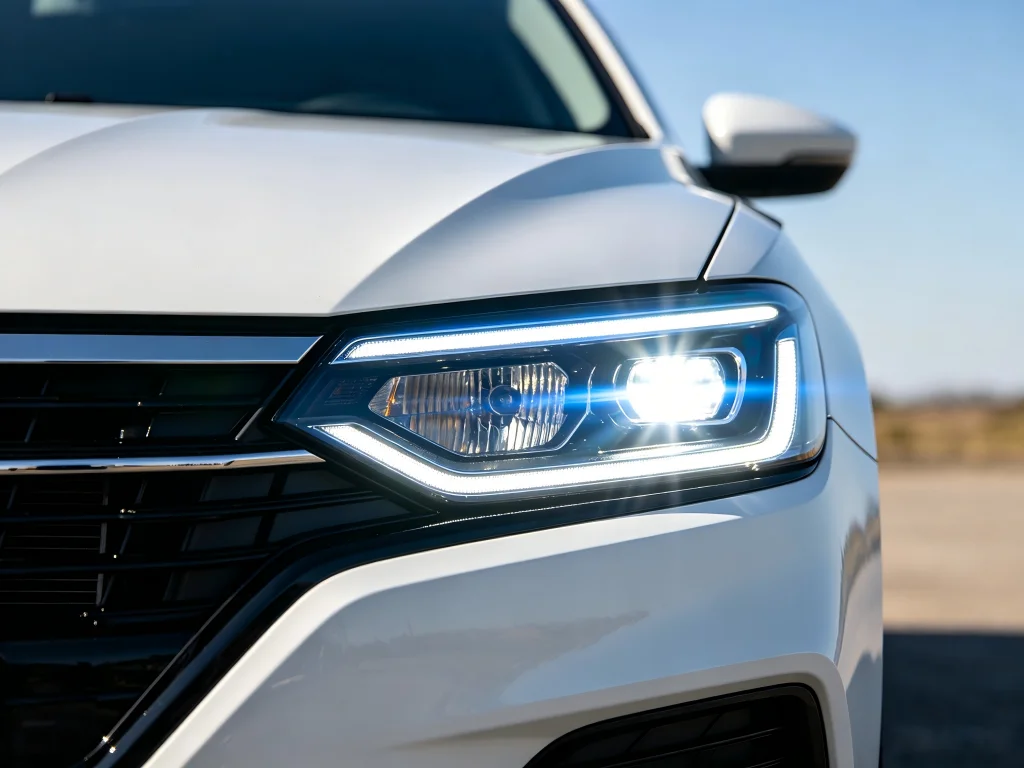
The Four Factors That Determine LED Headlight Performance
Four engineering variables separate excellent LED headlights from disappointing ones: chip positioning accuracy, thermal management design, CANbus compatibility, and beam pattern quality. A bulb can claim massive lumen output and still fail completely if any one of these factors is neglected. Understanding how they interact is the key to making a smart purchase.
Factor 1: LED Chip Positioning—The Most Critical Specification
Your headlight housing was designed for one specific light source: a halogen filament. That filament is approximately 1.6mm wide and emits light from a single central point in a 360-degree sphere. Reflectors and projectors are curved surfaces engineered to capture that exact point source and shape it into a controlled beam.
LED chips are fundamentally different. They are flat diodes that emit light directionally, not spherically. When an LED bulb is inserted into a halogen housing, the light source must occupy the same physical position as the filament it replaces. If the chips sit even 1mm too high, too low, or off-center, the beam pattern breaks down.
The result of misalignment: scattered light that blinds oncoming drivers, dark spots directly in front of your car, and a light output that feels dimmer than your old halogens despite the “brighter” specs.
ما الذي تبحث عنه: Manufacturers who publish beam pattern photos and explicitly state that their LED chips are positioned to 1:1 tolerance with the original halogen filament. If they do not mention positioning, they have not solved this problem.
Factor 2: Thermal Management—Why Bright Lights Get Dim
LEDs are more efficient than halogens, but they are not immune to heat. The critical difference is where the heat goes. Halogen bulbs radiate heat forward through the lens. LED bulbs generate heat at the chip junction and project it backward into the bulb base and driver circuitry.
When this heat is not managed, LED performance degrades in a process called thermal throttling. The bulb’s driver circuit reduces power to protect the chips from damage. Your $150 “high-output” LED bulbs gradually dim to half their rated brightness after twenty minutes of driving. You may not even notice the change—until you realize you can no longer see the road as well as you did at startup.
Thermal management approaches vary in effectiveness:
| طريقة التبريد | كيف يعمل | Limitations |
|---|---|---|
| Passive Heat Sink | Aluminum fins dissipate heat through surface area | Less effective in enclosed housings; can be bulky |
| تبريد نشط بالمروحة | Integrated fan moves air across heat sink | Fan can fail from dust/moisture; adds noise |
| Thermal Separation (TST) | Physically isolates LED die from driver circuit | Advanced engineering; not available in budget bulbs |
GTR’s Thermal Separation Technology takes a different approach. Instead of relying solely on a heat sink or fan to remove heat after it spreads, TST physically separates the heat-generating LED die from the temperature-sensitive driver circuit. This prevents the heat from reaching the components that trigger throttling. In testing, GTR Ultra 3.0 bulbs retained 87% of initial output after 27 minutes of continuous operation—a performance level that most competitors cannot match.
Factor 3: CANbus Compatibility—Avoiding Dashboard Errors
Modern vehicles monitor their lighting circuits. The computer expects to see the electrical signature of a 55-watt halogen bulb. When you install an LED bulb that draws only 20–40 watts, the system may interpret the lower draw as a burnt-out bulb.
The symptoms vary by vehicle: dashboard error messages, flickering headlights, bulbs that turn on and immediately shut off, or hyper-flashing turn signals.
How to avoid this problem:
- Choose LED bulbs with built-in CANbus compatibility rather than requiring separate adapter purchases.
- Verify the bulb’s voltage operating range. GTR Ultra 3.0 operates from 9–40V DC, covering a wide range of vehicle electrical systems.
- If your vehicle is particularly sensitive (many European models and newer domestic trucks), look for reviews from owners of the same make and model.
Cheap LED bulbs often leave CANbus compatibility as an afterthought. You discover the flickering problem after installation, then have to order additional modules that may or may not solve the issue. Quality bulbs include this engineering from the start.
Factor 4: Beam Pattern vs. Lumen Claims—The Marketing Trap
The single biggest mistake buyers make is choosing bulbs based on lumen ratings. A bulb claiming 20,000 lumens sounds impressive. But raw lumens measure light produced, not light delivered to the road. A bulb with perfect beam pattern and moderate output will always outperform a high-lumen bulb with scattered light.
What actually matters is effective light output—the amount of usable illumination that lands on the road surface in front of you. This is determined by how well the bulb’s light source aligns with the housing optics, not by the number on the box.
When evaluating any LED headlight, ask these questions:
- Does the manufacturer provide beam pattern photos on a wall or road?
- Do reviews mention glare or scattered light?
- Is there a sharp cutoff line with light concentrated below it?
A clean beam pattern with a sharp cutoff means the light is going where it should—on the road, not into the eyes of oncoming drivers and not into the trees.
GTR vs. Generic LED Bulbs: A Direct Comparison
Not all LED headlights are engineered to the same standard. The difference between a GTR bulb and a generic marketplace option is not just branding—it is measurable in every factor that matters.
| الميزة | GTR Ultra 3.0 | Typical Generic LED |
|---|---|---|
| LED Chip | Custom TST 7045 with thermal separation | Off-the-shelf CREE or Philips clones |
| Filament Matching | Digitally optimized 1:1 positioning | Approximate; often misaligned |
| التصميم الحراري | TST + active cooling | Basic heat sink or no cooling |
| CANbus | Built-in, wide voltage range | Often requires separate module |
| الضمان | Lifetime limited | 30–90 days |
| Output Stability | 87% retained after 27 min | Significant dimming under heat |
The price difference between GTR and generic options reflects real engineering. A $40 LED bulb that fails in three months is not a bargain—it is a waste of money and time. A quality bulb that works for the life of your vehicle is the better investment.
Installation: What to Expect
One advantage of modern LED bulbs is simplified installation. GTR Ultra 3.0 is designed for plug-and-play fitment in most vehicles. The compact body allows installation in tight housings where bulkier LED bulbs cannot fit.
Before installing any LED bulb:
- Test the bulb before fully reassembling the housing. Verify that it lights up without flickering and that the vehicle does not show error messages.
- Check the beam pattern against a wall. Park facing a flat surface and observe the light distribution. You want a sharp horizontal cutoff with even light below it.
- Ensure the dust cover can be reinstalled. Some LED bulbs with large heat sinks prevent the factory dust cover from sealing, which allows moisture into the housing.
الأسئلة المتداولة
Are expensive LED headlights worth it?
Yes, if you value consistent performance and longevity. Cheap LED bulbs often dim rapidly, fail within months, and provide poor beam patterns. Quality bulbs with proper thermal engineering and filament positioning deliver usable light for years and are backed by meaningful warranties.
Can I install LED bulbs in projector and reflector housings?
Yes, but performance varies. Projector housings generally produce sharper beam patterns with LED upgrades. Reflector housings are more sensitive to chip positioning. GTR bulbs are engineered to work in both types when properly positioned.
Why do my LED headlights dim after driving for a while?
This is thermal throttling. The bulb’s driver circuit reduces power when temperatures rise. It indicates inadequate thermal management. GTR’s TST design minimizes this effect by keeping heat away from sensitive components.
Do LED bulbs require special adapters for my vehicle?
GTR bulbs are designed for direct fitment in most applications. However, some vehicles have proprietary bulb retainers that may require an adapter. Check compatibility for your specific make and model before purchasing.
Make the Right Decision the First Time
The LED headlight market rewards research. Buyers who understand filament positioning, thermal management, and beam pattern quality end up with products that transform their night driving. Buyers who chase lumen numbers and low prices end up with flickering, dimming disappointments.
GTR has been engineering LED lighting solutions for years. Our products are tested, warranted for life, and trusted by drivers who have tried the alternatives and learned the difference. If you are ready to upgrade your vehicle’s lighting with a product that works as engineered—not just as advertised—we are ready to help.
Choose the GTR LED headlight that fits your vehicle. Visit rhgtr.com →