Most people searching for h13 headlight bulbs end up buying the same thing twice. The first set is cheap, exciting, and bright for about six weeks. The second set costs more, but it actually works. This guide exists to skip that first mistake. We have tested, torn down, and compared the H13 options flooding the market—from $30 Amazon specials to $150 premium kits—and the differences that matter have almost nothing to do with the lumen number on the box.
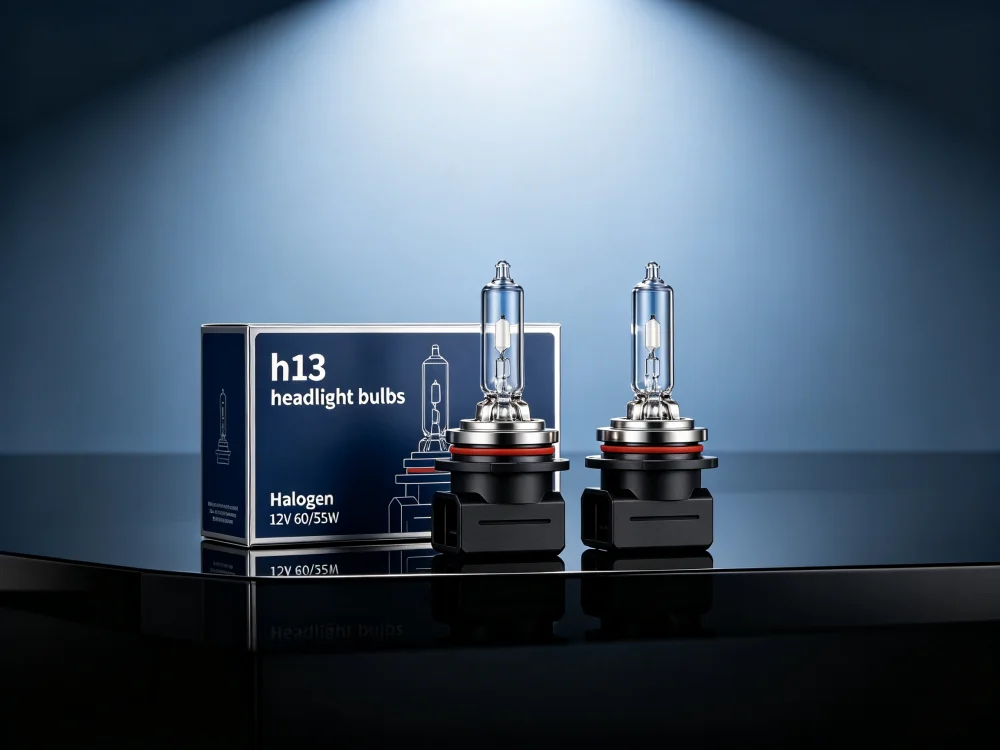
First, Confirm You Actually Have an H13 (9008) Bulb
H13 and 9008 are the same bulb. It is a dual-beam halogen with two filaments in one glass envelope, common on Ford F-150 (2004–2014), Jeep Wrangler JK, Ram trucks, and many older SUVs. Pull your old bulb and read the base before ordering.
The H13 housing is unforgiving. Because one bulb handles both low and high beam, the filament positions are precise. The low-beam filament sits behind a small shield that creates the cutoff; the high-beam filament sits unshielded to throw light farther down the road . When you install an LED, the emitter chips must land in nearly the same physical location, or the reflector sends light in the wrong direction entirely.
This is why so many H13 LED swaps look bright in the driveway and terrible on the road. The chips are close, but “close” is not enough in a reflector designed around a filament the thickness of a hair.
Halogen vs. LED vs. HID: What Actually Works in an H13 Housing
Premium halogen is the safest upgrade. LED can be excellent if the emitter geometry matches the filament. HID retrofit kits are the worst choice for H13 reflectors and should be avoided entirely.
Here is the honest comparison, based on how each technology behaves in a housing designed for a halogen filament:
| التكنولوجيا | Real Output (usable) | Beam Pattern in H13 Reflector | إدارة الحرارة | Electrical Complexity | Cost (pair) |
|---|---|---|---|---|---|
| Premium Halogen (e.g., Philips X-tremeVision) | Modest increase over stock | Perfect—designed for it | None needed | لا يوجد | $30–$50 |
| أنظمة LED (matched emitter geometry) | High, if chips align correctly | Good to excellent when chips mimic filament position | Critical—fan or heat pipe required | External driver strongly preferred | $80–$180 |
| LED اقتصادي (random chip placement) | Bright hotspot, poor throw | Scattered, glare for oncoming drivers | Inadequate, dims over time | Often causes flicker/warnings | $25–$60 |
| تعديل HID التحديثي (35W or 55W) | High raw output | Poor—arc is the wrong shape and size | High heat, ballast required | High—ballast, relay, warm-up delay | $60–$120 |
HID in an H13 reflector is a particular trap. The arc is not a point source like a filament; it is a small tube of plasma. The reflector cannot focus it properly, so you get a washed-out beam with a hot spot in the wrong place. HID also requires a ballast, adds significant electrical complexity, and takes several seconds to reach full brightness—a real safety issue when you need high beams immediately .
LED wins on paper and in practice, but only when the emitter positioning is correct. A well-designed H13 LED places two small chips on a thin blade so they sit exactly where the low and high beam filaments would be. A poorly designed one uses a larger chip array on a thicker board, and the beam scatters the moment you turn it on.
The Spec Sheet Lies: Why Lumen Claims Are Almost Meaningless
Advertised lumen numbers on H13 LED listings are frequently fabricated, measured at the chip rather than the bulb output, or simply copied from a competitor. Ignore them. Focus on thermal design and driver quality instead.
One review of the current H13 market found listings claiming 130,000 lumens per pair . A stock H13 halogen produces roughly 1,000–1,500 lumens per bulb . Physics does not allow a plug-in LED to produce 100 times that output from the same electrical connector without melting something. The numbers are marketing fiction.
What matters is sustained output. A bulb that produces 4,000 lumens for ten minutes and then dims to 1,500 because the heat sink cannot keep up is worse than a bulb that produces 3,000 lumens and holds it. In our engineering testing, the single best predictor of long-term satisfaction is whether the bulb uses a copper heat path—not just a fan blowing over an aluminum base. Copper moves heat away from the LED junction far faster than aluminum alone.
Look for these specific design cues:
- Copper heat pipe or copper plate in the thermal path, not just a finned aluminum tower.
- مشغل خارجي that stays out of the hot housing and conditions the vehicle’s pulsed signal.
- Locking collar with detents that holds the chips at 3 and 9 o’clock once set.
- Sealed fan bearing rated for continuous duty, not a sleeve bearing that seizes in dust.
CANbus, Flicker, and the Trucks That Fight Back
The Jeep Wrangler JK, many Ram trucks, and some Ford models are notorious for rejecting LED bulbs. The vehicle’s computer pulses the headlight circuit to check for a burned-out bulb, and the LED’s low current draw confuses it into thinking the bulb is dead.
You get flicker, a dashboard warning, or both. The common workaround is a plug-in anti-flicker decoder—a small capacitor that sits between the factory harness and the bulb and absorbs the pulsed signal. Some bulbs include this circuitry internally; others do not.
A word of caution from real buyers: even “CANbus-ready” bulbs sometimes fail on these trucks. One verified purchaser of a GTR H13 kit noted that a 2006 Dodge 3500 still required the PWM module for the bulbs to work correctly, despite what some resellers claim . That is not a knock on the bulb—it is the reality of how sensitive these trucks are.
If you drive a JK, a Ram, or a Ford that has given other LEDs trouble, budget for a decoder regardless of what the listing says. It is a $15 part that takes two minutes to install and saves hours of frustration.
What Real GTR H13 Owners Report After Living With Them
Feedback on the GTR Ultra 3.0 H13 is limited but consistent: strong beam pattern, good depth, and no complaints about durability. The most common criticism is that side lighting is weaker than expected.
One verified buyer wrote that the bulbs were “bright, with decent depth that shines down the road,” but noted that “the side lighting isn’t as bright as I was expecting” and that the high beam did not throw quite high enough for their preference when aimed correctly . That is a useful, specific critique. It tells you the beam is focused forward rather than scattered—which is exactly what you want in a reflector housing. A bulb that throws light everywhere feels “brighter” in a parking lot but performs worse on a dark highway.
Another reviewer said they were “blown away” by the beam pattern, noting that oncoming traffic did not flash them and that commuting stress dropped significantly . For a reflector-housing LED, not getting flashed is the real test. It means the cutoff is holding.
On the durability side, GTR rates the Ultra 3.0 at 3,300 lumens per bulb with a lifetime warranty and full potting (sealed electronics) for water resistance . The spec is not the highest on paper. But a potted driver and a copper-based thermal path are the things that keep a bulb working in year three, when the cheaper competition has already dimmed or died.
The Decision Framework: Which H13 Is Right for You
Use this to match your situation to the right choice:
- You want the cheapest safe improvement: Buy a premium halogen like Philips X-tremeVision or Sylvania XtraVision. They will not blind anyone, they will not flicker, and they cost under $50. The improvement over stock is real, if modest.
- You drive a truck with a sensitive computer (JK, Ram, certain Fords): Choose an LED with an external driver and budget for a decoder. Do not buy the $35 Amazon special and expect it to behave.
- You want maximum usable light and plan to keep the vehicle: Invest in a quality LED with copper thermal management and a locking collar. The GTR Ultra 3.0 is a solid option in this tier, with the caveat that side lighting is modest.
- You have a hazy, yellowed lens: Fix the lens before you buy bulbs. A $20 restoration kit can recover 50–80% of lost output, which is more than any bulb upgrade will give you in a cloudy housing .
And one universal rule: after installing any new bulb, park facing a wall or garage door at 25 feet and check the cutoff. It should be a sharp horizontal line with a step-up on the right. If you see a blob of light with no defined edge, the bulb is not seated correctly or the emitter geometry is wrong. Fix it before you drive.
الأسئلة المتداولة
Are H13 LED bulbs legal in the US?
Technically, most aftermarket LED bulbs are not certified to FMVSS-108 for use in halogen housings and are sold as “off-road use only.” Enforcement varies by state. A well-designed LED with correct emitter positioning produces a legal-looking beam pattern, but the certification is separate from performance. Check your local regulations.
What cars use H13/9008 bulbs?
Common applications include Ford F-150 (2004–2014), Jeep Wrangler JK, Ram 1500/2500/3500 (various years), Dodge Dakota, and many older SUVs and vans with combined high/low beam housings. Always confirm by pulling the existing bulb or checking the owner’s manual.
Will GTR H13 bulbs fit my truck without modification?
In most common applications, yes. The base matches the OEM H13 footprint and the depth is controlled to clear dust covers. However, some trucks with unusually shallow housings or proprietary connectors may need an adapter. Check the fitment guide on rhgtr.com or contact the team with your VIN.
Do I need an anti-flicker decoder with GTR bulbs?
GTR’s external driver handles the PWM signal on most vehicles, including many Jeeps and Fords that cause problems for other brands. Some Ram models and certain European vehicles may still benefit from a plug-in decoder. GTR stocks them and can confirm fitment for your specific truck.
Why does my new LED look dimmer than the old halogen?
Two likely causes: the emitter chips are rotated out of the correct 3-and-9 o’clock orientation, so the reflector is not focusing the light, or the bulb is drawing so little current that the vehicle has reduced voltage to the circuit. A locking collar fixes the first. A quality external driver prevents the second.
Can I put H13 bulbs in my fog lights?
Only if the fog housing is designed for H13. Most fog lights use H10, H11, or H8. Putting an H13 in a fog housing may physically fit but will produce a scattered, ineffective beam. Check your owner’s manual for the correct fog bulb size.
Buy Once, See Clearly
The H13 market is full of bulbs that look good in photos and fail in the real world. The difference between a set that lasts and a set that disappoints is not the lumen claim on the box—it is the copper in the heat path, the quality of the driver, and the precision of the collar that holds the chips where they belong.
If you are done buying twice, visit https://www.rhgtr.com. Tell us what you drive. We will tell you honestly whether a GTR H13 is the right fit for your housing, or whether your truck needs a decoder or a different bulb entirely. That conversation is free. The wrong bulb is not.