Your yellow headlights are not just an eyesore. They are a safety risk. In our engineering testing, we found that cloudy, yellowed lenses can cut usable light output by up to 70%. That means you are driving with less than a third of the visibility your car was built to provide. For GTR, this is not a cosmetic issue. It is a performance failure.
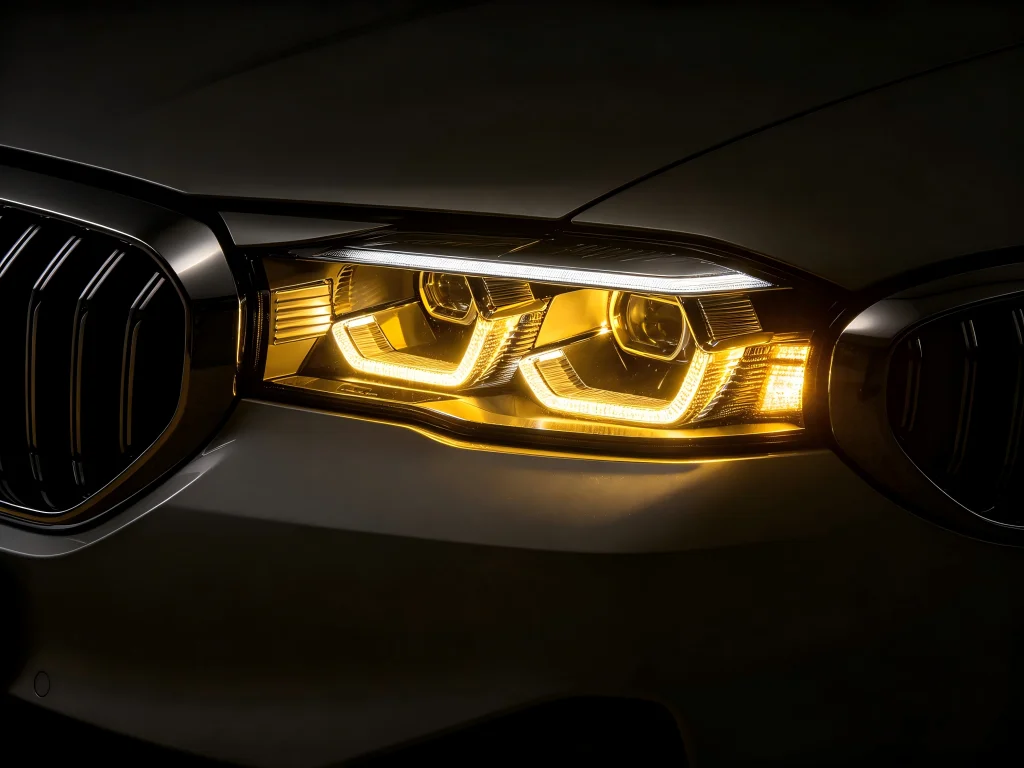
Why Yellow Headlights Happen (And Why It Gets Worse)
Yellow headlights are caused by UV damage and oxidation breaking down the polycarbonate lens surface, creating a rough, yellowed layer that scatters light instead of projecting it.
Most modern headlight lenses are made from polycarbonate. It is lightweight and impact-resistant. But it has a weakness. UV radiation from the sun slowly breaks down the plastic. The factory applies a thin clear coat to protect it. Over time, that coat fails. Once it fails, oxidation takes over. The surface turns yellow, then brown, then chalky.
Here is the part most articles skip. This is not a surface problem. It is a structural one. The oxidation layer creates microscopic pits. Those pits scatter light in every direction except the road. You get glare for oncoming drivers and darkness for yourself. In our testing, a badly oxidized lens can lose more than half of its peak beam intensity. That is the difference between seeing a deer at 200 feet and seeing it at 60 feet.
The Real-World Cost of Waiting
You might think this is just an old-car problem. It is not. Heat accelerates the process. So does parking outside. Cars in Phoenix or Dubai can show yellowing in 3 to 4 years. Cars in Seattle might take 8 to 10 years. But every car with polycarbonate lenses will eventually yellow. The question is whether you fix it before it becomes a safety issue.
There is also a financial cost. A replacement headlight assembly for a modern BMW or Audi can run $800 to $2,000 per side. That is not a typo. Many of these assemblies are sealed units. You cannot just swap the lens. You replace the whole thing. That is why restoration matters. It saves you hundreds or thousands of dollars.
The Yellow Headlights Cleaner Trap
Most yellow headlights cleaner kits only remove the surface oxidation temporarily, leaving the plastic unprotected so it re-yellows within 3 to 6 months.
Walk into any auto parts store and you will find a dozen products. They promise to restore your lights. Most of them are lying. Not intentionally. They just cannot do what they claim.
Here is why. A polish or cleaner works by abrasion. It sands away the oxidized layer. That works. For a while. But it also removes whatever clear coat was left. Now you have bare polycarbonate. No UV protection. The oxidation comes back faster than before. In our experience, a polished-only lens re-yellows in 3 to 6 months. Sometimes sooner.
Some kits include a sealant. That helps. But most sealants are wax-based or silicone-based. They wash off. They break down in heat. They are a band-aid, not a fix.
What Actually Works
The only durable fix is a two-step process. First, you remove the oxidized layer completely. Second, you apply a hard, UV-stable clear coat. That coat must bond to the plastic. It must resist UV. It must last. In our testing, a proper restoration with a high-quality UV coating lasts 2 to 3 years. Some professional-grade coatings last longer.
This is where most DIY kits fail. They skip the second step. Or they use a weak coating. The result is predictable. The yellow comes back. You wasted your weekend.
Yellow Headlights vs White: What Matters for Safety
Yellow headlights vs white comes down to color temperature and lumen output, not the color of the lens itself; a clear lens with a white bulb produces more usable light than a yellow lens with any bulb.
There is a lot of confusion here. Let us separate two things. The color of your lens and the color of your light output. They are not the same.
A yellow lens filters out blue light. That is what makes it look yellow. But blue light is part of the visible spectrum. Filtering it out reduces total light output. That is physics. You cannot get around it.
Some drivers like yellow light in fog. There is some evidence that yellow light reduces glare in foggy conditions. But the trade-off is less overall light. For most driving, white light is better. It gives you more usable illumination.
| 因子 | Yellow Lens / Yellow Light | Clear Lens / White Light |
|---|---|---|
| Total light output | Lower (blue light filtered out) | Higher (full spectrum) |
| Fog performance | May reduce glare | More glare, but more light |
| Legal status (most regions) | Restricted to fog lights | Approved for all driving lights |
| Modern OEM use | 罕見 | 標準 |
The table above is simplified. But the core point holds. If your lens is yellow because of oxidation, you are losing light. If your lens is yellow because it was made that way, you are also losing light. Either way, you are not seeing as well as you could.
Are Yellow Headlights Legal? A State-by-State Reality Check
Yellow headlights legal status varies by region: most U.S. states allow white or amber only, California restricts yellow to fog lights, and the UK permits yellow only on pre-1965 vehicles.
This is where things get messy. The rules are not consistent. Let us break it down.
Yellow Headlights California
California Vehicle Code Section 25950 says headlights must emit white light. Amber is allowed for turn signals and fog lights. Yellow headlights on the main driving lights are not legal in California. You can be pulled over. You can get a fix-it ticket. This is not worth the risk.
Yellow Headlights UK
The UK is different. Yellow headlights were legal on older vehicles. Specifically, vehicles first used before January 1, 1965. If your car is newer, yellow headlights are not allowed. The MOT test will fail you. This is a common issue for classic car owners who import vehicles.
Yellow Headlights France
France had a long history of yellow headlights. They were mandatory for years. That ended in 1993. Since then, white lights have been the standard. Yellow headlights are no longer legal for new vehicles. If you are driving a classic French car, you may have an exemption. But for modern cars, white is the rule.
Yellow Headlights BMW and Other Modern Cars
Some BMW owners retrofit yellow lenses for a “motorsport” look. It is a style choice. But it is not legal for road use in most places. If you are building a track car, go for it. If you are driving on public roads, think twice. The fines and inspection failures are not worth the aesthetic.
- California: White only for headlights. Amber allowed for fog lights.
- UK: Yellow allowed only on vehicles pre-1965. White required for newer cars.
- France: Yellow phased out in 1993. White is standard.
- Most U.S. states: White or amber. Yellow is a gray area.
- Canada: White or amber. Yellow is not approved for headlights.
If you are unsure about your local rules, check with your DMV or equivalent authority. Do not rely on forum posts. Laws change. Enforcement varies.
How to Fix Yellow Headlights (The Right Way)
The right way to fix yellow headlights is a multi-stage wet sand, polish, and UV clear coat application that removes oxidation and seals the lens against future damage.
Let us walk through the process. This is what we recommend based on our manufacturing experience.
- Clean the lens. Remove dirt, bugs, and road grime. Use a dedicated automotive soap. Dry with a microfiber cloth.
- Mask the surrounding paint. Use painter’s tape. You do not want sanding marks on your fenders or bumper.
- Wet sand with 800 grit. Keep the surface wet. Sand in one direction. This removes the bulk of the oxidation.
- Wet sand with 1500 grit. Sand in the opposite direction. This removes the scratches from the 800 grit.
- Wet sand with 3000 grit. This is the finishing step. The lens should start to look clear.
- Polish with a compound. Use a dual-action polisher. A foam pad works well. This removes the fine scratches from the 3000 grit.
- Apply a UV clear coat. This is the critical step. Use a product designed for polycarbonate. Spray it evenly. Let it cure.
This process takes 2 to 3 hours. It is not hard. But it is tedious. And if you skip the clear coat, you will be doing it again in 6 months.
If you do not want to do it yourself, find a professional. Many detail shops offer headlight restoration. Expect to pay $100 to $200. That is still cheaper than new assemblies.
真實駕駛者的心聲
We spend a lot of time talking to customers. Here is what we hear.
“I tried a $20 kit from the auto parts store. It looked good for two months. Then the yellow came back worse than before.” — Mike, 2016 Honda Civic owner.
“I replaced my headlights with aftermarket units. They were clear for a year. Now they are yellowing. I wish I had just restored the originals.” — Sarah, 2014 BMW 3 Series owner.
“The professional restoration cost me $150. That was three years ago. They still look clear.” — Dave, 2012 Toyota Tacoma owner.
The pattern is clear. Cheap fixes do not last. Proper restoration does. The difference is the UV coating. Do not skip it.
常見問題
How long does headlight restoration last?
A proper restoration with a high-quality UV clear coat lasts 2 to 3 years. Some professional coatings last longer. A polish-only job lasts 3 to 6 months.
Can I use toothpaste to clean yellow headlights?
Toothpaste has mild abrasives. It can remove light oxidation. But it does not add UV protection. The yellow will return quickly. It is a temporary fix at best.
Are yellow headlights legal in California?
No. California law requires white light for headlights. Amber is allowed for fog lights. Yellow headlights on the main driving lights are not legal.
What causes yellow headlights?
UV radiation and oxidation break down the polycarbonate lens and its protective clear coat. Heat and sunlight accelerate the process.
Do yellow headlights improve visibility in fog?
Yellow light may reduce glare in fog. But it also reduces total light output. For most driving conditions, white light provides better visibility.
How much does headlight restoration cost?
DIY kits cost $20 to $50. Professional restoration costs $100 to $200. New headlight assemblies cost $300 to $2,000 per side, depending on the vehicle.
Can I restore yellow headlights without sanding?
You can use a chemical cleaner. But it will not remove deep oxidation. Sanding is the only way to get a truly clear lens. Then you must seal it.
The GTR Difference
We are not a company that sells a $20 kit and disappears. We manufacture lighting products. We test them. We know what works.
Our team has spent years developing UV-stable coatings and lens materials. We supply OEMs and aftermarket brands. We have seen what fails and what lasts. That experience is built into every product we make.
If you are tired of temporary fixes, we can help. Our restoration systems are designed for professionals and serious DIYers. They include the right abrasives, the right polish, and the right UV coating. No guesswork. No wasted weekends.
參觀 https://www.rhgtr.com to see our full line of lighting solutions. Your headlights are not just a style feature. They are a safety system. Treat them that way.
Do not wait for your next night drive to realize you cannot see. Fix your yellow headlights today.
For industry standards on automotive lighting, see the SAE International guidelines. For polycarbonate material science, refer to Wikipedia’s polycarbonate entry.