LED projector headlights promise superior visibility, sharper beam patterns, and modern aesthetics. Yet thousands of drivers and fleet operators end up with dark spots, blinding glare, and premature failures. Here is why most LED projector headlights underperform—and what actually works.
没人谈论的噩梦
You are driving down a dark highway. The road ahead looks like a patchwork quilt—bright here, shadowy there. Your LED投影大灯 are supposed to illuminate everything clearly, but instead, you are squinting, straining, and second-guessing what lurks in the dark spots.
This is not how it is supposed to be. You paid good money for an upgrade. The marketing promised “super bright,” “plug and play,” and “perfect beam pattern.” Yet here you are, wondering if halogen would have been better.
You are not alone. Across forums like PakWheels and Grassroots Motorsports, drivers report the same litany of frustrations: dark spots in the beam pattern, blinding glare that gets you flashed by oncoming traffic, and LED bulbs that fail within months. One Civic owner described installing multiple LED bulbs only to find a “shadow area in front” that “really irritates me especially while driving on highways”.
These are not isolated incidents. They are symptoms of a systemic problem in the LED projector headlight market.
The Real Cost of Cheap LED Projector Headlights
Let us be blunt about what is at stake.
Dark Spots = Reduced Visibility = Increased Risk
When an LED bulb is not positioned correctly within a projector housing, the beam pattern suffers. The most common issue? A dark spot right in the middle of the low beam—exactly where you need light the most. This is not an inconvenience. This is a safety hazard. Studies consistently demonstrate the superiority of LED light sources over HID and halogen for projector headlights, but only when the optical system is engineered correctly. When it is not, you might as well be driving with one headlight out.
Glare That Makes You the Villain
Projector headlights are designed with a cutoff shield that creates a sharp upper edge to the low-beam pattern, preventing light from scattering into oncoming drivers’ eyes. But here is the catch: that cutoff shield only works if the light source is placed exactly where the optics expect it. Cheap retrofit LEDs often fail this test. The result? You become the driver everyone hates—the one blinding everyone else on the road. And yes, it is illegal in most jurisdictions.
Premature Failure That Wastes Your Money
LEDs are supposed to last 30,000 to 50,000 hours. Yet many aftermarket LED projector headlights fail within months. Why? Poor thermal management. LEDs generate heat, and without proper heat dissipation—quality heat sinks, active cooling, or both—they cook themselves to death. A bulb that fails on a dark road at midnight is more than an inconvenience; it is a genuine safety emergency.
The Hidden Cost of “Compatibility”
Here is something most buyers do not realize: not all LED projector headlights work with all vehicles. Retrofit kits often lack the correct mounting hardware, heat sinks, or driver modules needed for specific applications. What looks like a universal fit often turns out to be anything but. You end up with a product that does not fit, does not perform, or both.
In our engineering testing, we have seen projector headlights with lumen ratings that look impressive on paper but deliver less than half that intensity on the road. The gap between specification and real-world performance is where cheap manufacturers hide their shortcomings.
Why Most LED Projector Headlights Fail – The Technical Truth
Understanding the problem requires understanding the technology.
How Projector Headlights Actually Work
A projector headlight uses an optical system that directs light through a lens assembly with a cutoff shield—a small metal plate that creates that distinct, sharp upper edge to the low-beam pattern. The lens focuses the light into a concentrated beam, while the cutoff shield prevents upward scatter that would blind oncoming drivers.
This is precision optics. It is not a place for compromises.
The Two Critical Failure Points
Failure Point 1: Light Source Positioning. The LED chip must sit at the exact focal point of the projector’s optics. Move it even a millimeter off-axis, and the beam pattern falls apart. Dark spots appear. The cutoff line blurs. Hotspots shift. This is why simply swapping a halogen bulb for an LED “bulb” in a projector housing often produces terrible results.
Failure Point 2: Thermal Management. LED chips produce significant heat. Without proper dissipation through quality heat sinks or active cooling, the chips overheat. Output drops. Color shifts. The LED fails prematurely. Good thermal design is not optional—it is essential.
The “Lumen Myth”
Manufacturers love to advertise huge lumen numbers. But lumens measure total light output from the chip—not how much of that light actually reaches the road. What matters is lux: the focused intensity of light at a distance. A projector with 2,000 lumens and excellent optics will outperform one with 5,000 lumens and poor optics every time.
The GTR Difference – Engineering That Actually Works
Based on our years of manufacturing expertise in automotive lighting, we have engineered LED projector headlights that solve these problems at their root.
Precision Optics, Not Guesswork
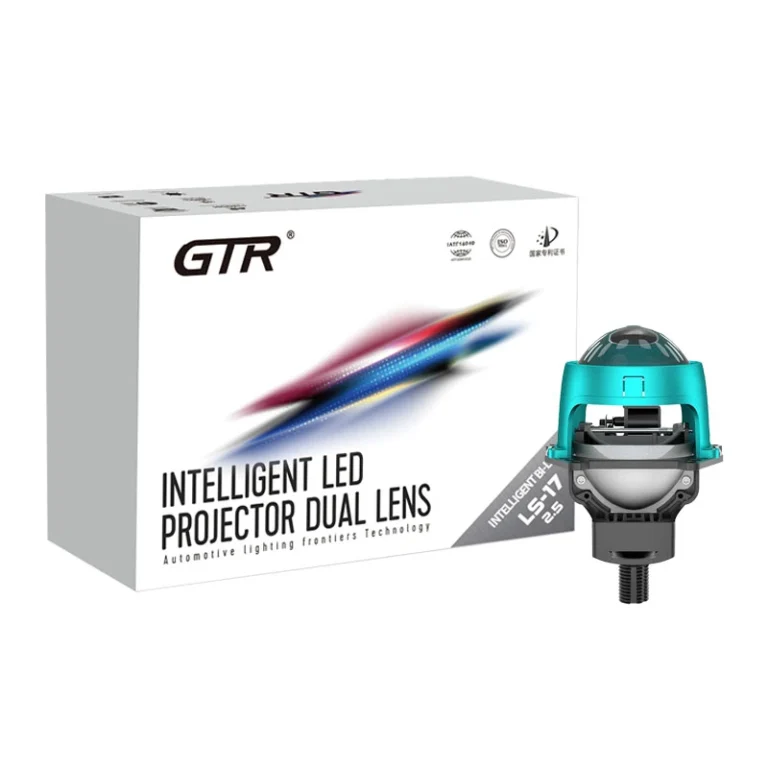
Every GTR LED projector headlight is designed as a complete optical system—not a retrofit bulb shoved into someone else’s housing. Our Bi-LED projector lenses feature razor-sharp cutoff lines, wide beam patterns, and intense hotspots that deliver real-world visibility. The beam is smooth and even, without blotches or dark spots.
We test every design on a photometer to measure actual luminance intensity—not just theoretical output. This is the same approach used in academic research to quantify headlight performance.
Advanced Thermal Engineering
Our projector headlights incorporate high-quality aluminum heat sinks and optimized thermal pathways that keep LED chips running cool. This extends lifespan to the 30,000–50,000 hours that LEDs are actually capable of delivering. No premature failures. No sudden darkness on a midnight drive.
Real Compatibility, Not Marketing Claims
We manufacture projector headlights for specific vehicle applications—including LED projector headlights for cars, LED projector headlights for bikes, and models tailored for popular vehicles like the Ertiga, Wagon R, Ciaz, Tata Nexon, and Kia Sonet. Each unit is engineered to fit correctly and perform optimally in its intended application.
Certified Quality You Can Trust
GTR products meet international certification standards including IC, RoHS, FCC, and EPR_Germany_Packing for global compliance. We do not cut corners on safety or performance.
What Real Users Say
One automotive enthusiast who upgraded to quality projector headlights described the difference as “night and day. The beam was incredibly wide and perfectly even, with a cutoff line so sharp you could read a newspaper by it”.
Another driver noted that after installing properly engineered projector LEDs, “the visibility range and brightness is out of this world”.
These are the experiences that come from engineering that respects the optics, not marketing that ignores them.
Frequently Asked Questions About LED Projector Headlights
Why do my LED projector headlights have dark spots?
Dark spots occur when the LED chip is not positioned at the exact focal point of the projector’s optics. This is most common with cheap retrofit bulbs that do not match the original halogen filament position. The solution is to use projector headlights designed as complete optical systems, not retrofit bulbs.
Are LED projector headlights better than LED reflector headlights?
Yes, for most applications. Projector headlights use a lens and cutoff shield to produce a focused, sharp, and precisely controlled beam. Reflector headlights create a broader, more scattered pattern that may cause glare. Academic research consistently demonstrates LED superiority in projector configurations.
What is the difference between LED projector headlights and regular LED headlights?
“Regular LED headlights” typically refers to reflector-style LED headlights. LED projector headlights use a lens-based optical system with a cutoff shield, producing a sharper beam pattern with less glare. Projector designs also tend to provide better down-road visibility.
How long should LED projector headlights last?
Quality LED projector headlights should last 30,000 to 50,000 hours. However, poor thermal design can reduce this to months or even weeks. Proper heat dissipation through quality heat sinks is essential for longevity.
Can I put LED bulbs in my halogen projector headlights?
Technically yes, but results vary widely. Many LED “bulbs” produce poor beam patterns and excessive glare because the LED chip does not sit in the same position as the halogen filament. For best results, replace the entire projector housing with a purpose-built LED unit.
What color temperature is best for LED projector headlights?
5000K to 6000K is the sweet spot. This range approximates natural daylight, reducing visual fatigue while providing excellent visibility. Lower temperatures look yellow; higher temperatures appear blue and may reduce visibility in wet conditions.
How many lumens do I need for LED projector headlights?
Focus on lux, not lumens. Lumens measure total chip output; lux measures focused intensity on the road. A well-engineered projector with 2,000–4,000 lumens per bulb will outperform a poorly designed unit with 10,000 lumens. Look for real-world beam pattern quality over marketing numbers.
Stop Compromising on Safety and Performance
The road does not care about marketing claims. It cares about what you can actually see. Every night you drive with subpar LED projector headlights, you are gambling with your safety and the safety of everyone around you.
Do not settle for dark spots, blinding glare, or premature failures. Do not waste money on products that look good on paper but fail on the road. Choose LED projector headlights engineered to perform—from a manufacturer that understands optics, thermal management, and real-world driving conditions.
参观 https://www.rhgtr.com to explore our complete range of LED projector headlights for cars, bikes, and specific vehicle models. See the GTR difference for yourself.