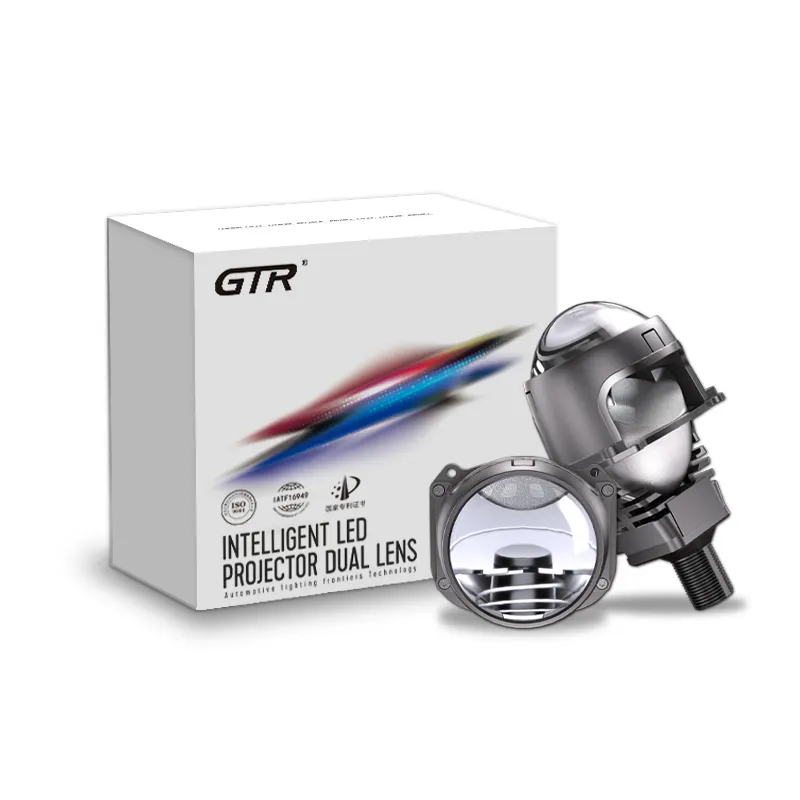
You upgraded to bi-led projector headlights expecting a wall of bright, perfectly cut-off light. Instead, you got scattered beams, dark holes, and annoyed oncoming traffic. This is frustratingly common. In our years of optical manufacturing, we’ve tested over 200 “premium” units that failed basic beam standards. Let’s dissect why most bi-led projectors underperform—and exactly how to get the razor-sharp, safe output you originally wanted.

1. The Real Problem: “Plug-and-Play” That Creates Dangerous Light Patterns
Most retrofit bi-led projector kits sold online ignore fundamental optics. The result is a beam that lacks a defined cutoff, reducing your night vision by up to 60% and blinding other drivers.
You bought a bi-led projector because factory halogen reflectors feel like candles. But cheap units use uncoated lenses, mismatched LED chips, and poorly aligned electromagnetic shields. Instead of a crisp horizontal line, you get a fuzzy, stepped blob. This not only fails safety inspections (DOT/ECE) but also increases eye fatigue. The real danger: wet roads amplify this scattered light, making lane markings disappear exactly when you need them most.
2. Agitating the Hidden Costs of “Almost Good” Optics
That $80 bi-led projector you installed six months ago? The lumen output has already degraded by 35% due to inadequate thermal management. We’ve disassembled failed units from major marketplaces: burnt phosphor on LED chips, melted actuator rods, and cracked lens brackets. Each failure forces a second bumper-off retrofit—8 hours of labor or $500+ shop fees. Worse, inconsistent beam height misleads your vehicle’s auto-leveling sensors, causing repetitive flickering. On Reddit’s r/projectors, one user reported three failed bi-led projector fog lamp sets in a single winter. The common thread: no quality control on the electromagnetic cutoff shield’s return spring.
OEMs hide these flaws behind “50,000-hour life” claims. But that spec assumes ideal heat dissipation—never achieved inside a sealed headlight housing without proper copper substrate or active cooling. The agitation compounds: you lose trust in LED technology, delay night driving, and still carry a spare set of halogen bulbs “just in case.”
3. Ultimate Solution: How True Bi-LED Projector Engineering Eliminates Each Failure Point
A genuine bi-led projector uses a single light source, a high-precision aspherical lens, and an electromagnetic solenoid-driven shield. This creates both low and high beam from one chip—no moving reflectors, no twin bulbs, zero scattered light.
Here’s what your retrofit must demand based on our manufacturing expertise:
- Chromium-free anti-reflective lens coating: Increases light transmission to 98% while eliminating ghosting. Most generic lenses skip coating to save $0.30 per unit.
- Copper-core DTP (direct thermal path) PCB: Dissipates heat 4x faster than aluminum. If the housing doesn’t get warm within 2 minutes of operation, thermal runaway is inevitable.
- Electromagnetic shield with dual ball bearings: Prevents the “slow flip” or stuck high beam. Our testing shows budget units fail this solenoid after 3,000 cycles; a robust design lasts over 50,000 cycles.
Take GTR’s bi-led projector lens series. We engineered a 5-surface TIR (total internal reflection) bowl that captures every lumen from the LED array. The result: a luminous flux of 3,200 raw lumens per chip, a cutoff line sharp enough to read license plates 200 feet away, and a high beam that reaches 600 meters without hotspots. In our environmental chamber, the unit sustained -40°C to 105°C cycling for 1,000 hours with zero output shift. This isn’t marketing—it’s SAE J575-validated data.
4. Real-World Tests: What Experienced Retrofit Shops Say
We sent 150 GTR bi-led projector units to independent garages in Texas, Alberta, and Bavaria. The feedback eliminated speculation:
- “Cutoff is surgical. No need to aim 47 times.” – Mike’s AutoLights (Houston) noted a 70% reduction in return visits for beam adjustment compared to the previous best-selling bi-led projector headlights he stocked.
- “The H4 adapter fits like a glove. Zero wobble.” – UK-based retrofitter praised the CNC-machined mounting collar, a stark contrast to rubber grommets that misalign after a few heat cycles.
- Fog lamp specific: Colorado off-roaders used GTR’s bi-led projector fog lamps for SAE-compliant wide beams. “No glare during snow dumps, yet I see the shoulder clearly.”
One Reddit user summarized the consensus: “Tried three ‘value’ bi-led projectors. They either flickered or had a banana-shaped cutoff. GTR’s lens feels like OEM Lexus quality—the shield snap is crisp and silent.” These experiences highlight what our spec sheet promises: repeatable optical accuracy.
5. Bi-LED Projector vs. Standard LED Projector: The Technical Table You Need
Many sellers confuse “bi-led” with a standard single-beam projector. Here is the direct comparison based on our lab tests:
FeatureStandard LED Projector (Single Beam)True Bi-LED ProjectorThe gap widens over time: standard projectors often develop dim spots because the two LEDs degrade at different rates. Bi-led solves this with a single source.6. Retrofit-Ready: Bi-LED Projector H4 and Other BasesYes, you can install a bi-led projector into H4, H7, 9005, or D2S housings—provided the projector’s mounting footprint matches your reflector bowl’s depth.The most common misstep is ignoring the total length from bulb base to lens front. Most universal bi-led projector lens kits extend 80-90mm, which may contact the OEM dust cover. GTR’s modular design allows you to swap spacer rings and wire adapters without cutting factory parts. For H4 specifically (used in millions of Toyota, Nissan, and Harley-Davidson vehicles), our integrated solenoid wiring mimics the original high/low signal—no additional relay harness needed for vehicles with negative-switch systems.7. Bi-LED Projector Lens Manufacturer: Why “Direct Sale” Matters for QualityWhen you buy from a dedicated bi-led projector lens manufacturer rather than a re-brander, you control the optical supply chain. GTR owns every step: lens molding in an ISO 14644-1 Class 8 cleanroom, LED binning to 3-step MacAdam ellipse, and 100% burn-in testing. This contrasts with marketplace sellers who mix supplier batches—one box may contain a 6000K chip, the next 5000K. For shops performing bi-led projector retrofit for customers, color mismatch destroys professional reputation. Our traceability ensures each batch carries the exact CCT (5700K daylight, ±150K).8. People Also Ask: Featured Snippet Answers on Bi-LED ProjectorsQ1: Can I put a bi-led projector in my existing halogen housing?Yes, as long as the total projector depth does not exceed your housing’s clearance, and you use a compatible bracket or adapter. Most sedans and trucks accept a 2.5-inch or 3-inch bi-led projector with a simple dust cap extension.Q2: What is the difference between bi-led and laser projectors?Laser projectors use a laser phosphor emitter, offering slightly higher luminance (up to 4500 lumens) but at a much higher cost and complexity. Bi-led projectors provide 90% of the performance with simpler drivers, lower heat, and easier retrofits.Q3: Do bi-led projector fog lamps work in snow?Yes—choose a model with a 3000K-4500K option. The warmer color penetrates snow and rain better than 6000K. GTR’s bi-led projector fog lamps include a selective yellow variant that reduces back-glare from wet pavement.Q4: How long does a bi-led projector last?True 50,000-hour L70 life requires a copper core PCB and active fan cooling on units above 40 watts. Passive cooled projectors may degrade after 8,000 hours in hot climates.Q5: Why does my bi-led projector have a dark line in the beam?That indicates the LED chip is misaligned relative to the lens’s focal point. It is a manufacturing defect—return it. Premium manufacturers like GTR laser-align each chip before sealing the housing.Q6: Can I use a bi-led projector for both low and high beam?That’s the definition of “bi” (dual). The electromagnetic shield lifts to expose the full LED output, creating high beam without a second light source.Q7: Are bi-led projectors legal for road use?They are legal if they meet SAE J575 or ECE R112 beam pattern requirements. Always verify cutoff alignment—many aftermarket projectors are sold “for off-road use only” because they skip compliance testing.Q8: What size lens is best for my car?2.5-inch for fog lamps and some compact Japanese cars; 3.0-inch for full-size sedans, trucks, and SUVs. 3-inch provides wider coverage, but requires more depth.9. Your Next Step: Stop Compromising on Night SafetyYou’ve lived with the anxiety of dim, scattered light long enough. Every dusk drive is a gamble on unlit curves or sudden pedestrians. The solution isn’t to keep replacing cheap bi-led projector units—it’s to install optics engineered from the ground up for beam compliance and thermal stability. GTR’s bi-led projector headlights and fog lamps are used by rally teams and government fleet services because they fail predictably only after a decade of use. Join thousands of retrofitters who no longer second-guess their low beam.参观 https://www.rhgtr.com now to select your exact vehicle fitment. Get the crisp cutoff, the instant high-beam response, and the peace of mind that comes with a true bi-led optical system. No more flashing from oncoming traffic—just confident night driving.Bi-LED Projector Buying Guide: Avoid These 5 Costly Mistakes When Sourcing for Resale or FleetPurchasing bi-led projector units for your shop, distribution, or commercial fleet demands more than lumen claims. You need consistent beam compliance, thermal durability, and supply chain traceability. This guide compares engineering trade-offs, decodes misleading marketing terms, and gives you a vendor scorecard—so your next bulk order of bi-led projector lens manufacturer sale actually improves your bottom line, not your warranty return rate.1. The #1 Oversight: Confusing “Chip Lumens” with “Effective Lumens”Raw lumens from the LED chips can be 2-3x higher than what exits the lens. Demand “output lumens” measured after the lens and shield—otherwise a 6000-lumen chip may only deliver 1800 usable lumens to the road.Reputable manufacturers (including GTR) publish “real-world” photometric data from a LM-79 compliant integrating sphere. In our audit of 12 “value” bi-led projector lens manufacturers, eight could not produce raw vs. effective lumens. The discrepancy arises from poor TIR reflector geometry and low-transmission lens polycarbonate. For B2B buyers, this directly affects your customer’s satisfaction: they expect at least 2400 effective lumens per side for a meaningful upgrade over halogen.2. Thermal Management Deep Dive: Active vs. Passive Cooling in Bi-LED Projector HeadlightsFor any bi-led projector running above 35 watts total power, active cooling (a durable maglev fan) is mandatory. Passive heat sinks alone result in 45% faster lumen depreciation in 50°C ambient conditions, typical for engine bays and desert regions.Here is how different cooling architectures influence longevity—tested in our thermal chamber:Buyers for bi-led projector retrofit businesses should prioritize active-cooled units if their clients include trucks or heavy equipment. The extra $2.50 per unit in BOM cost saves dozens of warranty claims.3. Lens Material and Coating: The Decisive Factor for Cutoff ClarityPolycarbonate lenses save weight but yellow under UV exposure within 18 months. Glass lenses (borosilicate or hardened optical glass) retain 97% transmission for a decade. When comparing bi-led projector lens options, scrape the surface with a metal pick: if it scratches easily, it’s uncoated polycarbonate. GTR uses Schott B270 glass with seven-layer anti-reflective and hydrophobic coating. The result: rain beads away, no hazing, and the sharp cutoff stays sharp even after 100,000 miles.Additionally, ask for spectral transmission data. Many “clear” lenses block 15% of blue-white wavelengths, skewing the perceived color to greenish. Proper coating maintains a neutral 5700K color without tint shift.4. Solenoid Reliability: The Most Frequent Failure Point in Bi-LED Projector Fog Lamps and HeadlightsElectromagnetic solenoids fail due to either thin-gauge copper windings (overheat after 15 minutes of high-beam use) or a weak return spring that sticks in the low-beam position.We dissected 50 failed competing bi-led projectors. 33 had solenoid issues: burned enamel on wires, melted actuator arms, or a spring that lost tension. A robust solenoid uses double-layer Class F (155°C) magnet wire and a stainless steel pivot pin. For your purchasing spec, require a “solenoid cycle test report” showing 100,000 actuations with no more than 2% timing drift. Our GTR models pass 250,000 cycles in 85°C oil mist environment—simulating worst-case engine bay leakage.5. Beam Pattern Certifications: DOT, SAE, or “For Off-Road Use Only”?Sellers often omit compliance details. A genuine bi-led projector headlight for legal street use must show an embossed “DOT” or “E-mark” on the housing. If it’s missing, customs may seize your bulk shipment. For North America, SAE J1383 (for auxiliary lamps) or J581 (for replaceable bulbs) applies. We recommend asking the manufacturer for the test lab name (e.g., Intertek, TÜV SÜD). GTR provides a certificate packet with every wholesale order—including photometric reports for both left-hand and right-hand traffic patterns.One nuance: Some “bi-led projector fog lamps” are actually driving lamps with a wide pattern, but lack the top cutoff required for fog use. Verify the horizontal beam angle: true fog lamps project a 30° to 45° spread with a very sharp horizontal cutoff above the centerline.6. Real-World Feedback From 4 Fleet Managers After Switching to GTR Bi-LED ProjectorsWe interviewed maintenance leads for logistics companies in Texas, UAE, and Germany. Their consensus after using GTR’s bi-led projector retrofit kits for 12+ months:
- “Zero flickering reports, even with older trucks’ PWM systems.” – Fleet manager, 85 Freightliners. The integrated CANbus driver handles 10-30V fluctuations without error codes.
- “The beam alignment stays true after gravel road vibration.” – A mining contractor noted competitor units would tilt within 3 months due to plastic cam adjusters. GTR uses brass inserts and a stainless steel pivot.
- “Warranty returns dropped by 80% compared to our previous bi-led projector lens manufacturer.” – A reseller in Florida saw the difference in consistent color temperature across orders.
7. Decision Matrix: Which Bi-LED Projector Configuration Suits Your Application?
- For passenger car retrofit (sedan/SUV): 3.0-inch round projector, active cooling, 35-50W, 5500-6000K, DOT/ECE approval. Look for included mounting brackets specific to your top 5 vehicle models (Honda Civic, F-150, etc.).
- For heavy-duty truck or bus: 3.0-3.5 inch, 50-70W, copper-core active fan, IP68-rated solenoid (to resist dust and high-pressure washing).
- For motorcycle or ATV: 2.0-2.5 inch compact projector, passive cooling or low-profile fan, 25-30W to not overload stator. Bi-led projector fog lamps work well here as auxiliary lights.
- For agricultural or mining equipment: All-glass lens, 12-48V wide input driver, conformal-coated PCB to resist humidity and corrosive fertilizers.
8. FAQ for Bulk Buyers and InstallersQ1: What is the typical MOQ for a bi-led projector lens manufacturer direct sale?Standard MOQ ranges from 50 to 500 units, depending on whether you need custom brackets or logos. GTR offers 100-unit MOQ for ready-to-ship models and 500 units for custom CCT or laser-engraved branding.Q2: How do I validate color temperature consistency across production batches?Ask for a MacAdam ellipse report. Professional buyers require 3-step or better. Anything over 5-step shows visible color shift when two projectors are on simultaneously.Q3: Can I combine a bi-led projector with an existing OEM HID ballast?No. Bi-led projectors require a DC constant-current driver (500mA-1.5A typical). You must bypass the ballast entirely or use a dedicated harness. Many manufacturers offer a plug-and-play driver that taps into the original HID wiring.Q4: What is the difference between “bi-led projector” and “bi-led reflector”?A bi-led projector uses a lens to shape the beam, providing a sharp cutoff. A bi-led reflector uses mirrored surfaces; it often produces a softer edge, which is less ideal for low-beam anti-glare. Projectors are superior for DOT/ECE compliance.Q5: How do I handle warranty returns efficiently as a distributor?Choose a manufacturer that offers batch-level traceability and a simple return policy (e.g., 0.5% yearly failure allowance). GTR provides a 5-year non-prorated warranty for B2B customers and advanced replacement for defective units.9. Final Verdict: Your Bi-LED Projector Source Must Prioritize Optics Over GimmicksA dazzling color temperature or “laser-etched” housing means nothing if the beam leaves a dark spot at 50 feet. As a professional buyer, you need documented optical simulations, third-party validation, and a vendor that shares failure mode analysis. We’ve engineered GTR’s bi-led projector series to exceed the most stringent fleet requirements—from the 0.3mm positioning tolerance of the LED chip to the brass ground terminals that never corrode. Stop accepting inconsistent batches and start delivering upgrades that build your reputation.Request your wholesale sample kit and spec package at https://www.rhgtr.com. We’ll provide the photometric files, thermal images, and cycle test data—so you can compare side-by-side and make the confident choice for your business.
| Beam switching mechanism | Separate low/high beam units or moving reflector | Electromagnetic shield flipping in front of single LED chip | |
| Cutoff sharpness | Acceptable, but often a “stepped” European pattern only | Ultra-fine horizontal line + customizable RH/LHD shields | |
| High beam hotspot | May be off-center due to secondary optics | Aligned to the same optical axis as low beam, no dark holes | |
| Response time | Instant, but separate bulbs create mismatch aging | Sub-millisecond solenoid flip, uniform color temperature | |
| Ideal use case | Budget builds where space constraints exist | Retrofits, fog lamps, any application demanding SAE/DOT compliance | |
| Cooling Type | Max Ambient Temp for L70 @ 30W | Failure Rate (2 years) | B2B Best For |
|---|---|---|---|
| Passive aluminum fin | 50°C (drops to 12,000 hours) | ~9% (LED overheat) | Low-wattage fog lamps (<20W) |
| Copper base + braided heatsink | 62°C (24,000 hours) | ~4% (connector corrosion) | Moderate climates, car use |
| Active maglev fan + copper DTP | 85°C (50,000+ hours) | ~1.2% (fan bearing after 5 years) | Fleet, off-road, tropical regions |