You flick the switch. The road ahead glows a weak, yellow-orange. Again. If your halogen headlight bulbs seem dimmer every month, you are not imagining it. And you are not alone.
Most drivers treat dim headlights as an unavoidable fact of car ownership. Replace the bulb, move on, repeat every six to twelve months. But that cycle hides a real problem. The bulb is rarely the root cause. The system around it is.
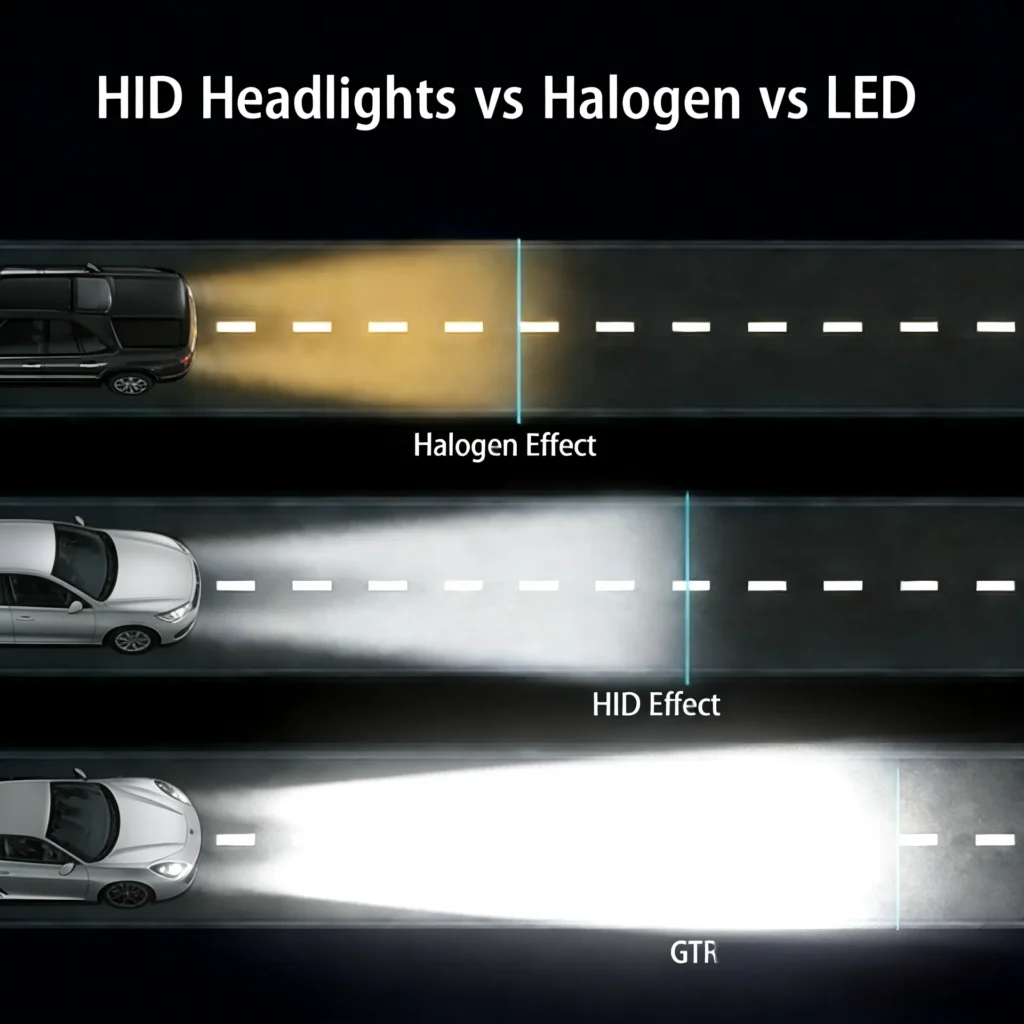
The Problem: Your Headlights Are Aging Faster Than Your Car
Halogen headlight bulbs lose roughly 20 to 30 percent of their light output over their rated lifespan, a process called lumen depreciation that most drivers never notice until night driving becomes genuinely stressful.
Here is what that looks like in practice. You bought the car used, or you have owned it for five years. The headlights worked fine at first. Now oncoming traffic feels blinding, wet asphalt swallows your beam, and you find yourself leaning forward at night like that will somehow help.
It is not your eyes. It is physics.
A halogen bulb works by running current through a tungsten filament inside a quartz envelope filled with halogen gas. The gas cycle redeposits evaporated tungsten back onto the filament, which is why halogen bulbs last longer than old-school incandescent lamps. But the cycle is imperfect. Over time, tungsten still migrates away. The filament thins, the glass envelope darkens from deposits, and output drops.
Meanwhile, your headlight housing is doing its own damage. Plastic lenses yellow and haze from UV exposure. Reflector surfaces dull. Wiring harnesses develop resistance and voltage drop, which means the bulb receives less power than it was designed for. A bulb rated at 1,500 lumens might be getting enough voltage to produce 1,100.
Why This Is Worse Than You Think
Dim headlights are not just annoying. They change how you drive.
According to road safety research, the majority of fatal pedestrian collisions happen at night, and reduced driver visibility is a contributing factor in a large share of them. You do not need statistics to feel this. You already slow down more than you used to on unfamiliar roads after dark. You already avoid certain highways.
The cost adds up in other ways too. Cheap replacement bulbs burn out fast, so you are buying them two or three times a year. Every swap risks scratching the housing or stripping a brittle connector. And if you have ever paid a shop to replace a bulb buried behind a wheel-well liner, you know the labor charge can dwarf the part itself.
There is also the matter of mismatched output. When one bulb dies and you replace only that side, you end up with two different color temperatures and two different brightness levels. The car looks neglected, and the imbalance is genuinely distracting at night.
The Solution: Stop Replacing Bulbs and Start Fixing the System
This is where most advice online stops. Buy a brighter halogen, buy an LED kit, done. That advice is incomplete.
The real fix has two parts. First, restore the electrical and optical system so any bulb can perform at its rated output. Second, choose a bulb that actually matches your driving conditions rather than whatever is on the shelf.
Step 1: Diagnose Before You Buy
- Check your voltage. With the engine running, measure voltage at the headlight connector. Below 12.5V means you are losing light to resistance. Cleaning grounds and upgrading the harness can recover meaningful output.
- Inspect the lens. If the plastic looks cloudy, a restoration kit can recover 70 percent or more of lost transmission. A hazy lens will waste even the best bulb.
- Confirm the fitment code. Your housing takes a specific base type. Common ones include H4, H7, H11, and 9005. Putting the wrong base in, or forcing a bulb that does not seat correctly, throws the beam pattern off and can dazzle oncoming drivers.
- Replace in pairs. Matched output on both sides matters more than most people realize.
Step 2: Choose the Right Bulb for Your Actual Driving
Not all halogen headlight bulbs are the same, even within the same fitment code. The differences come down to filament design, gas fill pressure, and coating.
| Loại bóng đèn | Typical Output | Nhiệt độ màu | Tuổi thọ | Phù hợp nhất cho |
|---|---|---|---|---|
| Standard halogen | 1,000–1,400 lm | 3.000–3.200K | 500–1.000 giờ | Budget replacement, stock look |
| High-output halogen | 1,500–2,000 lm | 3,400–3,800K | 300–600 hrs | Drivers wanting more reach without conversion |
| Coated “white” halogen | 1,200–1,600 lm | 4,000–4,300K | 250–500 hrs | Cosmetic upgrade, whiter look |
| LED conversion | 2,000–4,000 lm | 5,000–6,500K | 10,000–30,000 hrs | Long-term cost savings, maximum output |
| HID conversion | 2,500–3,500 lm | 4,300–6,000K | 1,500–2,500 hrs | Warm-up tolerant drivers, projector housings |
Notice the tradeoff pattern. Higher output in a halogen bulb usually means a shorter life, because you are pushing the filament harder. A coated bulb that looks whiter typically produces less usable light than an uncoated one at the same wattage, because the coating filters output. These are not marketing opinions. They are the direct result of how the physics works.
Step 3: Know When Halogen Is the Wrong Answer
If you drive a lot at night, tow a trailer, or regularly travel rural roads with no street lighting, a halogen bulb, even a premium one, has a ceiling. You can only push a filament so far before lifespan collapses.
This is the point where many drivers look at LED or HID conversions. And this is also where a lot of them get burned by cheap kits that scatter light, overheat, or fail within months.
In our engineering testing, the most common failure we see in aftermarket lighting is not the emitter itself. It is thermal management. A bulb that cannot shed heat will derate, flicker, or die. That is why heatsink design and driver quality matter more than the lumen number printed on the box.
What Real Drivers Report
Scroll through owner forums and a pattern emerges. Drivers who replaced failing halogens with another cheap halogen often report the same dim result within a year. Drivers who first restored their lenses and wiring, then upgraded to a properly engineered conversion, report the change as night-and-day.
One recurring complaint is worth highlighting: color mismatch. A 6,000K bulb in a reflector housing designed for a 3,200K halogen often produces glare for oncoming traffic and less usable foreground light for the driver. Whiter does not automatically mean better. It means different, and sometimes worse.
The other recurring theme is fitment. Bulbs that do not clock correctly into the housing rotate the beam pattern. You get a hot spot in the wrong place and dark zones where you need light most.
Câu hỏi thường gặp
How long do halogen headlight bulbs last?
Most last between 500 and 1,000 hours of use. High-output versions often last 300 to 600 hours. If yours fail more often than that, check voltage and connector condition before blaming the bulb.
Are halogen headlight bulbs white?
Standard halogens produce a warm yellowish light around 3,000 to 3,200K. So-called white halogen bulbs use a blue coating to shift the color toward 4,000K or higher, but that coating reduces total light output.
Can I replace halogen headlight bulbs with LED?
Yes, in many vehicles, provided the LED kit is designed for your housing type and clocking position. Poorly matched kits scatter light and can fail inspection in some regions. Check local regulations before converting.
What is the difference between H4, H7, H11, and 9005?
These are base and connector standards. H4 is a dual-filament bulb for high and low beam in one housing. H7 and H11 are single-filament. 9005 is a common high-beam or fog-light base. Using the wrong one means the bulb will not seat or seal correctly.
Why do my new halogen bulbs look dimmer than the old ones?
Two likely causes. First, aged lenses and wiring reduce output regardless of bulb quality. Second, some “long life” bulbs trade brightness for durability. Check both before assuming the bulb is defective.
Are halogen bulbs legal for motorcycles?
In most markets, yes, provided the bulb matches the original specification for the bike. Converting a motorcycle to LED or HID may require additional reflectors or projectors to stay compliant.
Where GTR Fits In
We build lighting for people who are tired of the replacement cycle.
GTR’s approach starts with the same diagnosis we described above. If your housing and wiring are sound, a properly engineered bulb solves the problem long-term. If they are not, no bulb will save you, and we will tell you that.
Our manufacturing background is in automotive and powersports lighting, which means we test for the conditions that kill cheap bulbs: vibration, heat soak, voltage spikes, and moisture intrusion. Every product we ship is designed around thermal performance first, because that is what determines whether a bulb lasts three months or three years.
We also support custom and OEM programs. If you are a distributor, a fleet operator, or a workshop that needs consistent quality across volume orders, our team can work with your specifications directly.
Do This Tonight
Walk out to your car, turn on the headlights, and look at the beam on a wall or garage door. If it is yellow, uneven, or weak, you have your answer.
Then stop guessing. Start with the diagnosis, fix what is actually broken, and choose a bulb built to last. Your night driving should not feel like a gamble every time you leave the house.
Ready to end the replacement cycle? Visit https://www.rhgtr.com to see GTR’s full range of automotive and powersports lighting, or contact our team for help matching the right bulb to your vehicle and driving conditions.