You flick on the high beams on a dark backroad, and the road ahead barely changes. The trees blur into a yellow smear. Your eyes strain. Your speed drops. You lean forward, gripping the wheel tighter than you should. If this sounds familiar, you are not alone—and the fix is not another set of premium halogen bulbs. A properly engineered h4 led conversion addresses the root cause of poor night vision: outdated lighting technology that was never designed for modern driving speeds. In our engineering testing at GTR, we have seen how a focused LED upgrade transforms not just visibility, but the entire driving experience.
The Real Reason Your Night Driving Feels Exhausting
Stock halogen bulbs lose brightness over time due to filament degradation and voltage drop, and their warm yellow light lacks the contrast your eyes need to identify hazards quickly. A quality H4 LED replaces that fading output with a precise, white beam that restores depth perception and reaction time.
Here is what most drivers never hear from a parts counter: a halogen bulb that produced 1,500 lumens on day one may struggle to push 1,000 lumens after two years of nightly use. The filament thins. The glass yellows. The reflector housing, designed around a specific filament position, receives less and less usable light. You adapt by slowing down. You adapt by squinting. But adaptation is not safety—it is resignation.
The problem compounds on wet asphalt. Yellow halogen light reflects poorly off dark, rain-slicked surfaces. Lane markings fade. Potholes become invisible until the last second. Pedestrians in dark clothing emerge from the blackness with terrifying suddenness. This is not a matter of driver skill. It is a physics problem, and no amount of concentration fixes a beam that never had enough usable light to begin with.
Why Cheap LED Conversions Make the Problem Worse
Poorly designed LED bulbs scatter light in every direction because their chips do not align with the halogen filament’s focal point, creating glare for oncoming traffic while leaving dangerous dark spots directly ahead.
Perhaps you have already tried a budget LED kit from an online marketplace. The listing promised “10,000 lumens” and “plug-and-play simplicity.” What you got was a bulb that sprayed light into the treetops and into the eyes of every driver you passed. Oncoming cars flashed their high beams at you. The beam pattern on the road was a blurry mess with a hot spot five feet in front of the bumper and nothing beyond it.
This happens because H4 housings are optical instruments. They rely on the light source sitting at an exact focal point relative to the reflector or projector lens. A halogen filament is a tiny, precisely placed wire. An LED chip array is a flat panel. If the panel’s dimensions and mounting depth do not mirror the original filament’s geometry, the reflector cannot focus the light. The result is glare, scattered beams, and a driver who has spent money to make their visibility worse—not better.
In markets like Indonesia and across Southeast Asia, where lampu h4 led motor và lampu led mobil h4 paling terang are common search terms, this problem is rampant. Riders and drivers chase raw brightness numbers without understanding beam control, and they end up with unsafe, blinding setups that fail inspection and endanger everyone on the road.
The Engineering That Separates a Solution from a Mistake
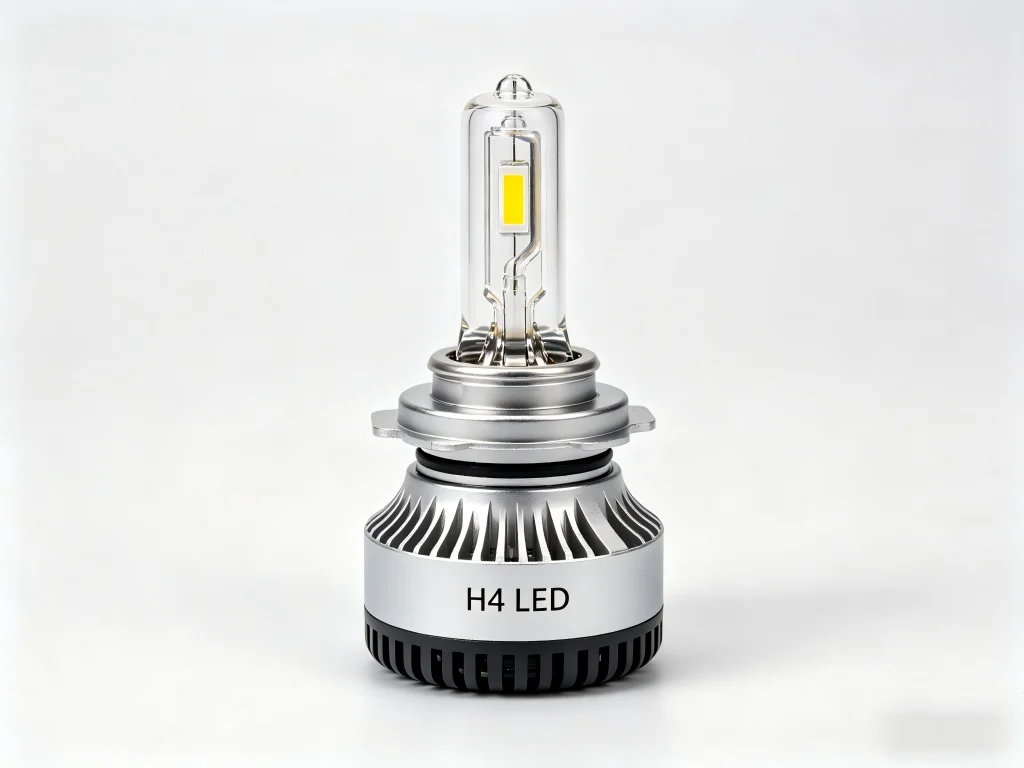
A properly engineered H4 LED matches the halogen filament’s dimensions and optical center, uses a thin substrate that mimics the original light source’s shape, and includes a precision-cut cutoff shield for the low beam. This preserves the factory beam pattern while increasing intensity and color temperature.
When our engineers at GTR approached the H4 platform, they started with a simple constraint: the bulb must behave optically like the halogen it replaces. That meant positioning the LED chips on a substrate thin enough to approximate a filament, aligning them at the exact depth and width required by standard H4 reflector geometry, and designing the low-beam cutoff to produce the sharp horizontal line that keeps light on the road and out of oncoming windshields.
This is harder than it sounds. The H4 bulb serves two functions in one housing: low beam and high beam. The low beam uses a shield to block light from hitting the upper portion of the reflector, creating the cutoff. The high beam exposes the full reflector. An LED conversion must replicate both functions without compromise. Our testing showed that substrate thickness variations of even a few tenths of a millimeter could shift the cutoff line enough to cause glare. That is why we machine our heat sink and chip mounting surfaces to tolerances that most budget manufacturers ignore entirely.
The color temperature matters too. Halogen bulbs produce roughly 3,200K—a warm, yellow light. A 6,000K LED produces a crisp white beam that improves contrast against road markings, signs, and obstacles. But color temperature alone is meaningless without beam control. A 6,000K bulb that scatters light is still a bad bulb. A 6,000K bulb with a factory-matched beam pattern is a genuine upgrade.
What Real Drivers Notice After a Proper H4 LED Upgrade
Drivers who switch from aged halogens to a correctly designed H4 LED consistently report sharper road edge definition, earlier hazard recognition, and reduced eye strain on long night drives. The improvement is most dramatic on unlit rural roads and in heavy rain.
We track feedback from customers across commercial fleets, motorcycle touring groups, and daily commuters. A few themes repeat. The first is depth perception. With a halogen, the road ahead fades gradually into darkness. With a properly focused LED, the transition is sharper—you see further, and you see what is in that further distance. The second is the reduction of that strained, forward-leaning posture that creeps in on long drives. When the light is adequate, your body relaxes. You drive at normal speeds. You arrive less fatigued.
One fleet operator we work with in Southeast Asia runs a mixed fleet of light trucks and vans, many with H4 housings. His drivers cover rural routes with poor road markings and frequent motorcycle traffic. After switching to GTR units, his maintenance team reported fewer complaints about night driving and, anecdotally, fewer close calls at intersections. That is the kind of feedback that matters more than any lumen rating on a box.
On forums like Reddit’s r/cars and regional motorcycle groups, the h4 led osram và philips h4 led discussions often center on legality and beam pattern. Drivers who have tried both premium halogen upgrades and cheap LEDs eventually arrive at the same conclusion: the only LED worth installing is one that preserves the beam. A night breaker led vintage h4 style halogen may look period-correct, but it cannot match the usable light output of a focused LED from a manufacturer that understands optical geometry.
How to Choose an H4 LED Without Getting Burned
Look for a bulb that explicitly states it matches the halogen filament position, includes a visible cutoff shield for the low beam, and comes from a manufacturer with verifiable engineering documentation. Avoid products that lead with lumen claims and say nothing about beam pattern.
Here is a practical checklist you can apply before spending money:
- Ask for the beam pattern, not the brightness. A reputable seller should be able to show you a wall-shot comparison between halogen and LED in the same housing. If the cutoff line is blurry or the hot spot is wrong, walk away.
- Check the substrate design. The LED chips should sit on a thin, centrally mounted substrate that mimics the halogen filament’s shape. Thick, multi-sided chip arrays are a red flag for beam scatter.
- Verify thermal management. LEDs produce heat at the chip junction. A passive aluminum heat sink with sufficient surface area is reliable and silent. Active fans can work, but they introduce a moving part that can fail. For commercial or high-vibration applications, a well-designed passive system tends to be more durable.
- Understand your local regulations. In many jurisdictions, LED retrofits in halogen housings occupy a legal gray area unless the bulb carries specific type approval for your vehicle. The UNECE framework is evolving, with H4 LED approvals under active discussion . Check what applies where you drive, and prioritize products from manufacturers who can speak to compliance honestly rather than making blanket claims.
- Ignore “off-road only” labels if you drive on public roads. Products sold without type approval for road use may fail inspection or create liability issues. A legitimate manufacturer will be transparent about the intended use case.
Why GTR Builds H4 LEDs the Hard Way
GTR designs H4 LED conversions around optical fidelity rather than raw output claims. We machine our substrates and heat sinks to tolerances that preserve the factory beam pattern, and we document our engineering approach so buyers can verify what they are getting.
We are not the cheapest option on the market. We do not pretend to be. What we offer is a product built by people who understand that a headlight is a safety instrument, not a fashion accessory. Our H4 units are tested against halogen baselines in controlled conditions. We measure cutoff sharpness. We measure hot spot location. We measure glare intensity at oncoming driver eye height. If a design change improves a lumen number but degrades the beam, we reject it.
For B2B partners—distributors, fleet managers, and accessory retailers—we provide technical documentation and support that helps you stand behind the product. If you are sourcing harga lampu h4 led mobil for a regional market, you need a supplier who can answer questions about beam compliance and thermal performance, not just quote a price per unit. We built our reputation on being that supplier.
Cái h4 led ece regulatory landscape is shifting, and we track those developments closely. As type-approval frameworks mature, the gap between compliant and non-compliant products will become clearer. Our engineering process is designed to meet that future, not just the current unregulated market.
Frequently Asked Questions About H4 LED Upgrades
Will an H4 LED work in my stock halogen housing?
A properly designed H4 LED with 1:1 filament positioning will fit and function in most standard H4 reflector housings without modification. The key is choosing a bulb whose chip placement mirrors the halogen filament’s optical center. Cheap “universal” LEDs often fail this requirement and produce glare or dark spots.
Do I need a CANbus decoder or anti-flicker module?
Some vehicles, particularly newer European and Asian models, monitor bulb resistance and may display error messages or cause flickering with low-wattage LEDs. A quality H4 LED kit may include an integrated driver that addresses this. If not, an external decoder may be necessary. This is vehicle-specific, so check compatibility before purchasing.
Is an H4 LED legal for road use?
Legality varies by country and region. Some jurisdictions permit LED retrofits if the bulb carries specific type approval for the vehicle. Others restrict them to off-road use only. The UNECE R37 framework is expanding to include H4 LED categories, but full harmonization is not complete . Always verify local regulations before installing.
How long does a quality H4 LED last compared to halogen?
Halogen bulbs typically last 500 to 1,000 hours before output degrades significantly. A well-engineered LED with proper thermal management can last 25,000 to 50,000 hours or more. The practical lifespan in a vehicle depends on heat dissipation, voltage stability, and housing ventilation.
Will a 6,000K LED improve visibility in rain and fog?
Color temperature is less important than beam control in poor weather. A sharp cutoff and focused beam pattern matter more than Kelvin rating. That said, 6,000K white light generally provides better contrast against wet asphalt and road markings than the yellow output of aged halogens, as long as the beam is properly aimed and patterned.
Can I install an H4 LED myself?
In most H4 applications, yes. The process is similar to replacing a halogen bulb: access the housing, release the retaining clip, swap the bulb, and reconnect the connector. Some vehicles have tight engine bays or require removal of airbox components for access. If you are not comfortable working around fragile plastic clips and wiring, a professional installation is worth the cost.
Stop Settling for Less Light Than You Need
Every night you drive with dim, yellowing halogens, you are accepting a compromise you do not have to make. The road ahead deserves better than a beam that fades into blackness twenty meters out. Your reaction time deserves better than a light source that cannot reveal a pothole or a pedestrian until it is too late.
At GTR, we build H4 LED conversions for drivers and businesses who refuse to accept that compromise. We engineer for beam fidelity first, output second, because a headlight that blinds oncoming traffic is not an upgrade—it is a liability. If you are ready to see what a properly focused H4 LED actually looks like on a dark road, visit https://www.rhgtr.com to explore our H4 platform and speak with our team about the right configuration for your vehicle or fleet. The difference is not just brighter. It is clearer, safer, and built to last.