A new H3 LED bulb should make night driving easier. Yet many drivers install an LED upgrade and get the opposite result: scattered light, weak road illumination, flicker, excess heat, or a bulb that fails far sooner than expected.
The frustrating part is that the package may still claim huge lumen numbers and extreme wattage.
So what went wrong?
In most cases, the problem is not LED technology itself. It is the way the bulb’s optical position, thermal system, driver, housing compatibility, and real operating power work together. Understanding those factors can turn an expensive lighting mistake into a much more effective upgrade.
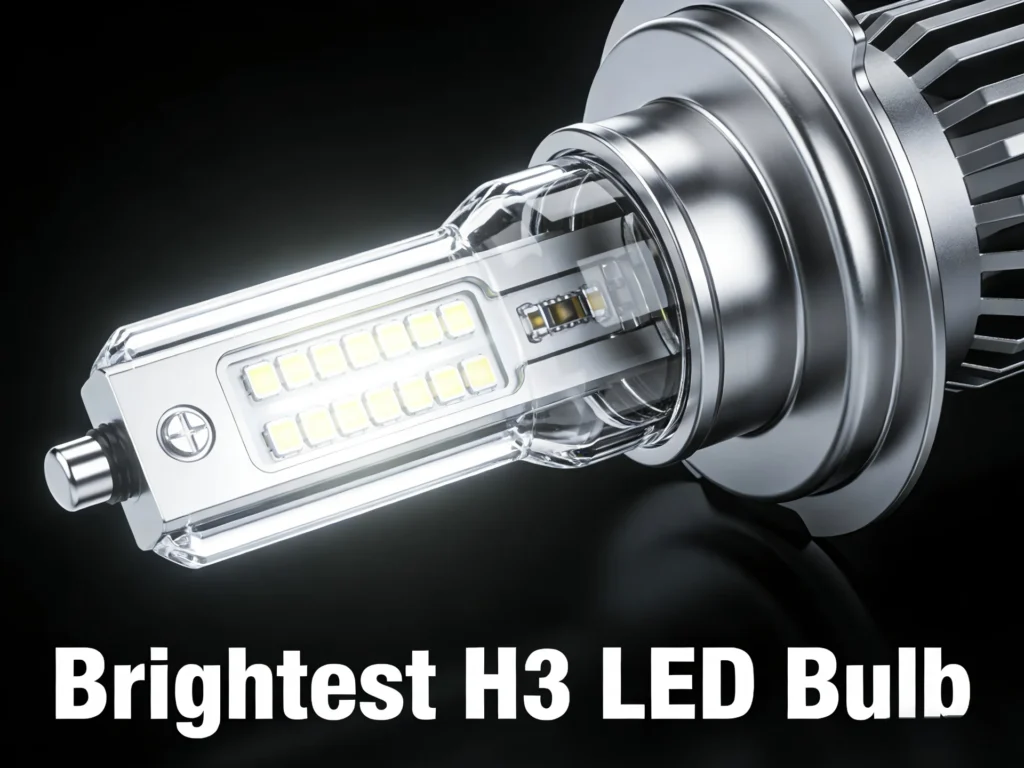
Why Can an H3 LED Bulb Still Give Poor Visibility?
An H3 LED bulb can look extremely bright while producing poor road visibility when its LED chips do not match the original filament position. Incorrect focus spreads light outside the useful beam area. Heat buildup can then reduce output further, creating a bulb that is bright on paper but disappointing on the road.
This is one of the most common problems we see when evaluating aftermarket automotive lighting.
Imagine driving on a wet rural road at night. You switch on your fog lamps. The area directly in front of the bumper becomes bright white, yet road edges and surface details remain difficult to read.
Your first reaction may be: “I need a brighter bulb.”
That assumption can send you in the wrong direction.
Problem 1: Brightness Without Beam Control
A halogen H3 bulb creates light from a small filament positioned at a specific point inside the reflector or projector.
An LED replacement works differently. Semiconductor chips become the light source. Their position relative to the original filament matters because the lamp housing was designed around that focal point.
If the emitting surface is too wide, too thick, too high, or incorrectly positioned, the reflector may send light where you do not need it.
This explains why two bulbs with similar advertised output can perform very differently.
Khi đánh giá một H3 LED replacement bulb, therefore, do not ask only:
“How many lumens does it produce?”
Hãy hỏi:
“How much usable light reaches the road?”
Problem 2: The Bulb Is Bright for Five Minutes—Then Fades
Heat is the hidden enemy of high-output LEDs.
LEDs are efficient, but they still generate heat around the semiconductor junction and driver electronics. If that heat cannot move away quickly enough, operating temperature rises.
The driver may reduce current to protect the LEDs.
The result is thermal throttling.
A bulb may therefore appear extremely powerful when first switched on but lose part of its output after reaching operating temperature.
Based on our manufacturing experience, this is why comparing initial brightness alone gives buyers an incomplete picture. Sustained output after thermal stabilization is far more useful when judging an automotive LED product.
Why a 100W H3 LED Bulb May Not Be the Best Choice
An H3 LED bulb 100W is not automatically brighter or better than a lower-power design. Actual road performance depends on electrical efficiency, LED efficacy, optical focus and cooling capacity. Excessive power inside a compact housing may increase heat and accelerate output reduction instead of delivering proportional visibility gains.
This is especially relevant when buyers search for an H3 LED bulb 100W.
Wattage tells you how much electrical power a system uses. It does not directly tell you how effectively that power becomes useful road illumination.
For example, imagine two designs:
| Evaluation Factor | High-Wattage Budget LED | Engineered H3 LED Bulb |
|---|---|---|
| Advertised wattage | Often emphasized heavily | Matched to thermal capacity |
| Độ sáng ban đầu | May be very high | Cao và được kiểm soát |
| Độ sáng duy trì | May decline with heat | Designed for stable output |
| LED positioning | May vary | Designed around optical focus |
| Driver quality | Basic on some products | Stable current management |
| 热设计 | May rely on oversized claims | Designed as a complete system |
| Batch consistency | Can vary by supplier | Critical for professional supply |
The lesson is simple: buy engineering, not wattage.
The Yellow H3 LED Bulb Question
A yellow H3 LED bulb, commonly around the selective-yellow to warm-yellow range, may be attractive for fog, rain and poor-weather applications because many drivers find the warmer visual output comfortable in low-contrast conditions. However, beam placement and optical design remain more important than color alone.
Các tìm kiếm cho H3 LED bulb yellow often come from drivers dealing with fog, heavy rain, snow, or off-road conditions.
There is a practical reason for that interest.
A cool-white lamp can produce excellent contrast under many normal nighttime conditions. In difficult weather, however, some drivers prefer warmer yellow output because it can feel less visually harsh when light is reflected by rain, mist, or wet pavement.
That does not mean yellow automatically performs better in every lamp.
The beam still needs to stay where the housing was designed to put it.
For B2B buyers, this creates an opportunity. Instead of carrying only one color temperature, distributors serving different climates may consider a product portfolio designed around actual regional applications.
The Hidden Problem: Physical Fitment
You find an H3 LED bulb nearby, buy it, open the housing, and discover that the heat sink will not fit behind the cover.
This happens more often than many product listings suggest.
H3 applications can be compact. A replacement LED may need room for:
- the LED body;
- the heat sink;
- a cooling fan, if used;
- the driver;
- the original retaining spring or clip;
- wiring and connectors;
- the rear dust cover.
That means “H3” confirms the bulb-base family, but it does not guarantee that every LED conversion will physically fit every H3 lamp assembly.
Before ordering, measure the available rear clearance and inspect the retaining mechanism.
Why Cheap H3 LED Bulbs Can Become Expensive
For one consumer, a failed bulb is annoying.
For a distributor, importer, or automotive lighting chain, the same problem scales.
Imagine importing 2,000 pairs of bulbs.
A small inconsistency in driver components, soldering, waterproofing, fan quality, or thermal interfaces can create warranty claims across hundreds of customers.
Then the real cost is no longer the bulb.
It becomes:
- replacement inventory;
- shipping;
- technician labor;
- customer complaints;
- negative reviews;
- dealer confidence;
- brand damage.
This is why professional buyers should evaluate failure risk before negotiating the last few cents from the unit price.
What Should You Check Before Buying?
A good H3 LED bulb should be selected by fitment, optical alignment, sustained light output, thermal performance, driver stability and application—not by advertised lumens alone. Confirm the vehicle socket first, then compare physical dimensions and beam performance before considering extreme wattage or brightness claims.
- Confirm the bulb type. Check the existing bulb, owner’s information, or a reliable vehicle fitment database.
- Identify the application. Fog lamps, auxiliary driving lamps and other H3 applications may require different beam priorities.
- Measure available space. Check heat-sink and driver clearance.
- Study LED chip position. A compact emitting area can help reproduce the original optical focus.
- Evaluate sustained output. Ask what happens after the lamp reaches normal operating temperature.
- Check thermal construction. Heat needs a reliable path away from the LED chips.
- Xem xét khả năng tương thích điện. Some vehicles may require additional solutions for bulb monitoring or flicker.
- Kiểm tra quy định địa phương. A physically compatible LED replacement is not automatically approved for every road-going headlamp or fog-lamp application.
What About AutoZone, NAPA, Advance Auto and Other Retail Searches?
Các tìm kiếm như H3 LED bulb AutoZone, H3 LED bulb NAPA, và H3 LED bulb Advance Auto usually signal strong purchase intent.
The shopper is no longer asking what LED technology is. They want a replacement they can obtain quickly.
The same intent appears internationally through searches such as H3 LED bulb Canadian Tire, H3 LED bulb Supercheap Auto, và H3 LED bulb NZ.
Availability matters, but compatibility should come first.
Before buying from any retailer, compare the exact bulb dimensions, voltage requirements, intended lamp function, cooling design, and vehicle fitment. Never assume that every product carrying an H3 label will behave identically inside your original optics.
From Consumer Upgrade to Professional Lighting Solution
This is where GTR approaches the problem differently.
We do not see an LED bulb as an LED chip attached to a base.
It is a complete optical, electrical and thermal system.
Based on our years of automotive lighting manufacturing experience, product development should consider how the LED emitting surface interacts with the original optics, how efficiently heat moves through the structure, how stable the driver remains under vehicle voltage conditions, and how consistently the product can be manufactured across production batches.
For wholesalers, distributors, automotive lighting specialists and modification chains, those factors become even more important.
Professional sourcing may require:
- stable production capacity;
- OEM and ODM options;
- private-label packaging;
- regional product configurations;
- consistent batch quality;
- technical support;
- product portfolio planning for different markets.
GTR develops automotive lighting solutions around these practical requirements rather than relying only on headline lumen numbers.
H3 LED Bulb FAQ
Can I replace an H3 halogen bulb with LED?
Often, physically, yes—but verify socket fit, housing clearance, electrical compatibility, beam pattern and local regulations first. Retrofit legality varies by vehicle, lamp assembly and market.
Is an H3 LED bulb brighter than halogen?
A well-engineered LED can produce more useful light with lower electrical consumption, but advertised lumens alone do not guarantee better road visibility. Optical focus is critical.
Is a 100W H3 LED bulb better?
Not necessarily. Higher electrical power generates additional heat. A well-focused, thermally stable lower-power design could outperform a poorly cooled high-wattage bulb during extended use.
Should I choose white or yellow H3 LED bulbs?
White is popular for general nighttime visibility and modern appearance. Yellow is often preferred for fog and adverse-weather applications. Choose according to climate, application, optics and local requirements.
Why does my H3 LED bulb flicker?
Possible causes include voltage fluctuations, incompatible bulb-monitoring systems, driver issues, poor electrical connections or unsuitable adapters.
Why does an H3 LED bulb become dimmer after running?
Thermal protection may reduce drive current as temperature rises. This is why sustained output and heat dissipation are better evaluation factors than initial brightness alone.
Where can I find an H3 LED bulb nearby?
Local automotive parts retailers may stock H3 replacements. Search by vehicle year, make, model and lamp position rather than bulb name alone. Professional distributors should verify specifications directly with the manufacturer before bulk purchasing.
Are H3 LED conversions road legal?
Rules vary by country and lamp application. Check applicable vehicle-lighting regulations and approval requirements before road use. For background on international vehicle-lighting frameworks, consult the UNECE vehicle regulations resources or your local transport authority.
Stop Replacing the Same Lighting Problem
If your customers keep asking for “more watts” or “more lumens,” the real opportunity is to give them something better: more usable light, better thermal stability, accurate fitment and dependable product consistency.
For importers, automotive lighting wholesalers, retrofit chains and regional distributors, one poorly engineered product can create months of warranty problems. The right product can do the opposite—it can become the SKU installers repeatedly request.
Khám phá các giải pháp chiếu sáng ô tô GTR tại https://www.rhgtr.com and discuss your target vehicle applications, market requirements, packaging needs and wholesale program with our team. Build the H3 product line around what drivers actually experience on the road—not what looks impressive on a specification sheet.