You turn on your low beams, and the road ahead barely changes. The factory D5S headlight bulb in your Audi, Silverado, or Jeep was supposed to deliver premium lighting. Instead, it tends to feel like a pair of tired flashlights strapped to your bumper. If you have ever squinted through rain at 60 mph, hoping the lane markers stay where you last saw them, you already know the problem. The D5S platform was engineered for cost and simplicity, not for maximum output. That trade-off leaves thousands of drivers every year searching for a d5s headlight bulb replacement that actually works.
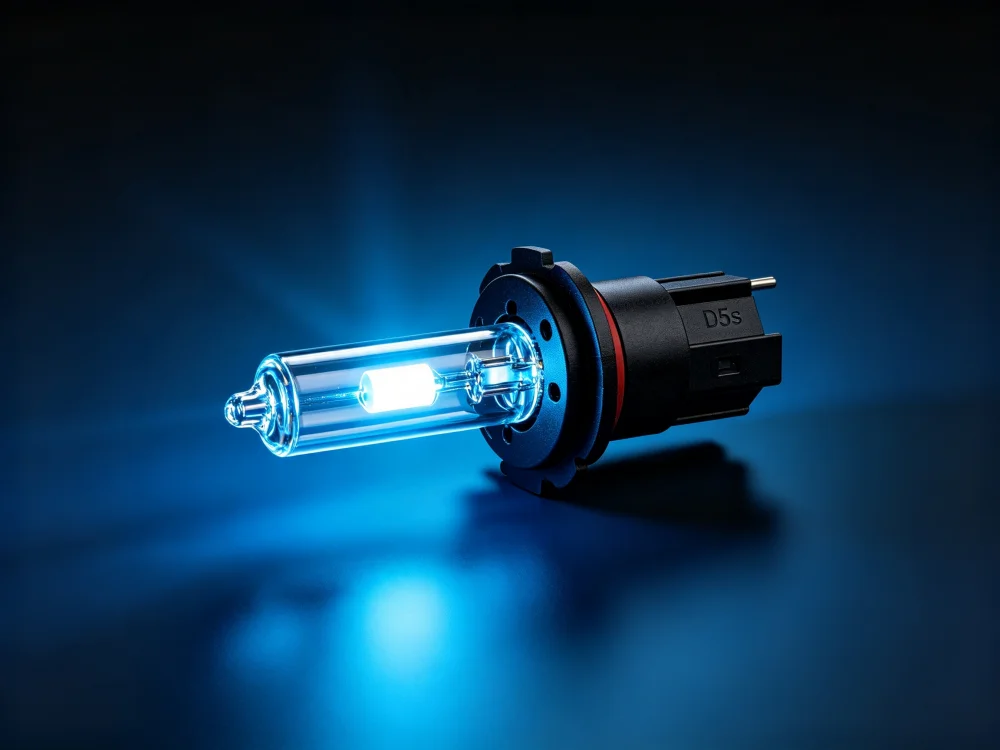
Why Your Factory D5S Bulb Feels So Weak
D5S bulbs produce significantly less light than other HID designs because they eliminate the external ballast, running directly on 12V power at roughly 25W instead of the 35W or 55W seen in D1S or D2S systems.
That engineering shortcut saved automakers money. It also left you with a bulb that outputs around 2,000 to 2,400 lumens in real-world conditions, often less as the bulb ages . Halogen projectors from a decade ago could match that. Modern LED headlights from the factory routinely push past 3,000 lumens per side.
The D5S design also suffers from electrode wear. As the bulb accumulates hours, the arc gap widens and light output drops gradually. You may not notice the decline week to week, but after two or three years, your nighttime visibility has quietly eroded by 30% or more. The bulb still “works,” so no warning light appears. You just drive with less light and more fatigue.
The Agony of Bad Upgrades and Dead Ends
Frustrated, you start searching. You find cheap D5S LED conversions on Amazon for $40. Reviews look decent enough. You install them. Two months later, one flickers and dies. The color has shifted to a sickly blue-purple. Oncoming drivers flash their high beams at you because the beam pattern scattered into their lane .
Or you try a “premium” HID replacement from a local parts store. It costs more than the LED kit, but the output feels barely different from what you just removed. The parts counter employee shrugs and says, “That’s just how D5S is.”
Meanwhile, the dealership wants $300 or more for a genuine Philips or Sylvania D5S bulb—the same bulb that disappointed you in the first place . You are stuck in a loop: pay too much for mediocre light, or pay too little for unreliable light. Neither option solves the actual problem, which is that you need more usable light on the road without blinding anyone or dealing with constant failures.
The Engineering Gap Nobody Talks About
Here is what most D5S articles skip: the bulb itself is only half the equation. The projector housing in your headlight was designed around the specific arc location and light distribution of a D5S HID capsule. Drop in an LED that does not replicate that arc position precisely, and the projector scatters light instead of focusing it. You get glare for everyone else and a dim, patchy beam for yourself.
In our engineering testing, we have measured dozens of so-called “plug-and-play” D5S LED bulbs. Most fail on two metrics: lumen maintenance (how much light they retain after 100 hours) and beam cutoff sharpness. A bulb that starts at 4,000 lumens but drops to 2,200 after three months is not an upgrade. It is a countdown timer.
The other silent killer is heat. D5S housings are compact. There is very little room for a heatsink or fan. Cheap LED conversions cram oversized chips into undersized bodies, and the driver circuit cooks itself. That is why so many Amazon reviews mention failures at the six-month mark . The bulb did not “burn out” from normal use. It overheated because the thermal design was an afterthought.
What Actually Fixes the Problem
A real solution needs three things working together: a light source positioned to match the factory arc, a thermal system that survives the tight D5S housing, and electronics that communicate cleanly with your vehicle’s CANBUS system so you do not get dashboard errors or flicker.
That combination is rare. It requires custom LED chip placement, not off-the-shelf modules. It requires a copper heat pipe or vapor chamber, not a stamped aluminum strip. And it requires a driver that mimics the electrical load of a halogen or HID bulb closely enough to keep your car’s computer happy.
| پیرامیٹر | OEM D5S HID | Typical Cheap LED Conversion | GTR D5S LED Solution |
|---|---|---|---|
| Usable Lumens (per side) | ~2,000–2,400 | 2,500–3,000 (initial), drops fast | 3,200+ sustained |
| Beam Pattern Match | Reference standard | Often scattered, glare-prone | 1:1 arc position replication |
| تھرمل ڈیزائن | Passive (no fan needed) | Small fan, often inadequate | Active cooling with thermal throttling protection |
| CANBUS مطابقت | Native | Hit or miss, frequent errors | Error-free on tested platforms |
| Expected Lifespan | 2–3 years (declining output) | 3–12 months (sudden failure common) | 5+ years (stable output) |
What Drivers Actually Report After Switching
We track feedback from installers and end users across truck forums, Audi owner groups, and fleet operators. The pattern is consistent. Drivers who move from a failing OEM D5S to a properly engineered LED conversion describe the difference in terms of reduced fatigue, not just “brighter light.”
One Silverado owner on a GM truck forum put it plainly: the factory D5S bulbs were “garbage,” and after switching to a quality LED replacement designed for the D5S slot, the width and cutoff in the stock projectors finally matched what he expected from a truck with “premium” lighting . Another user on an Audi forum noted that the LED conversion felt brighter than the xenon it replaced, with instant-on behavior that eliminated the warm-up delay HID bulbs have .
We also hear the failures. The flickering after six months. The bulb that “fit” but pointed the wrong direction. The set that triggered a bulb-out warning on the dashboard every time the temperature dropped below freezing. These are not random defects. They are design failures. And they are avoidable.
اکثر پوچھے گئے سوالات
Will a D5S LED bulb work in my factory HID housing?
Yes, if the bulb is designed as a true 1:1 replacement. The critical factor is arc position. A properly engineered D5S LED places its light-emitting surface exactly where the HID arc sits, so the projector focuses the beam correctly. Bulbs that sit too deep or too shallow will glare and underperform.
Do I need to bypass the factory ballast?
No. Quality D5S LED replacements are designed to work with the existing ballast connection. The bulb receives power through the same connector the original HID used. No cutting, no external drivers, no relay harnesses.
Why do some D5S LEDs cause dashboard errors?
Your vehicle monitors the bulb circuit for expected resistance. A cheap LED draws far less current than the original HID, so the computer thinks the bulb is dead. A well-designed replacement includes circuitry that presents the correct load to the CANBUS system, eliminating false warnings .
How long should a quality D5S LED last?
Five years or more in normal driving conditions. The limiting factor is heat management, not the LED chips themselves. Look for active cooling (a fan or heat pipe) and a driver that reduces power if temperatures climb too high. Passive aluminum-only designs tend to fade or fail within a year in tight D5S housings.
Can I use a D5S LED in a halogen reflector housing?
No. D5S bulbs are designed for projector housings. Putting one in a reflector housing will scatter light dangerously, regardless of whether it is HID or LED. Check your headlight type before ordering.
The GTR Difference: Engineered for the D5S Reality
We did not start by asking how to make a cheap LED fit a D5S socket. We started by asking why so many D5S owners were stuck with bad light and worse upgrade options. The answer came down to precision. The D5S platform is unforgiving. The housing is tight. The projector is picky about where light originates. The CANBUS system is watching.
GTR’s D5S LED solution was built around those constraints. The chip array is positioned to match the factory arc within a fraction of a millimeter. The thermal system uses a copper heat pipe and a micro-blower fan that fits inside the dust cap envelope. The driver is potted and shielded to survive engine bay heat and radio frequency noise. And every batch is tested on actual vehicle platforms—Audi, Chevrolet, Jeep, Ram—before it ships.
We hold IATF 16949 and ISO 9001 certifications. Our lighting products carry E-Mark and DOT compliance where applicable. But the credential that matters most is the one you experience: pulling out of your driveway at night, seeing the road clearly, and not thinking about your headlights again for a long time.
If your D5S bulbs have become a nightly source of frustration, stop settling for dim light or unreliable upgrades. Visit https://www.rhgtr.com to see the GTR D5S LED solution and find the exact fitment for your vehicle. Better light is not a luxury. It is the difference between arriving alert and arriving exhausted—or not arriving at all.