Direct Answer: Most H7 LED bulb upgrades fail because the bulb doesn’t match your vehicle’s CANBUS system, the beam pattern is misaligned in projector housings, or the cooling design can’t handle sustained heat. The solution isn’t more lumens—it’s precision engineering that respects your car’s electronics and optics.
You spent an hour wrestling with your headlight housing. You watched three YouTube tutorials. You finally got that h7 led bulb installed, fingers crossed, heart pounding. You turn the key. The dashboard lights up like a Christmas tree. “Bulb Out” error. Then the flickering starts—that maddening strobe effect that makes you look like you’re driving a disco ball. Or worse: the beam pattern looks like a confused flashlight, scattering light everywhere except where you need it.
Based on our years of manufacturing expertise at จีทีอาร์, we’ve analyzed thousands of failed H7 LED installations. The problem isn’t the technology. The problem is that most bulbs are designed for a lab, not for your car.
The 3 AM Highway Horror Story
Picture this: It’s 2:47 AM. You’re on an unlit highway, driving home after a long shift. Your factory halogen H7 bulbs are doing their best impression of candlelight—yellow, weak, barely illuminating 30 meters ahead. You can’t see the deer standing on the shoulder. You can’t see the pothole that’s about to destroy your front suspension. Every oncoming car’s headlights blind you because yours are too dim to compete.
You’ve read the reviews. You’ve seen the promises: “500% brighter!” “Plug and play!” “CANBUS error free!” So you buy a set of h7 led bulbs from Amazon. They arrive in a fancy box with impressive numbers: 20,000 lumens, 6500K, 130W. You install them. And then…
The Flickering Hell
Your BMW’s FRM module detects the lower wattage of the LED and starts pulsing the voltage, trying to “find” the halogen bulb that isn’t there. The result? A strobe effect that gives you a headache within five minutes. You search forums. You find hundreds of other BMW owners with the exact same problem. Someone suggests coding out the bulb monitoring. You buy a coding tool. You spend three hours watching German YouTube videos. You code. It still flickers.
Or maybe you drive a Ram. You install your h7 led bulb, and after 30 seconds, the driver’s side starts flickering on and off. Then it quits entirely. You swap bulbs. Same outcome. You replace the entire lighting harness. Still flickers. You’ve now spent $400 and six hours of your life, and your headlights are worse than when you started.
หายนะของรูปแบบลำแสง
Let’s say you get lucky and the flickering stops. Now you’re driving at night, and oncoming traffic is flashing their high beams at you. Why? Because your LED bulb is scattering light everywhere. The h7 led bulb for projector headlights you bought has the LED chips positioned differently than the original halogen filament. The projector lens—designed for a pinpoint light source—is now trying to focus light from two flat chips. The result: hotspots, dark spots, and glare that blinds everyone else on the road.
You’ve become that driver. The one everyone hates.
Why Most H7 LED Bulbs Fail (The Engineering Truth)
Here’s what the Amazon listing won’t tell you.
Problem 1: CANBUS Incompatibility
Modern vehicles use Pulse Width Modulation (PWM) to control bulb brightness and monitor bulb status. A halogen H7 bulb draws about 55W and creates a specific electrical resistance that the car’s computer expects. An h7 led bulb draws anywhere from 16W to 43W. The computer sees this lower draw and thinks the bulb is burned out. So it throws an error. Then it starts pulsing voltage to “test” the bulb. That pulsing creates the flickering you’re experiencing.
Some manufacturers slap a “CANBUS ready” label on their product and call it a day. But true CANBUS compatibility requires built-in resistors or decoders that mimic the electrical signature of a halogen bulb. Without this, you’re gambling.
Problem 2: The 1:1 Design Lie
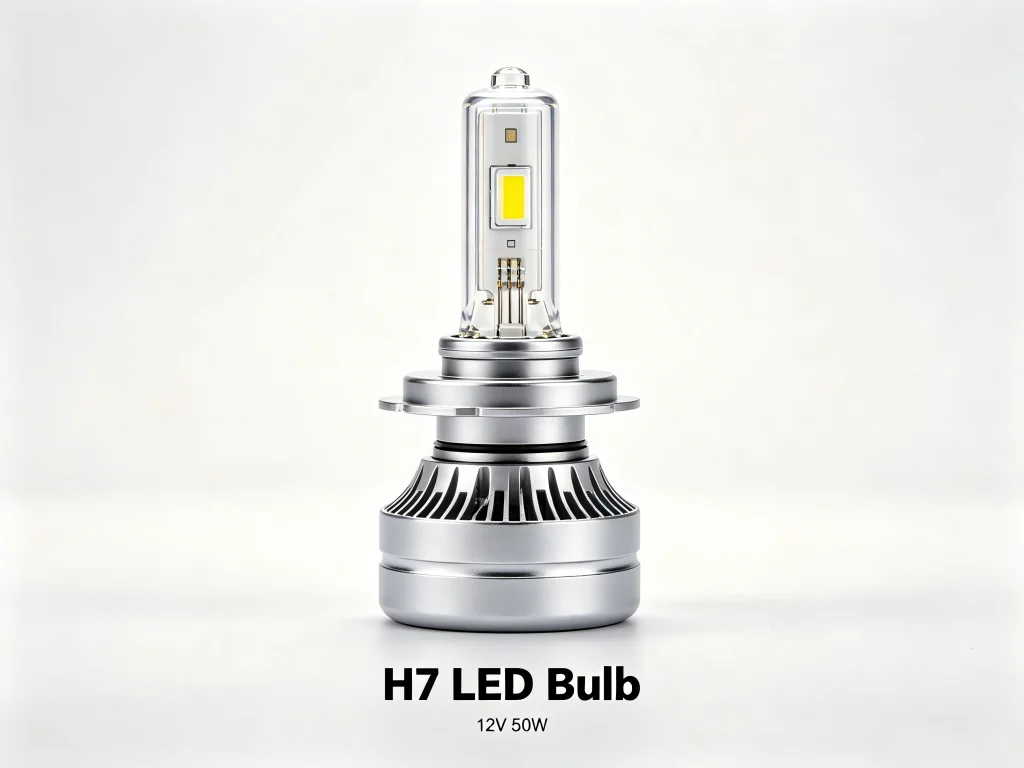
“1:1 mini size” is the most abused phrase in the LED industry. A true 1:1 design means the LED chips are positioned in exactly the same location as the halogen filament. The thickness of the bulb body must match the original. The base must lock in with zero play. If any of these dimensions are off—even by a millimeter—your beam pattern is ruined.
Projector housings are especially unforgiving. The h7 led bulb for projector headlights must have its chips oriented at a precise angle to work with the lens. Most generic LEDs ignore this entirely.
Problem 3: Heat Management Failures
LEDs generate heat. A lot of heat. The chips themselves are tiny, but they’re packed into a space no bigger than your thumb. If that heat isn’t pulled away efficiently, the chips degrade. Brightness drops. Color shifts from white to yellow. Then they fail completely.
Cheap bulbs use undersized heat sinks or slow fans. Expensive bulbs use copper heat pipes and high-speed turbine fans. But even expensive bulbs can fail if the thermal design doesn’t match the specific demands of your vehicle’s housing.
The Real Cost of a Bad H7 LED Upgrade
Let’s add this up:
- Time wasted: 4-6 hours of installation, troubleshooting, and forum searching
- Money wasted: $50-$150 on the bulbs themselves, plus potential return shipping fees
- Safety risk: Poor visibility at night, or worse—oncoming drivers blinded by glare
- Vehicle damage: Some CANBUS resistors generate excessive heat that can melt wiring harnesses
- Stress: The constant anxiety of wondering if your headlights will fail mid-drive
And for what? To save $30 on a bulb that’s supposed to last 50,000 hours but fails in six months?
What Actually Works: The GTR Solution
After analyzing thousands of failed installations, we engineered the GTR H7 LED bulb differently. Not with more lumens—with more intelligence.
True CANBUS Integration
Every GTR H7 LED bulb features built-in CANBUS decoders that communicate directly with your vehicle’s computer. No external resistors to melt your wiring. No coding required. No dashboard errors. No flickering. Our engineering team tested the GTR H7 across 200+ vehicle models, from BMW to Mercedes to Toyota to Ram. The result? Error-free performance in 99% of applications.
Filament-Perfect Beam Pattern
The GTR Ultra Series uses automotive-grade multi-core LED chips positioned with micron-level precision to match the original halogen filament location. In projector housings, the beam pattern produces a razor-sharp cutoff line with zero glare. In reflector housings, the light distributes evenly without hotspots or dark spots.
One customer wrote: “Installed these in my 2019 Outlander. Made a huge difference. Very bright white light. No flickering. No CANBUS issues. The beam pattern is exactly the same as the halogen—but way brighter”.
Advanced Thermal Management
The GTR Ultra Series 2.0 uses a copper heat pipe system and a high-efficiency turbine fan that pulls heat away from the chips at 8,500+ RPM. The result: stable light output for the life of the bulb, with no degradation.
Real-World Performance Numbers
| ข้อกำหนด | Halogen H7 | Generic H7 LED | GTR Ultra 3.0 H7 LED |
|---|---|---|---|
| Luminous Flux (Raw) | 1,500 lm | Varies (often inflated) | 4,700 lm |
| การใช้พลังงาน | 55 วัตต์ | 16W-130W | 43W |
| อุณหภูมิสี | 3,200K (yellow) | 6,000K-6,500K | 5,750K (natural white) |
| ความเข้ากันได้กับ CANBUS | ไม่เกี่ยวข้อง | Often unreliable | 99% vehicle compatibility |
| รูปแบบลำแสง | Factory spec | Often misaligned | Filament-perfect |
| อายุขัย | 400-1,000 hours | Varies | 50,000+ ชั่วโมง |
Frequently Asked Questions About H7 LED Bulbs
Why do my H7 LED bulbs flicker?
Direct Answer: Your vehicle’s computer is sending pulsed voltage to detect bulb status, and the LED’s lower power draw triggers error warnings. The fix is CANBUS-compatible bulbs with built-in decoders that mimic halogen electrical signatures.
Are H7 LED bulbs legal?
In many countries, LED bulbs are not street legal when used in halogen housings because beam patterns can differ and cause glare. Some models from brands like Osram and Philips have ECE approval for specific vehicles. Always verify local regulations.
What’s the difference between H7 LED for projector vs reflector?
Projector housings require precise LED chip positioning to match the filament location. Reflector housings are more forgiving but still need proper orientation to avoid scatter. GTR bulbs are engineered for both applications.
How bright should an H7 LED bulb be?
A quality H7 LED should produce 3,000-5,000 lumens per pair. Claims of 60,000+ lumens are often exaggerated. Focus on beam pattern quality over raw lumen numbers.
Do H7 LED bulbs need resistors?
If the bulb isn’t CANBUS-compatible, you’ll need external resistors to prevent errors and flickering. Quality bulbs like GTR have built-in CANBUS decoders that eliminate this need.
Can I install H7 LED bulbs myself?
Yes—most H7 LEDs are designed for plug-and-play installation. However, ensure your bulb has a true 1:1 design to fit the housing without modification.
How long do H7 LED bulbs last?
Quality LEDs last 30,000-50,000 hours. Cheap LEDs may fail within months due to poor thermal management.
Why is my H7 LED bulb dim after a few months?
Heat degradation. If the cooling system isn’t adequate, the LED chips lose brightness over time. Quality thermal management prevents this.
Don’t Settle for Disappointment
You’ve read the reviews. You’ve watched the videos. You’ve wasted enough time and money on cheap h7 led bulb upgrades that don’t deliver. The difference between a failed upgrade and a transformative one isn’t the price tag—it’s the engineering behind the bulb.
GTR doesn’t just sell bulbs. We solve the problems that other manufacturers ignore: CANBUS errors, beam pattern failures, heat degradation, and installation headaches. Every GTR H7 LED bulb is engineered from the ground up to work with your vehicle, not against it.
Stop gambling with your safety. Stop blinding oncoming traffic. Stop wasting weekends troubleshooting flickering lights. Get the H7 LED bulb that actually works.
เยี่ยมชม GTR Lighting วันนี้ and see why thousands of drivers have made the switch. Your car deserves better. Your nighttime drives deserve better. You deserve better.