Night driving should not feel like gambling with your safety. Yet thousands of drivers push through poorly lit highways, backroads, and off-road trails every night with driving lights that simply cannot deliver. The problem is not the darkness. The problem is that most auxiliary lighting—even many so-called “premium” options—fails when you need it most.
Based on our years of manufacturing expertise in the automotive LED sector, we have tested hundreds of lighting configurations across real-world conditions. What we have discovered is sobering: most drivers are running around with lights that offer impressive-looking lumen numbers on the box but completely fall apart in actual performance.
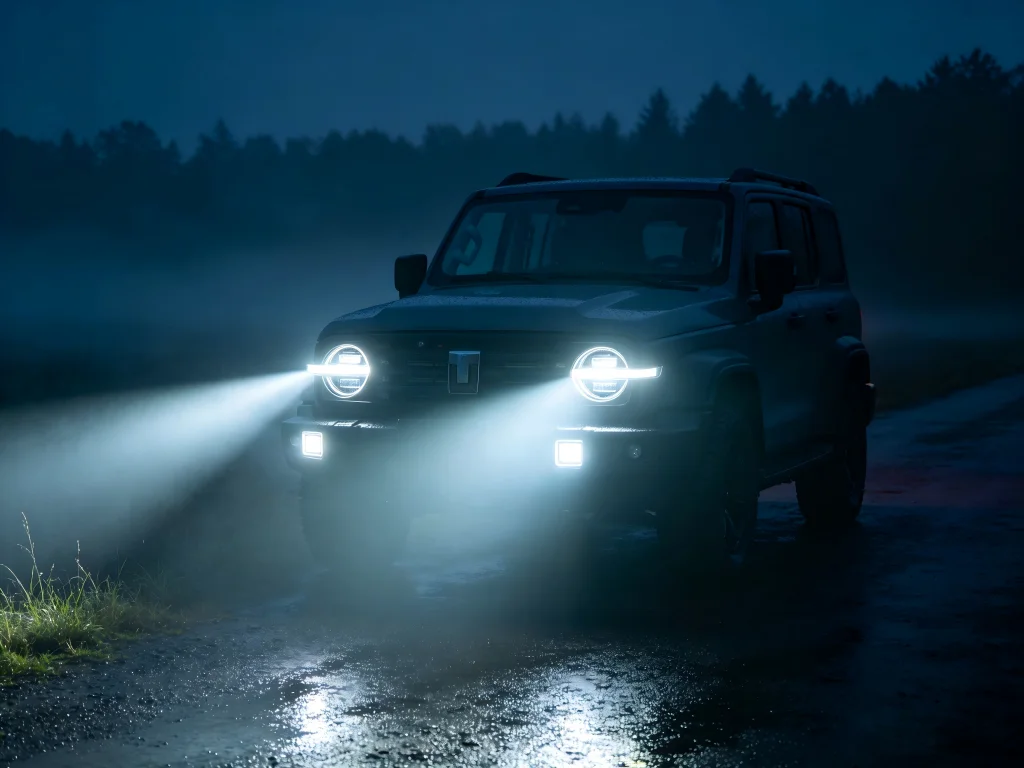
The Real Problem: Your Driving Lights Are Lying to You
The uncomfortable truth about most driving lights on the market today is that their performance claims are based on laboratory conditions that bear almost no resemblance to how you actually drive. Raw lumen figures—the numbers plastered across product packaging—measure theoretical LED output, not what reaches the road. A light rated at 10,000 raw lumens may deliver only 7,000 effective lumens after thermal losses, optical inefficiencies, and absorption through the lens.
That gap between claimed and actual performance is not trivial. At 100 km/h, you cover 100 meters every 3.6 seconds. A driving light that fails to illuminate a hazard 400 meters ahead gives you less than 15 seconds to react. A quality unit that throws useful light to 900 meters gives you over 30 seconds. The difference is the margin between a close call and a collision.
What Happens When Your Lights Cannot Deliver
Consider a typical scenario: you are driving on a rural highway at night. The road is unlit. Your factory headlights reach maybe 100 meters ahead. You have installed aftermarket driving lights—or so you thought. But at 80 km/h, you are overtaking the effective range of your lights every few seconds. Kangaroos, deer, or stray livestock can appear from the treeline with almost no warning.
This is not just about inconvenience. The Insurance Institute for Highway Safety has found that approximately 16% of vehicle lighting systems tested are rated marginal or poor due to inadequate visibility. When your driving lights underperform, you are not just struggling to see—you are actively increasing your crash risk.
Why Most “Bright” Driving Lights Fail in the Real World
The disconnect between marketing claims and real-world performance stems from three critical issues that cheaper driving lights simply cannot overcome.
1. The Raw Lumens Trap
Manufacturers love quoting raw lumens because the number is always higher. But raw lumens are a theoretical calculation—multiplying each LED’s maximum output by the number of LEDs in the unit. This figure ignores the 10% to 25% (or more) losses that occur in every real-world system.
A high-quality driving light from GTR, by contrast, is measured by effective lumens and—more importantly—lux at distance. One lux is roughly the amount of light needed to read a newspaper. The further a light can project one lux, the better its real-world performance. A superior driving light may achieve one lux at 900 meters or more; an inferior unit might struggle to reach 400 meters. Both might claim similar lumen outputs. The difference is staggering.
2. Heat: The Silent Killer of LED Driving Lights
The biggest enemy of any LED is heat. When LEDs overheat, their output drops. Their lifespan shortens. In extreme cases, they fail entirely.
Cheaper driving lights cut corners on thermal management. They use undersized heat sinks, poor-quality aluminum alloys, or inadequate passive cooling. Run them at full output—especially in hot Australian conditions or on an idling vehicle with no airflow—and thermal degradation begins almost immediately. The light that seemed bright in your garage dims noticeably after 20 minutes of actual driving.
Premium driving lights from GTR incorporate advanced thermal path engineering. The housing itself acts as a heat sink. The LED drivers are thermally compensated to maintain consistent output regardless of ambient temperature. This is not a luxury feature—it is the difference between a light that performs and one that merely pretends to.
3. Beam Pattern Confusion
Even if your driving lights produce sufficient lumens and manage heat effectively, the beam pattern determines whether that light is actually usable. Spot beams offer long, narrow reach—ideal for distance but useless for peripheral vision. Flood beams spread wide but lack distance. Combo beams attempt both but often compromise on both.
Most drivers have no idea which beam pattern suits their needs. They buy whatever looks impressive and hope for the best. The result? Driving lights that either blind oncoming traffic or fail to illuminate the road ahead.
What Quality Driving Lights Should Actually Deliver
Let us be direct about what proper driving lights should provide. After years of engineering testing and real-world validation, we have identified four non-negotiable performance criteria.
Long-Range Visibility Without Guesswork
Your driving lights should project useful light far enough ahead that you have ample time to identify and react to hazards. For highway driving at 100 km/h, that means at least 500 meters of effective range. For off-road conditions at lower speeds, a combination of distance and width becomes more relevant.
Consistent Output, Not Initial Flash
Quality driving lights maintain their output over hours of operation. They do not dim as they heat up. They do not flicker. They do not shift color temperature as the driver temperature rises. What you see in the first minute is what you get in the 60th minute.
Legal Compliance Where It Matters
In markets like Australia, driving lights must comply with Australian Design Rules (ADR 13/00 for installation and ADR 101/00 for LED performance). Many off-road-only lights are not ADR-compliant and cannot be legally used on public roads. Using non-compliant lights risks fines, demerit points, and potentially voided insurance. A reputable manufacturer clearly states compliance status for each product.
Durability That Matches the Environment
Your driving lights should survive dust, water, vibration, and temperature extremes. This means IP67 or IP68 sealing, robust polycarbonate lenses, and corrosion-resistant housings. Cheap lights cut corners on sealing and materials. They may work for a season. They will not last for years.
GTR Driving Lights: Engineering That Actually Solves the Problem
At GTR, we do not believe in selling lights that merely look good on a spec sheet. Our driving lights are engineered from the ground up to deliver consistent, reliable performance in the conditions where you actually drive.
We use advanced LED chipsets with precision optics designed to maximize effective lumens and lux at distance. Our thermal management systems ensure output remains stable even under sustained high-load operation. Every unit undergoes rigorous testing—including photometric analysis—to verify real-world performance before it reaches you.
We also understand that driving lights are not a one-size-fits-all product. Whether you need long-range spot beams for highway touring, wide flood patterns for technical off-road trails, or a combo beam that balances both, GTR offers solutions designed for your specific application.
Stop Accepting Mediocre Driving Lights
You have probably spent money on driving lights that promised the world and delivered disappointment. You have probably driven home at night wondering why you cannot see as far as you should. You have probably felt that knot of anxiety when a dark highway stretches ahead and your lights are not keeping up.
That ends now.
Quality driving lights are not an expense—they are an investment in your safety, your confidence, and your peace of mind. The difference between adequate lighting and exceptional lighting is the difference between reacting to a hazard and anticipating it.
Посетите https://www.rhgtr.com to explore our range of premium driving lights. See the specifications. Review the photometric data. Compare the performance. Then make a decision that actually improves your night driving experience.
Because the darkness is not going to get any lighter. Your driving lights should.
Driving Lights FAQ: Your Most Common Questions Answered
What is the difference between lumens and lux in driving lights?
Lumens measure the total volume of light emitted from the source. Lux measures the intensity of that light when it hits a specific surface at a distance. For driving lights, lux at distance is the more meaningful metric—it tells you how far the light actually reaches.
Are LED driving lights better than halogen?
Yes, significantly. LED driving lights consume about 20 watts where a comparable halogen may use 125 watts, while delivering more light and lasting up to 50,000 hours—roughly 10 times longer than halogen. The light output is also cleaner and whiter, improving visibility of road markings and hazards.
Can I use any driving lights on public roads in Australia?
No. Many driving lights are marked “off-road only” and are not legal for public road use. To be road-legal in Australia, driving lights must comply with Australian Design Rules (ADR 13/00 and ADR 101/00). Always check for ADR compliance labeling before purchasing.
How many driving lights can I legally fit to my vehicle?
In most Australian jurisdictions, you may fit up to four additional driving lights to the front of your vehicle. They must be front-facing and mounted no higher than the front edge of the bonnet if fitted to a bull bar.
What beam pattern is best for my driving needs?
Spot beams excel at long-distance visibility—ideal for highway and rural driving. Flood beams provide wide coverage for close-range and off-road situations. Combo beams offer a balance of both. Consider your primary driving environment: distance for touring, width for technical trails, and combo for mixed use.
Why do my LED driving lights seem dimmer after extended use?
This is likely thermal degradation. As LEDs heat up, their output drops unless the thermal management system is adequate. Premium driving lights incorporate advanced heat sinking and thermal compensation to maintain consistent output regardless of operating temperature.
How far should quality driving lights project useful light?
A quality pair of driving lights should achieve one lux at 800 meters or more. Some premium units exceed 1.5 kilometers. At 100 km/h, every additional 100 meters of effective range gives you roughly 3.6 seconds of additional reaction time.