You are riding home. The forecast said light rain, but the mountain pass has other plans. A thick, gray wall of fog swallows the road ahead. You flip on your auxiliary lights—the ones you bought because the listing promised “20,000 lumens of ultimate brightness”—and the world turns into a blinding white wall. You cannot see the center line. You cannot see the shoulder. You can barely see your own handlebars. That is not a lighting upgrade. That is a safety liability.
In our engineering testing at GTR, we see this exact scenario play out with alarming consistency. The problem is rarely a lack of brightness. The problem is that most motorcycle fog lights on the market are not actually fog lights at all. They are floodlights, spotlights, or repurposed off-road pods dressed up with a fog-light label. And in real fog, rain, or snow, the wrong beam pattern does not just fail to help—it actively makes you more dangerous.
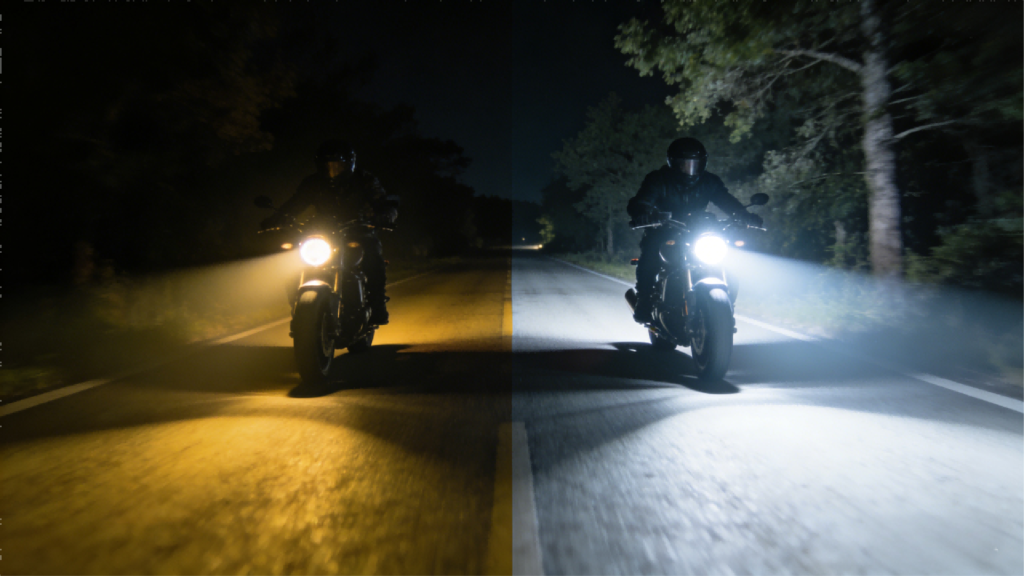
The Problem: Why Your Current Lights Are Useless in Bad Weather
Most motorcycle fog lights fail in poor visibility because they lack a sharp horizontal cut-off line and project light upward into the water droplets, creating a reflective wall that blinds the rider instead of illuminating the road.
Here is what happens every time you ride into fog with a standard reflector-based auxiliary light. The LED chip fires light in every direction. The reflector bowl bounces it forward and slightly up. In clear conditions, that upward spill seems harmless—maybe even helpful for reading road signs. But fog is not clear air. It is a suspension of microscopic water droplets. When your light hits those droplets from below, the light scatters backward, straight into your eyes. The result is a phenomenon our engineers call the “Wall of White.” You are not lighting the road. You are lighting the fog itself, and the fog is winning.
This is not a minor inconvenience. It is a critical safety failure. A rider traveling at 60 km/h covers nearly 17 meters per second. If your effective visibility drops to 10 meters because your lights are bouncing off the fog, you have less than one second to react to a fallen branch, a stalled car, or a tightening corner. The stakes are that simple.
The Agitation: Why Cheap Fixes Make Everything Worse
You might think the solution is obvious: buy a brighter light. That is exactly what the aftermarket wants you to believe. Search for motorcycle fog lights amazon and you will find thousands of listings screaming about lumen counts, “military-grade” aluminum, and “laser” technology. Most of them cost less than a tank of gas. And most of them will fail you in the exact moment you need them most.
Here is what the listings do not tell you.
First, cheap LEDs overheat and dim. A 40-watt LED crammed into a housing with a thin aluminum slug and no active thermal path will hit junction temperatures above 110°C within fifteen minutes. The driver circuit responds by reducing current to protect the chip. Your “20,000 lumen” light quietly becomes a 6,000 lumen light just as the fog thickens. You never notice the fade because it happens gradually, but your stopping distance has just doubled.
Second, cheap seals fail. A single rubber O-ring is not a weatherproof seal. It is a temporary barrier. Through a winter of freeze-thaw cycles, that O-ring hardens, cracks, and lets moisture in. The lens fogs on the inside. The reflector corrodes. The light flickers, then dies. You paid for a season of use, not a lifetime.
Third, cheap optics scatter. A proper fog light uses a projector lens or a carefully engineered reflector to create a sharp horizontal cut-off. Light goes down and wide, not up. Budget lights skip the optics because precision tooling is expensive. Instead, they give you raw output and hope you will be impressed by the brightness long enough not to notice that you are blinding every oncoming driver and destroying your own night vision in the process.
We have torn down competitors’ units in our lab. The pattern is depressingly consistent. The claims are inflated. The engineering is absent. And the rider pays the price in reduced safety and wasted money.
The Solution: What a Real Motorcycle Fog Light Must Do
A genuine fog light solves a specific optical problem: it must place a wide, flat beam of light low on the road while preventing any meaningful light from escaping above the horizontal plane. That is the entire job. Everything else—lumens, color temperature, housing material—is secondary to that single optical requirement.
GTRでは、当社の motorcycle fog lights led platform is built around three non-negotiable principles.
Optical Discipline: The Cut-Off Line Is Everything
Our projector housings use a precision-machined internal shield to create a hard horizontal cut-off. When aimed correctly, the beam terminates cleanly just below the eye level of oncoming traffic. In fog, that means the light hits the road surface and the immediate shoulder, then stops. It does not climb into the water droplets. It does not bounce back. The difference between a sharp cut-off and no cut-off is the difference between seeing the road edge and staring into a white void.
We also engineer the beam width deliberately. Fog lights should illuminate a wide arc—typically 60 to 70 degrees—so you can see the road margins and any debris that has drifted into your path. A narrow spot beam is useless here. It throws light far down the road, but in fog, “far” is irrelevant. You need to see what is immediately around you.
Thermal Stability: Brightness That Does Not Fade
Our fog light assemblies use automotive-grade CSP chips mounted on copper-core PCBs, with a thermal path that conducts heat into the housing body rather than trapping it at the junction. In our long-duration bench tests, GTR units maintain over 90% of initial output after two hours of continuous operation at ambient temperatures up to 40°C. Cheap units in the same test lose half their output within twenty minutes.
This matters because fog does not care about your first thirty seconds of brightness. It cares about the next two hours of your ride.
Sealed Against the Real World
Every GTR fog light uses a dual-lip silicone gasket and a hydrophobic pressure-equalization vent. The vent allows air to move in and out as the housing heats and cools, preventing the pressure differential that pulls moisture past seals. The gasket remains flexible from -40°C to 120°C. We do not rate our units “waterproof” and hope for the best. We build them to survive the condensation cycle that kills ordinary lights.
| 特徴 | Typical Budget Fog Light | GTR Motorcycle Fog Light |
|---|---|---|
| ビーム制御 | Scattered, no cut-off | Sharp horizontal cut-off, 70° wide |
| 熱管理 | Thin aluminum, rapid fade | Copper-core PCB, sustained output |
| Sealing | Single O-ring, prone to leaks | Dual-lip silicone + pressure vent |
| レンズ素材 | Plastic, yellows and scratches | Tempered HD glass |
| Effective Fog Performance | Poor—creates backscatter | Excellent—illuminates road, not fog |
What Riders Actually Say After Switching
We monitor rider forums and owner groups because the feedback loop matters. A consistent theme emerges when riders move from generic auxiliary lights to properly engineered fog optics. One adventure rider on a StromTrooper thread put it bluntly: “My HID lights are useless in fog. All they do is light up the immediate front of the bike and reflect back at me” . Another rider, describing a dual-color setup with amber mode, noted that the amber fog mode was “the real deal” for commuting through rain and fog, and that the difference was felt “on the first wet ride” .
The pattern is not brand loyalty. It is physics. When the beam pattern is correct, the rider notices immediately. The road appears. The glare disappears. The anxiety lifts. That is what a fog light is supposed to do.
We also hear from riders who tried the budget route first. A common story: the lights worked brilliantly for the first month, then began flickering after a rainstorm, or dimmed noticeably on a long night ride. These are not isolated defects. They are predictable outcomes of cutting corners on thermal design and sealing. The money saved upfront is spent again on a replacement—or worse, on a recovery after a crash that better visibility might have prevented.
よくある質問
Are yellow motorcycle fog lights better than white?
For fog, rain, and dust, yes. Yellow light (around 3000K) scatters less off airborne particles than cool white (6000K+), which means less glare reflected back at the rider. Yellow also increases contrast on road edges and debris. White is better for clear-condition distance lighting, but if your primary goal is foul-weather visibility, amber or yellow is the right choice. Many GTR-compatible setups allow you to run either.
Do I need a special bracket for motorcycle fog lights?
It depends on your bike. Most universal fog lights use a clamp-style motorcycle fog lights bracket that mounts to engine guards, crash bars, or fork tubes. Bar diameter matters—common sizes are 22mm, 25mm, and 28mm. For models with factory fog light cutouts, vehicle-specific brackets provide a cleaner install and better beam aim. GTR offers mounting solutions for common adventure and touring platforms.
Can I wire motorcycle fog lights directly to my battery?
You can, but you should not run them without a relay and a switch. A direct battery connection without a relay risks overloading the factory harness or draining the battery if you forget to turn them off. A proper motorcycle fog lights wiring diagram includes a fused relay triggered by an ignition-switched source, so the lights turn off with the bike. This is the safe standard.
Are motorcycle fog lights legal in the UK?
UK regulations require front fog lamps to be used only in “seriously reduced visibility” and to be switched off when visibility improves. They must not cause undue dazzle to other road users . For MOT purposes, fog lights must be securely mounted and functional, but auxiliary lights are not tested for beam pattern the way headlights are. However, if they can be switched on and blind the tester, that is a fail . Aim them low and keep a separate off switch.
What is the difference between fog lights and driving lights?
Fog lights have a wide, low beam with a sharp cut-off to illuminate the road surface in poor visibility. Driving lights have a narrower, longer-throw beam designed to supplement high beams in clear conditions. Using driving lights in fog is counterproductive—they project light upward and create glare. If you ride in mixed conditions, a dual-color or switchable setup is the practical answer.
The GTR Difference: Engineered for the Ride You Actually Take
We are not a generic accessory brand. GTR builds lighting systems for riders who understand that visibility is not a cosmetic upgrade. Our motorcycle fog lights are designed in-house, tested in real weather conditions, and manufactured to tolerances that budget brands cannot match. Whether you need a compact 3-inch projector for a tight fairing or a dual-color pod for an adventure rig, our engineering team has done the optical work so you can focus on the road.
If you are tired of guessing whether your lights will work when the fog rolls in, stop guessing. Visit https://www.rhgtr.com to see the full lineup of GTR motorcycle fog lights. Your next ride in bad weather does not have to be a white-knuckle gamble. It can be just another ride—because you can see.