Your headlights are on, yet the road still feels dark. You install brighter H7 LED bulbs, expecting an instant upgrade. Instead, you may get scattered light, dashboard errors, flicker, poor fitment, or a beam that looks bright against a garage wall but performs badly on a wet road.
That is the frustrating truth about H7 upgrades: more claimed lumens do not automatically create better driving light.
For drivers, installers, distributors, and automotive lighting buyers, the real goal is not simply finding the brightest LED. It is creating usable light where the driver needs it while controlling glare, heat, electrical compatibility, and fitment.
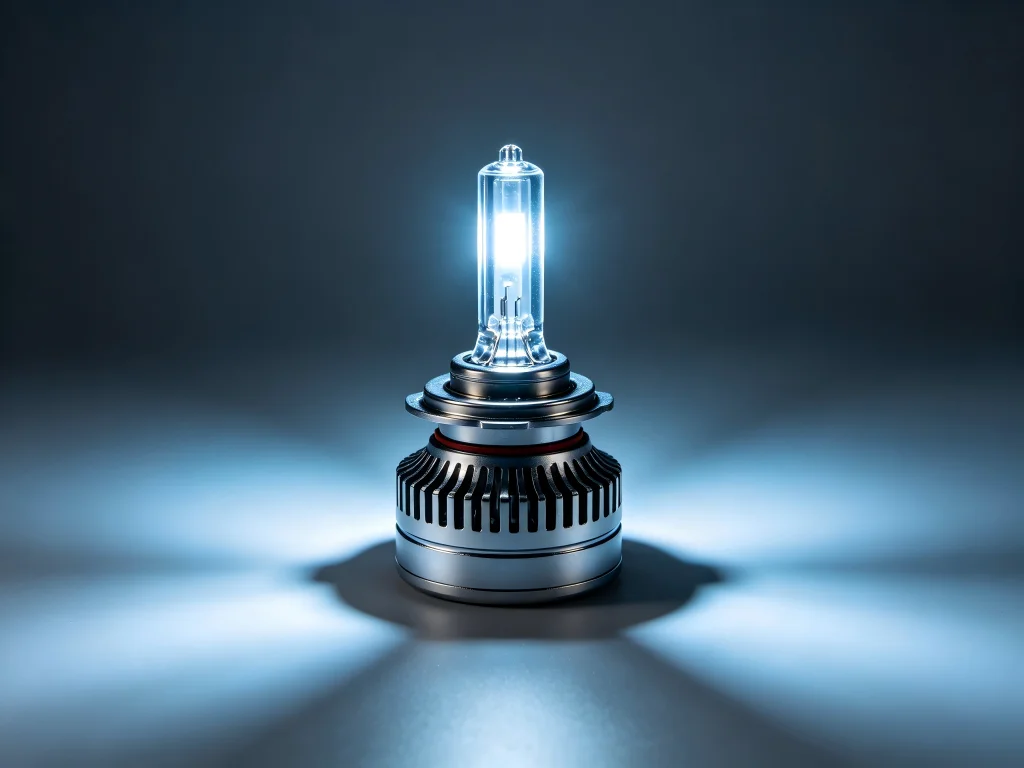
Why Can H7 LED Bulbs Perform Worse Than Expected?
H7 LED bulbs can perform poorly when their LED chips do not reproduce the position and geometry of the original halogen filament. The result may be excessive foreground light, a weak hotspot, scattered glare, or an unclear cutoff. Good optical compatibility matters more than a huge advertised lumen figure.
An H7 halogen lamp is a simple-looking component built around a precise optical relationship. The filament sits at a defined position relative to the reflector or projector optics.
Change that light-emitting position and you change what the headlamp does with the light.
This explains a common complaint:
“My new LEDs look much brighter, but I cannot actually see farther.”
The LED may indeed produce more raw light. But if the headlamp cannot collect and project that light correctly, much of the extra output could go somewhere you do not need it.
The Problem Is Usually Optical, Not Just Electrical
Think of your headlamp as an optical system rather than a bulb holder.
The bulb creates light. The reflector or projector collects it. The shield and lens control its shape. The final beam places that light on the road.
For this reason, we pay close attention to LED chip position and light-emitting surface geometry when evaluating an H7 design. A compact light source that better approximates the original filament position tends to give the optical system a better starting point.
Problem #1: Your Halogen H7 Headlights Feel Too Dim
Older halogen H7 lamps commonly produce a warmer beam than modern LED systems. Drivers may especially notice the difference on unlit roads, during rain, or when moving between bright urban areas and darker roads.
The obvious response is to search for the highest-lumen H7 LED bulbs available.
That can be the first mistake.
Why Extreme Lumen Claims Can Mislead Buyers
A product page might promote 20,000, 30,000, or even more lumens. That number alone tells you very little about the actual beam.
For practical driving performance, evaluate:
- LED chip geometry
- hotspot intensity
- beam distribution
- cutoff control
- thermal stability
- temperatura del colore
- optical compatibility with the headlamp
A well-engineered bulb with controlled output may create more useful road illumination than an aggressively driven LED with a much larger marketing number.
Problem #2: The Beam Is Bright but Creates Glare
Glare often appears when an LED light source does not match the optical position of the original H7 filament. The reflector or projector then sends light outside its intended zones. Correct chip placement, bulb orientation, headlamp compatibility, and beam alignment can therefore matter more than maximum electrical power.
This problem becomes obvious when another driver flashes their high beams at you even though your low beams are selected.
That is not a sign of a successful upgrade.
It could mean the beam has lost control.
Why a Thin LED Board Can Matter
In our engineering evaluation of replacement LED designs, one factor we examine is the distance between the light-emitting surfaces.
If the LED board and chip arrangement create a light source that is much thicker than the original filament geometry, the optical focus can shift.
A compact architecture can help reduce this difference.
But bulb geometry is only part of the equation. The headlamp itself still determines whether a retrofit LED can produce an acceptable beam.
Problem #3: H7 LED Bulbs for Projector Headlights Look Weak
Le ricerche per H7 LED bulbs for projector headlights often come from drivers who already tried an LED upgrade and were disappointed.
Projectors can be unforgiving.
The internal reflector, shield, focal point, and lens work together within tight tolerances. If the LED chip sits too far forward, backward, or sideways, the projector may lose hotspot intensity.
The driver sees a clean white beam but gets poor distance illumination.
What Should You Check in a Projector?
- Confirm the bulb fitting. H7 refers to the fitting, but the headlamp design still varies by vehicle.
- Check the mounting adapter. Some vehicles need a model-specific H7 holder or collar.
- Inspect chip orientation. Incorrect orientation can alter beam distribution.
- Compare hotspot performance. Do not judge the bulb only by brightness close to the car.
- Test the cutoff. A controlled low-beam pattern is critical.
Problem #4: The Dashboard Says the Bulb Has Failed
You install the LEDs. They work.
Then the dashboard reports a lighting fault.
This is where searches for H7 LED bulbs CANbus error free e H7 LED bulbs with CANbus begin.
Why Does CANbus Create LED Errors?
Many vehicles monitor exterior lighting circuits. LED lamps generally consume less power than traditional incandescent or halogen light sources. The vehicle may interpret the changed electrical load as a failed bulb.
Some vehicles also use pulse-width modulation, which may contribute to flickering or other compatibility issues with certain LED systems. Philips, for example, describes CANbus adapters as a solution for some false bulb-failure warnings caused by the lower power consumption of LEDs. Philips Automotive Lighting
The lesson is simple: “CANbus compatible” should not be treated as a universal guarantee.
Different vehicles use different monitoring strategies.
Built-In Decoder vs External CANbus Adapter
| Caratteristica | Built-In CANbus Design | External Decoder |
|---|---|---|
| Installazione | Cleaner and simpler | Extra wiring required |
| Housing space | Usually easier | May require more room |
| Heat sources | More integrated | Additional component outside bulb |
| Vehicle coverage | Depends on driver design | Can solve specific load-related issues |
| Serviceability | Whole bulb may need replacement | Decoder can sometimes be replaced separately |
Problem #5: The LED Fits the Socket but Not the Headlamp
“H7” does not mean “fits every H7 vehicle without accessories.”
Halfords notes that H7 bulbs share a common fitting but compatibility still depends on vehicle and headlamp design, and some cars may require adapters.
Real-world installation may be affected by:
- retaining clips
- OEM bulb holders
- rear dust covers
- heat sinks
- cooling fans
- electrical connectors
- limited internal headlamp space
This is why compactness is not merely cosmetic.
A huge fan and driver may look powerful in an online listing, yet create installation problems inside a tightly packaged European or Asian headlamp.
Problem #6: LED Output Drops After the Bulb Gets Hot
Turn on a high-output LED and it may look impressive during the first minute.
The harder test comes later.
LED junction temperature rises during operation. If heat cannot move efficiently from the chips into the substrate, heat sink, and surrounding air, the driver may reduce power to protect the system.
The result can be thermal droop.
This is why serious testing should compare output after warm-up rather than only recording cold-start brightness.
What We Look for in Thermal Design
Based on our manufacturing experience, a dependable H7 platform should balance several elements:
- efficient thermal transfer from LED chips
- stable driver electronics
- adequate heat-sink surface area
- reliable fan performance where active cooling is used
- dust and moisture resistance appropriate to the design
- stable output after extended operation
Problem #7: “H7 LED Bulbs Road Legal UK” Is Confusing
Drivers should not assume an aftermarket H7 LED retrofit is road legal in the UK simply because the bulb fits or produces a good beam. Current GOV.UK MOT guidance states that qualifying halogen headlamp units must not be converted to use LED bulbs where the light source and lamp are incompatible.
This is an area where marketing claims can create costly confusion.
Under the current MOT inspection manual for cars and passenger vehicles, existing halogen headlamp units on vehicles first used on or after 1 April 1986 must not be converted for use with LED or HID bulbs. A light source and lamp incompatibility is classified as a major defect.
Complete replacement headlamp units manufactured for LED use are treated differently, provided they meet the applicable requirements.
For current rules, buyers should check the official UK MOT Inspection Manual rather than relying on a marketplace listing.
Why GTR Approaches H7 LED Bulbs as an Optical System
The difference between a commodity LED and a professional automotive lighting product begins with engineering priorities.
At GTR, the target is not simply to push more electrical power through the LED chips.
Our development philosophy focuses on the relationship between:
light source → optical focus → beam pattern → thermal control → electrical compatibility → installation.
That approach is especially valuable for professional distributors, wholesalers, automotive lighting specialists, and retrofit businesses that cannot afford high return rates caused by flickering, adapters, poor beam patterns, or premature thermal failure.
What B2B Buyers Should Ask Before Ordering
Instead of asking only, “How many lumens does it have?”, ask your supplier:
- Can you show actual beam-pattern testing?
- How close is the LED emitting position to the original H7 filament?
- What happens to output after 30–60 minutes?
- Which vehicles may require additional CANbus modules?
- Which vehicles need special H7 adapters?
- What cooling architecture is used?
- Can you provide OEM, ODM, packaging, and branding support?
- How are production consistency and quality controlled?
Real-World Feedback: What Installers Actually Care About
Across automotive lighting communities, installer discussions tend to return to the same practical issues.
A typical experienced installer cares less about an enormous lumen claim and more about whether the bulb seats correctly, maintains a clean beam, closes under the dust cap, avoids dashboard errors, and performs consistently after warming up.
That reflects what we see from professional buyers as well.
The best product on a spreadsheet is not always the best product in a headlamp.
H7 LED Bulbs FAQ
Are H7 LED bulbs brighter than halogen?
They can produce more and whiter light, but useful road performance depends on beam distribution, optical compatibility, thermal stability, and headlamp design rather than raw lumen output alone.
What are the best H7 LED bulbs for projector headlights?
Look for compact LED chip geometry, accurate positioning, adjustable orientation where appropriate, stable thermal management, and proven beam performance in projector optics.
What does CANbus error free mean?
It usually means the LED system is designed to reduce dashboard bulb-out errors or flicker in vehicles with lamp monitoring. It does not guarantee compatibility with every vehicle.
Are H7 LED bulbs road legal in the UK?
Do not assume retrofit H7 LEDs are road legal. For qualifying cars originally equipped with halogen headlamp units, the current MOT manual prohibits conversion to incompatible LED light sources. Check current official rules for the specific vehicle and headlamp.
Are H7 LED bulbs from Amazon all the same?
No. Products can differ significantly in optical geometry, driver design, thermal management, CANbus behavior, output stability, warranty, and manufacturing consistency.
Are Philips H7 LED bulbs good?
Philips is a major automotive lighting manufacturer and publishes detailed vehicle compatibility information for certain LED products and markets. Compatibility and approval can depend on the exact vehicle, headlamp approval, accessory, country, and product version.
Can I find H7 LED bulbs near me?
Ricerche come H7 LED bulbs near me, H7 LED bulbs nearby, e H7 LED bulbs Halfords can help locate retail replacements. Professional retrofit shops and distributors should also verify optical compatibility and electrical requirements before installation.
Stop Buying H7 LEDs by Lumen Claims Alone
A headlight upgrade should help the driver see the road, not merely make the headlamp look brighter.
If you are a distributor, wholesaler, retrofit chain, or automotive lighting brand, poor beam control and unstable electronics can become warranty claims, negative reviews, and lost customers.
GTR develops automotive lighting products around practical optical performance, installation needs, heat control, and B2B market requirements.
If your market needs an H7 LED solution built for professional aftermarket distribution rather than another generic high-lumen listing, explore GTR automotive lighting solutions at www.rhgtr.com. Bring us your vehicle applications, target market, and performance requirements—and build an H7 program around what your customers actually need on the road.