The Hidden Frustration Wrecking Your Dual-Color Projects
You order a batch of bi color LED components for a new control panel design. You follow the spec sheet, solder everything in place, power up the circuit — and nothing works the way it should. One color glows dimly while the other barely flickers. Or worse, both channels refuse to light at all. Your production schedule slips. Your client grows impatient. You stare at the schematic wondering what went wrong.
This exact scenario plays out hundreds of times every week in workshops, factories, and engineering labs around the world. A builder on a popular electronics forum recently described spending three days troubleshooting a bi-color LED that refused to cooperate because — unbeknownst to him — his entire batch was common cathode when his PCB required common anode. “Problem solved,” he wrote, “and also created a new problem. Good times!”[reference:0]
The truth is that luci LED bicolore appear deceptively simple on the surface: two LED dies in one package, two colors, straightforward wiring. But the gap between how they should work and how they actually behave in real circuits catches even seasoned engineers off guard.
Why Most Bi-Color LED Implementations Fail — And Why It Keeps Happening
The Common Cathode / Common Anode Trap
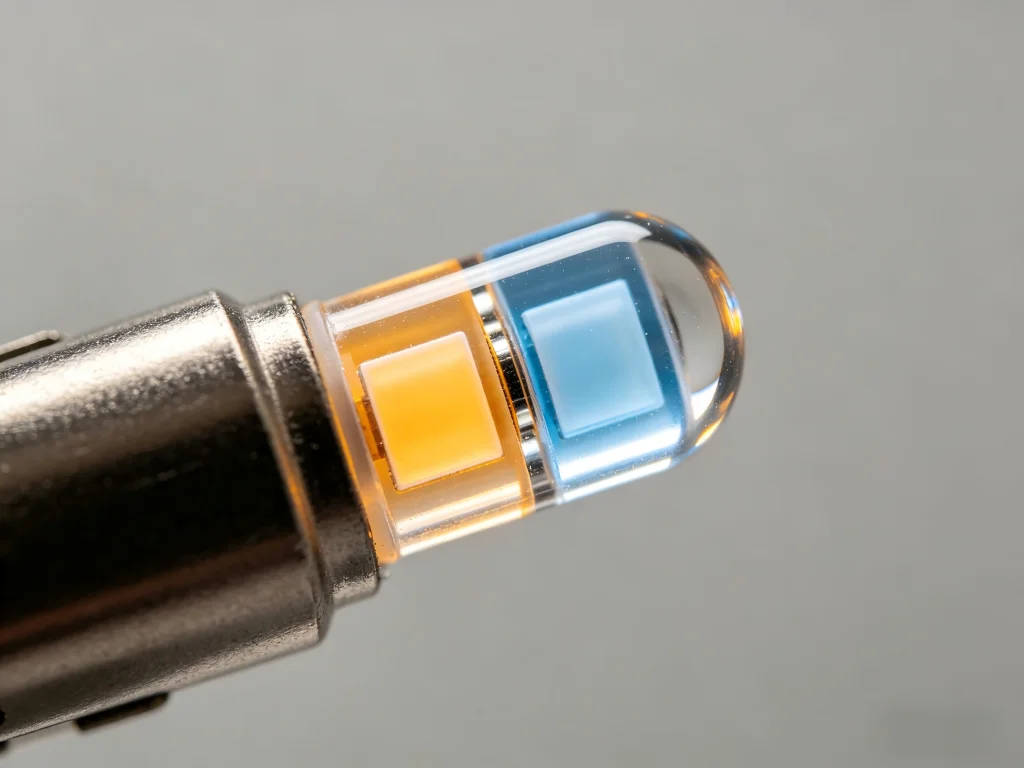
The single most frequent source of bi-color LED failure is the polarity configuration mismatch. A bicolor LED consists of two LED dies co-packaged in a single case that either share a common anode with separate cathodes or a common cathode with separate anodes.[reference:1] If your PCB design expects a common anode LED and your supplier ships common cathode, the circuit simply will not function.
What makes this particularly maddening is that many distributors list bi-color LEDs without clearly specifying the polarity type. A designer on the Electro-Tech forum put it bluntly: “Some Bi-colour LEDs have a common Anode. Some are three leads and some are two. As for resistor placement for the 3 pin devices, it depends.”[reference:2] That single word — “depends” — sums up the entire problem. There is no universal wiring convention. Each project demands its own careful verification.
On model railroad forums, hobbyists regularly report purchasing replacement bi-color LEDs only to discover the new batch uses the opposite polarity from the original. One user recounted replacing decoder LEDs with white-red units, only to find the replacements came with a common anode — “less ‘common’ than a common cathode found on most LEDs.” The fix required replacing the entire OEM decoder board.[reference:3]
The Uneven Brightness Problem
Even when your bi-color LED lights up, you may notice one color appears significantly dimmer than the other. This is not a manufacturing defect — it is a physics problem. Different LED colors have different forward voltages. A typical red LED has a forward voltage (Vf) of approximately 1.85V, while a green LED in the same package may have a Vf of 2.2V.[reference:4]
When you use identical current-limiting resistors for both channels — a common shortcut for simplicity — the red channel receives more current and appears noticeably brighter. Engineers on Stack Exchange frequently encounter this issue, with experienced builders advising: “Various wavelengths are perceived differently — while current could be exactly 2mA each, one can still seem far brighter than the other.”[reference:5]
For applications where visual balance matters — status indicators, medical device panels, automotive dashboards — this uneven brightness can make your product look cheap or defective.
The Color Shift Nobody Warns You About
When you adjust a bi color LED panel o bi color LED video light across its color temperature range, something subtle happens. The light does not simply move from warm to cool along a straight line. Instead, the color output tends to drift off theblack body curve — the natural path that true tungsten or daylight sources follow.
Industry cinematographers have documented this phenomenon extensively. As one professional noted in the Cinematography Mailing List, bicolor LEDs take two points on the color curve and build LEDs to match only those endpoints. When you adjust between them, “that curve shifts toward green which means the straight line of bicolor LEDs is shifting magenta. And that’s exactly what many of these lights do when you start adjusting color temperature.”[reference:6]
For a content creator filming a client interview or a product photographer shooting color-critical merchandise, this green-magenta shift means extra time in post-production correcting skin tones — time that costs money and credibility.
What a Properly Engineered Bi-Color LED Solution Should Deliver
Solution: When sourcing bi color LED SMD components or complete bi color LED panel assemblies, insist on three non-negotiable specifications from your supplier before a single unit ships to your production line. First, demand complete electrical specifications — including forward voltage per color channel — before committing to a purchase. Second, verify the common cathode or common anode configuration matches your circuit design precisely. Third, for color-critical applications, require CRI and TLCI test data, not just marketing claims.
A bi color LED common cathode configuration offers distinct advantages in many designs. With a shared cathode and separate anodes, you can drive each color independently with its own optimized current-limiting resistor. This solves the uneven brightness problem at the engineering level. With a three-lead common cathode device, applying positive voltage to both anodes simultaneously produces a third blended color — typically amber from red and green — through additive color mixing.[reference:7]
For bi color LED circuit designs, the resistor math is straightforward but must be calculated separately for each color channel. The formula followsOhm’s Law: R = (Vsupply − Vf) / If. A red channel with Vf = 1.85V on a 5V supply at 20mA requires approximately 157Ω. A green channel with Vf = 2.2V on the same supply requires approximately 140Ω. Using a single resistor value for both channels guarantees one will be under-driven or over-driven.
The Component-Level Answer: What GTR Engineering Demands
Based on our years of manufacturing expertise in LED automotive lighting systems, we have identified the minimum thresholds that separate reliable dual-color performance from disappointing results:
- Per-channel forward voltage specification: Each color channel must have independently stated Vf values at rated current. No consolidated numbers.
- Reverse voltage tolerance: For 2-lead antiparallel bi-color LEDs, the reverse voltage rating must exceed the supply voltage by at least 30%. Datasheets that omit this spec are a warning sign.
- Luminous intensity matching: The mcd rating difference between the two colors should not exceed a 3:1 ratio for visually balanced output, unless intentional brightness asymmetry is part of the design.
- Thermal derating curve: Any bi color LED SMD destined for enclosed or high-temperature environments must include a temperature-versus-forward-current derating chart. Kingbright’s APGB0607 series, for example, provides full thermal characterization down to the package level.[reference:8]
When Bi-Color LED Lights Go Wrong in the Field
Industrial Control Panels: The Status That Lies
Consider a wastewater treatment facility where a bi-color LED panel indicator shows green for normal operation and red for a fault condition. If the red channel is dimmer than the green due to resistor mismatch, an operator in broad daylight may miss a critical warning. Dialight’s 557 series panel-mount indicators address this with multi-LED construction and daylight-viewable output rated for 100,000 hours.[reference:9] But not every installation uses components of that caliber.
For outdoor or industrial applications, the LED panel mount indicator must withstand temperature extremes. Standard bi-color panel indicators from manufacturers like Dialight operate from -40°C to +85°C for bi-color PMIs, with IP67 and NEMA 4X certification available in the 657 series.[reference:10] If your supplier cannot produce these environmental ratings, walk away.
Automotive Lighting: When Night Driving Becomes Dangerous
In the automotive sector, bi color LED technology has moved beyond simple panel indicators into main lighting functions. Seoul Semiconductor’s WICOP bi-color LED technology — which puts both white and yellow emitters in a single package — has been adopted in Audi A4 headlamps for daytime running lights and front turn signals.[reference:11] The advantage is not just aesthetic; it enables slimmer headlamp profiles and reduces component count in space-constrained housings.
HELLA’s Bi-LED NovoLED modules take this further by combining low beam and high beam in a single unit, using daylight-similar color temperature (5700K) to improve driver concentration and safety during night driving.[reference:12] These modules meet ISO 26262:2018 functional safety standards and are protected against reverse polarity, dust, and water ingress.IP 6K9K protection is not a luxury — it determines whether the light survives a pressure wash or a flooded road crossing.
But here is the critical distinction: automotive-grade bi-color LEDs are a different species from general-purpose indicator LEDs. They require multivoltage operation (10-32V), ECE or SAE regulatory approval, and thermal management capable of handling the enclosed heat of an engine bay. A bi color LED 3 pin indicator that works perfectly on a hobby breadboard may fail catastrophically when mounted behind a vehicle grill.
Photography & Video Production: The Color Accuracy Nightmare
The creative industry has embraced bi color LED video light panels for their ability to shift between warm tungsten (3200K) and cool daylight (5600K) from a single fixture. Top-tier units like the Godox LDP8BI deliver soft, flattering light with TLCI ratings of 98 for broadcast-grade accuracy.[reference:13]
Yet even professional fixtures have a fundamental limitation. As documented by CineD’s testing, “a daylight-only fixture will nearly always be brighter than its Bi-Color counterpart.”[reference:14] The Litepanels Astra Daylight model produces 5790 lux at 5 feet, while the Bi-Color version at the same daylight setting outputs only 4577 lux — a 21% drop in usable light output.[reference:15]
For filmmakers shooting in daylight environments where they must compete with ambient window light, that 21% deficit means the difference between properly exposing a subject and struggling with underexposure.
What separates professional-grade bi color LED video light fixtures from consumer units comes down to two metrics: CRI (Color Rendering Index) and TLCI (Television Lighting Consistency Index). A CRI above 95 and TLCI above 96 is the current benchmark for broadcast work where skin tones must render accurately out of camera.[reference:16] Units with CRI below 90 may look acceptable to the naked eye but introduce color casts that become obvious in post-production grading.
What GTR Brings That Generic Suppliers Cannot Match
After 18 years of manufacturing high-performance LED automotive lighting at our 30,000 m² production facility, we have learned something that component-level spec sheets alone cannot teach you: the difference between a working LED and a reliable LED system is everything that happens around the emitter — the thermal path, the ingress protection, the voltage tolerance range, and the batch-level consistency control.[reference:17]
Our OEM and ODM capabilities mean we do not just sell you a part number. We integrate the bi color LED solution into your specific application requirements — whether that involves custom CCT tuning for a photography lighting brand, hardened sealing for marine-grade panel indicators, or full ECE regulatory compliance for automotive headlamp assemblies.
We maintain rigorous incoming QC on every LED wafer batch for forward voltage binning and chromaticity consistency. For clients requiring bi color LED SMD components in production volumes, we offer pre-shipment testing reports including per-reel sampling data — so the polarity confusion that plagues hobbyist forums never reaches your assembly line.
For automotive and industrial clients, our engineering team can design the complete bi color LED circuit with protection against reverse polarity, transient voltage spikes, and thermal runaway — the three silent killers of LED longevity in harsh environments.
Questions Engineers Ask Before They Buy
What is the difference between a 2-pin and a 3-pin bi-color LED?
A 2-pin bi-color LED contains two LED chips connected antiparallel — anode to cathode, back to back. Current flowing in one direction lights one color; reversing the polarity lights the other color. Only one color can be illuminated at a time. A 3-pin bi-color LED has a common connection (either anode or cathode) plus separate leads for each color channel. This allows independent control of each color, and driving both simultaneously produces a third blended color.[reference:18]
How do I identify whether my bi-color LED is common anode or common cathode?
Use a multimeter in diode test mode. Place the black probe on the center lead. If touching the red probe to either outer lead lights that color, you have a common cathode LED. If nothing lights, reverse the probes — red on center. If the outer leads now light when probed with black, you have a common anode LED.[reference:19]
Why is one color on my bi-color LED much brighter than the other?
Two factors contribute. First, different LED materials have different forward voltages — red typically drops 1.8-2.0V while green or blue drops 2.2-3.2V. If both channels use the same current-limiting resistor, the lower-Vf channel draws more current. Second, the human eye perceives green wavelengths as brighter than red or blue at the same radiometric power level. The fix is to calculate separate resistor values for each channel based on their individual Vf specifications.
Can a bi-color LED produce a third color?
Yes, but only with 3-pin devices. When both LED dies in a common cathode or common anode configuration are energized simultaneously, additive color mixing occurs. A red-green bi-color LED driven on both channels produces amber. A red-blue combination produces magenta. This capability makes 3-lead bi-color LEDs popular for status indicators requiring three distinct visual states (e.g., standby/active/fault).
What is the typical lifespan of a bi-color LED?
Quality bi-color LEDs are rated for 50,000 to 100,000 hours to L70 (the point at which light output drops to 70% of initial brightness). Dialight’s 557 series panel-mount indicators, for example, are rated for 100,000 hours.[reference:20] However, this rating assumes proper current limiting and adequate heat dissipation. Operating an LED at or above its maximum rated forward current without thermal management can reduce lifespan by orders of magnitude.
Do bi-color LED panels maintain color accuracy when dimmed?
This depends entirely on the driver electronics. High-quality bi-color panels maintain consistent CRI and TLCI values across their dimming range. Lower-quality units may exhibit color shift at low dimming levels — particularly a green or magenta cast — because the ratio of warm to cool LED output changes non-linearly as current decreases. For color-critical applications, request CRI data measured at multiple dimming points, not just at full output.
How do I calculate the correct resistor for a bi-color LED circuit?
Use Ohm’s Law: R = (Vsupply − Vf) / If, calculated separately for each color channel. For a 5V supply with a red LED (Vf=1.85V) at 20mA target current: R = (5 − 1.85) / 0.020 = 157.5Ω (use 160Ω or 180Ω standard value). For a green LED (Vf=2.2V) in the same package: R = (5 − 2.2) / 0.020 = 140Ω (use 150Ω standard value). Using identical resistors for both channels is the most common cause of brightness mismatch.[reference:21]
Your Next Project Deserves Better Than Trial-and-Error
Every hour spent debugging a bi-color LED circuit that should have worked out of the box is an hour stolen from product development, customer delivery, and revenue generation. The components exist. The engineering knowledge exists. What is often missing is a supplier who treats your application — whether it is a single prototype or a 100,000-unit production run — with the technical rigor it demands.
At GTR, we have spent nearly two decades helping automotive manufacturers, industrial equipment builders, and lighting brands eliminate the guesswork from LED integration. Our engineering team reviews your schematic, verifies component compatibility, and ships product backed by test data — not just a packing slip.
If you are sourcing luci LED bicolore for a project where reliability matters — automotive lighting, industrial control panels, professional video fixtures, or any application where a failed indicator means downtime, warranty claims, or safety risk — start a conversation with our engineering team today. Tell us your voltage requirements, color targets, environmental conditions, and volume expectations. We will return a complete solution proposal within 48 hours, including electrical compatibility verification at no cost.
Your project timeline should not be held hostage by a polarity mismatch or a missing datasheet. Let us handle the component engineering so you can focus on building products your customers trust.