A projector bulb replacement should do more than make a headlight look brighter. In an automotive projector system, the replacement bulb must place light at the correct focal point, work with the projector optics, manage heat, and produce a controlled beam. Get those factors wrong, and a brighter bulb may actually make nighttime driving worse.
That is the problem many drivers, retrofit shops, distributors, and automotive lighting installers discover only after installation.
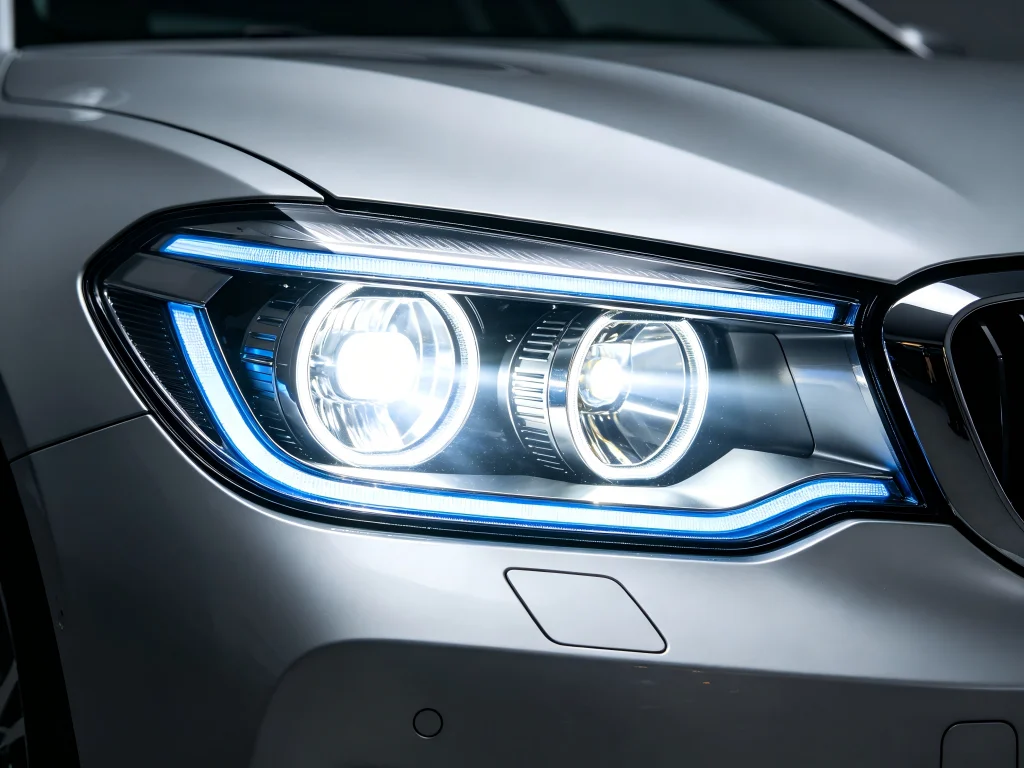
Why Does a Projector Headlight Become Dim?
A projector headlight may become dim because of an aging bulb, declining LED output, damaged reflector surfaces, cloudy lenses, voltage problems, poor bulb positioning, or heat-related degradation. Before replacing the bulb, identify the actual cause. Otherwise, a new bulb may provide little improvement and waste both time and money.
Picture a customer arriving at a retrofit shop with one simple complaint: “My headlights are too weak.”
The obvious answer seems to be a new bulb.
But automotive projector lighting is an optical system. The bulb, reflector bowl, cutoff shield, lens, driver or ballast, and cooling structure work together. Changing one component can change the entire result.
This is why two bulbs with similar advertised lumen ratings may produce very different road illumination.
The Problem Is Often Beam Quality, Not Raw Brightness
A projector collects light around a specific focal area. It then directs that light through a cutoff shield and projector lens.
If the replacement light source does not match that optical geometry, the projector cannot use the available light efficiently.
The result could include:
- A weak hotspot in the center of the road
- Excessive foreground lighting
- A fuzzy or distorted cutoff
- Dark zones within the beam
- Reduced long-distance visibility
- Glare above the intended cutoff
- Uneven left-to-right illumination
This explains a common frustration: the new bulb looks extremely bright when viewed from outside the vehicle, yet the driver still cannot see far enough down the road.
When Projector Bulb Replacement Goes Wrong
The most common projector bulb replacement mistake is choosing a bulb by wattage or advertised lumens alone. Projector optics depend heavily on light-source position, emitting-area geometry, thermal stability, electrical compatibility, and alignment. A replacement that ignores these factors could produce more light inside the housing but less useful illumination on the road.
The problem becomes more serious at highway speeds.
A short, bright foreground can make the driver’s eyes adapt to the area immediately in front of the vehicle. Objects farther away may then appear relatively darker.
More brightness is therefore not automatically more visibility.
Useful automotive lighting depends on where the light goes.
The Hidden Cost of a Cheap Replacement
Low-cost bulbs can be attractive to workshops and distributors because the purchase price looks good on paper. Yet purchase price is only one part of projector bulb replacement cost.
Consider what happens when a bulb has poor thermal control or inconsistent optical geometry.
The workshop installs it. The customer returns because the beam is uneven. The technician removes the bumper or dust cover again. Another bulb is tested. Headlight aim may need to be corrected.
One inexpensive component has now created additional labor, warranty handling, and customer dissatisfaction.
For professional buyers, the better metric is often cost per successful installation, not cost per bulb.
Projector Bulb vs. Projector System: Know What You Have
Before ordering any projector lamp replacement for an automotive application, identify the original lighting architecture.
| Lighting System | Typical Light Source | Key Replacement Concern | Simple Bulb Swap? |
|---|---|---|---|
| हैलोजन प्रोजेक्टर | Halogen bulb | Filament position and base alignment | Often possible |
| HID/Xenon Projector | HID capsule | Arc position, ballast and ignition | Use compatible components |
| LED Retrofit in Halogen Projector | LED replacement bulb | Emitter geometry and cooling | Depends on optical compatibility |
| Integrated LED Projector | LED module/chip | Driver, optics and thermal system | Usually not a conventional bulb swap |
| Bi-LED Projector | Integrated LED optical module | Projector fitment, beam pattern and cooling | Usually replaced/upgraded as a module |
This distinction matters because an integrated LED projector is fundamentally different from a halogen projector containing an LED replacement bulb.
Should You Choose Projector Bulb Replacement LED?
An automotive projector bulb replacement LED can be effective when its emitting surface closely matches the optical requirements of the projector and the bulb has adequate thermal management. However, LED technology alone does not guarantee a better beam. Optical compatibility should be evaluated before brightness, color temperature, or marketing lumen figures.
Why LED Emitter Position Matters
A halogen filament is small and located at a carefully controlled position relative to the bulb base.
An LED replacement attempts to reproduce that light-source position with semiconductor emitters.
If the LED chips are too large, too thick, too far apart, or positioned incorrectly, the projector receives light from a different geometry.
That changes how the reflector and lens focus the beam.
In our automotive lighting evaluation process, this is why we tend to examine beam distribution rather than judging a replacement only by its brightness at the source.
Heat Does Not Disappear With LED
LEDs are efficient, but high-output automotive LEDs still generate significant heat at the semiconductor junction.
That heat must move through the substrate, heat sink, and often a fan or other cooling structure.
Poor thermal management may cause the LED driver to reduce output as temperature rises. A bulb can therefore look impressive during the first minute of testing but deliver less output after extended operation.
For workshops, distributors, and professional buyers, sustained performance is more meaningful than cold-start brightness.
7 Checks Before Replacing a Projector Headlight Bulb
- Confirm the bulb base. Check the original bulb specification instead of relying only on vehicle year and model.
- Identify the projector type. Determine whether the system was designed around halogen, HID, replaceable LED, or an integrated LED module.
- Inspect the projector lens. A damaged or heavily degraded optical system may not be fixed by a bulb.
- Check electrical compatibility. Some vehicles may require appropriate drivers, decoders, ballasts, or CAN-bus solutions.
- Evaluate available space. Large heat sinks and fans can interfere with dust covers or internal housing components.
- Test the beam pattern. Examine the cutoff, hotspot, width, foreground light, and distance illumination.
- Re-aim the headlights. Installation or suspension changes may alter the final beam position.
Why “Projector Bulb Replacement Near Me” Is Not Enough
Drivers searching for projector bulb replacement near me या projector bulb replacement nearby usually want the fastest solution.
Speed matters, but diagnosis matters more.
A professional automotive lighting installer should be able to determine whether the failure comes from the bulb, ballast, driver, wiring, projector, lens, or complete headlight assembly.
Ask the installer to show the beam against a wall before and after replacement. That simple comparison can reveal more than a package full of lumen claims.
What Does Automotive Projector Bulb Replacement Cost?
Automotive projector bulb replacement cost varies according to bulb technology, vehicle access, electrical components, installation labor, and whether the projector itself requires repair or replacement. A simple halogen bulb change may be inexpensive, while HID systems, integrated LEDs, or complete projector upgrades can require substantially more parts and labor.
For B2B buyers, calculate cost differently.
A useful formula is:
Total Replacement Cost = Product Cost + Installation Time + Failure Risk + Warranty Cost + Customer Return Cost
This changes the buying decision.
A product that costs slightly more but installs correctly the first time may create a lower total cost for a retrofit chain or distributor.
What We Look for in a Professional Lighting Upgrade
Based on our years of automotive lighting manufacturing experience, several characteristics tend to separate professional lighting products from specification-driven products.
- Accurate optical alignment
- Stable output after thermal saturation
- Effective heat dissipation
- Consistent manufacturing tolerances
- Reliable electrical components
- Controlled beam distribution
- Application-specific fitment
- Repeatable performance across production batches
For wholesalers, distributors, and retrofit chains, repeatability becomes especially important. A sample that performs well means little if production batches behave differently.
When a Complete Bi-LED Projector Makes More Sense
Sometimes replacing the bulb treats the symptom rather than the limitation.
An older halogen projector may have optics that were never designed for modern high-output LED sources. An aging HID projector may also suffer from internal optical degradation.
In these situations, upgrading the complete optical system can make more sense than repeatedly changing bulbs.
A properly engineered bi-LED projector integrates the LED source, optical bowl, cutoff mechanism, lens, driver strategy, and thermal system around one lighting architecture.
That allows engineers to control the beam from the beginning rather than forcing a new light source into optics designed around another technology.
How GTR Approaches Automotive Projector Lighting
GTR focuses on automotive lighting and aftermarket projector solutions rather than consumer multimedia projector lamps.
For professional automotive buyers, the objective is not simply to produce a brighter light source. It is to build a lighting system that delivers usable road illumination, controlled optics, thermal stability, and consistent production quality.
This distinction matters for importers and distributors.
Your customer does not ultimately buy lumens.
They buy the ability to see the road.
अक्सर पूछे जाने वाले प्रश्न
Can I replace a projector headlight bulb myself?
Some replaceable automotive bulbs can be changed without specialized equipment. Access varies by vehicle. HID and integrated LED systems may require additional electrical knowledge. Always confirm the vehicle and headlight specification before disassembly.
Can I put an LED bulb in a projector headlight?
Sometimes, but compatibility depends on the original projector design. The LED emitter position, bulb dimensions, cooling system, electrical interface, and resulting beam pattern should all be evaluated.
Why are my projector headlights still dim after replacing the bulbs?
The bulb may not be the problem. Aging reflector surfaces, cloudy lenses, voltage loss, poor alignment, incorrect focal position, or thermal problems could reduce useful output.
Is LED better than HID for projector headlights?
Neither technology is automatically superior in every projector. A well-engineered LED or HID optical system can outperform a poorly matched replacement. Judge the complete beam system rather than the light source alone.
How do I know whether my projector bulb is bad?
Symptoms may include reduced brightness, intermittent operation, color changes, failure to ignite, or one headlight becoming noticeably weaker than the other. Electrical and optical problems can produce similar symptoms.
Should I replace both headlight bulbs together?
Replacing bulbs as a pair can help maintain more consistent color and output when both bulbs have similar operating hours, especially with aging halogen or HID sources.
Can a brighter LED bulb damage a projector?
Potential problems depend on heat, physical fitment, electrical load, and optical compatibility. High advertised output alone does not determine whether a bulb is suitable.
When should I replace the whole projector instead of the bulb?
Consider a complete projector solution when the original optics are degraded, the beam remains poor after correct bulb replacement, or the desired performance cannot be achieved within the original optical architecture.
Stop Replacing Bulbs When the Optics Are the Real Problem
If your customers keep asking for more brightness, the answer may not be another higher-wattage bulb.
For automotive lighting distributors, retrofit chains, wholesalers, and professional installers, GTR can help evaluate bi-LED projector and automotive LED lighting solutions around the application rather than a marketing number.
Bring us your vehicle application, target market, installation requirements, and performance goals. We can help you identify a more suitable automotive lighting direction before another weak beam becomes another customer return.
GTR ऑटोमोटिव लाइटिंग समाधान देखें www.rhgtr.com.