You are driving on a familiar road at night. It should feel routine. But your headlights are throwing that dull, yellow pool of light maybe forty feet ahead—just enough to make you grip the wheel tighter and hope nothing steps out from the darkness. If that sounds familiar, you are not alone. The headlight halogen vs LED debate is not really about specs on a spec sheet. It is about whether you can see the deer before it moves, whether your shoulders relax on a backroad, and whether you arrive home without that knot in your stomach.
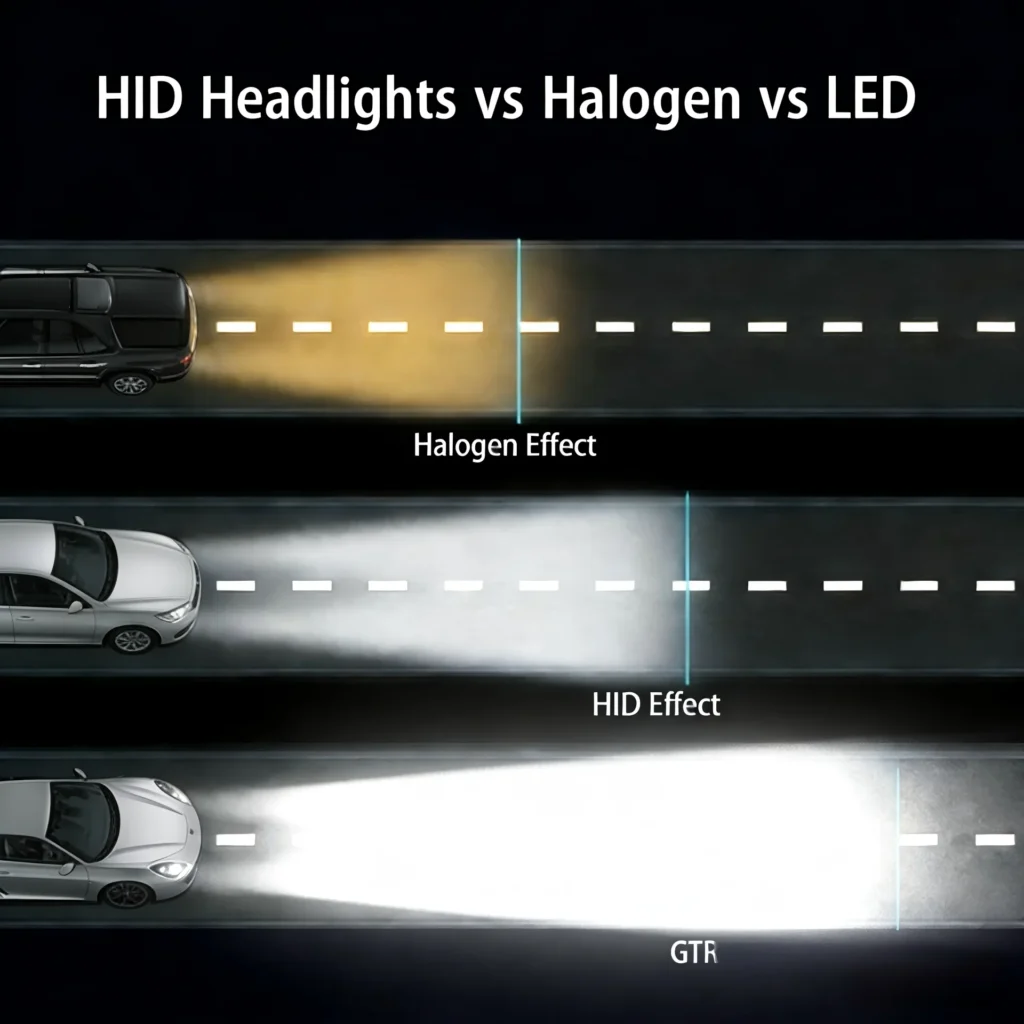
The Problem: When “Good Enough” Lighting Isn’t Good Enough
Halogen headlights have been the default for decades, but their limits show up exactly when you need light most: at night, in rain, or on unlit highways.
Halogen bulbs work by heating a tungsten filament until it glows. That process is simple, cheap, and universally understood. It is also wildly inefficient. Roughly 80% of the energy a halogen bulb consumes turns into heat rather than light . The light that does escape leans yellow, somewhere around 3000K to 4300K, which feels warm but does little for contrast against dark pavement or wet roads .
Here is where the problem compounds. Halogen output degrades over time. A bulb that has been in service for a couple of years may still “work,” but it is no longer producing the light it did when new. The filament thins. The glass envelope darkens. You do not notice the decline because it happens gradually, night after night, until one evening you realize you are leaning forward, squinting, driving slower than traffic around you.
And that is before we talk about the housing. Many older reflector housings were designed around the specific filament position of a halogen bulb. Light scatters in directions you do not need. You get a bright spot on the road sign ahead but poor coverage of the lane edges where cyclists and pedestrians actually appear.
Why This Hurts More Than You Realize
Fatigue is the hidden cost. When your visual system works harder to resolve what is ahead, your reaction time stretches. A study measuring beam luminance across headlight types consistently found LED superior to halogen in projector configurations, with the researchers explicitly linking improved focus and extended visibility to safer nighttime driving . That is the technical way of saying: when you can see farther, you react sooner.
The frustration is not just about seeing. It is about being seen. Dim, yellow light blends into the clutter of modern roads. Other drivers misjudge your distance. Pedestrians in dark clothing register later. You compensate by driving more cautiously—which is rational, but exhausting.
And then there is the retrofit trap. Many drivers try a cheap LED “upgrade” only to find the beam pattern turns to mush. The emitter chips sit in the wrong position relative to the reflector, scattering light into oncoming traffic while leaving the road itself poorly lit. The result is glare for everyone else and disappointment for you. In our engineering testing, we have seen dozens of these failed retrofits come through customer complaints—not because LED technology is flawed, but because the housing and the emitter were never matched.
समाधान: वास्तव में क्या काम करता है
The right LED solution does not simply replace a bulb. It matches the light source geometry to the housing so the beam lands where it belongs: on the road, with a sharp cutoff that respects oncoming drivers.
LEDs produce light through semiconductors rather than filaments. That fundamental difference means they convert far more energy into illumination and far less into heat. A well-designed LED system can deliver roughly three times the usable light output of a comparable halogen setup while drawing less current from your electrical system . The color temperature sits in the 5000K to 6500K range—closer to daylight, which improves contrast and reduces the “washed out” feeling that yellow halogen light creates on dark asphalt.
But here is the part that separates a genuine upgrade from a frustrating experiment: optical compatibility. The emitter must sit at the same focal point the housing was designed to work with. When that alignment is correct, the beam pattern stays tight. You get a defined horizontal cutoff. Light goes down the road, not into the eyes of the driver approaching you.
| पैरामीटर | Halogen (Typical) | Quality LED Retrofit |
|---|---|---|
| Usable Lumens | 700–1,200 lm | 3,000–6,000 lm |
| रंग तापमान | 3000K–4300K (warm/yellow) | 5000K–6500K (crisp white) |
| जीवनकाल | 450–1,000 hours | 15,000–50,000 hours |
| बिजली की खपत | 55W–100W | 30W–60W (often lower) |
| Beam Control Risk | Predictable (housing matched) | High if emitter geometry is wrong |
Notice the last row. It is the one that matters most. A cheap LED kit with the wrong chip placement will underperform a fresh halogen bulb. A properly engineered LED system will outperform it by a margin you feel immediately on the first dark road.
What Separates a Real Upgrade from a Waste of Money
Based on our years of manufacturing expertise and the photometric data we review from independent testing, here is what separates a solution worth buying from one destined for the returns bin:
- Emitter position over raw lumen claims. Marketing numbers mean little if the beam scatters. Look for a design that explicitly mimics the filament location of the bulb it replaces. A 3,000-lumen LED with correct geometry beats a 6,000-lumen unit with poor alignment every time.
- Thermal management that actually works. LEDs concentrate heat at the emitter. Without a proper heatsink or active cooling, output fades and lifespan drops. A metal body with adequate surface area is not optional.
- Cutoff verification, not guesswork. After installation, park facing a wall at roughly 25 feet. The beam should form a sharp horizontal line with a stepped rise on the right side. Diffuse scatter or a fuzzy edge means the housing and emitter are fighting each other.
One fleet operator we work with—running cargo vans on rural routes—replaced three sets of “bargain” LED bulbs before trying a matched system. Their feedback was blunt: “The cheap ones made us a hazard. The right ones made the night shift feel like day.” That is not marketing language. That is the difference between a product that generates photons and a system that puts light where a driver needs it.
अक्सर पूछे जाने वाले प्रश्न
Are LED headlights actually brighter than halogen?
Yes, meaningfully so. A quality LED system produces roughly two to three times the usable lumens of a standard halogen bulb while consuming less power . The difference is most apparent on unlit roads and in wet conditions where contrast matters.
Can I just swap my halogen bulbs for LED bulbs?
You can, but results vary wildly. If the LED emitter does not match the focal position of the original halogen filament, the beam pattern degrades. Light scatters upward and sideways instead of focusing on the road. The safest path is a system designed for your housing type.
Why do some LED retrofits cause glare?
Glare happens when light escapes above the cutoff line or scatters outside the intended beam. This is almost always a geometry problem—the LED chips sit too far forward or backward relative to the reflector’s focal point. It is not an inherent flaw of LED technology; it is a mismatch between components.
Do LED headlights last longer than halogen?
Substantially. A halogen bulb typically lasts 450 to 1,000 hours. A well-cooled LED system can run 15,000 to 50,000 hours or more . For anyone driving regularly at night, the long-term cost advantage is real.
Will LED headlights improve visibility in rain and fog?
It depends on color temperature and beam control. Cooler white light can reflect off fog and rain, creating glare. A warmer LED option (around 4000K–5000K) combined with a sharp cutoff tends to perform better in poor weather than a very blue, high-Kelvin setup.
Are LED headlights legal for road use?
Legality varies by region and vehicle. Some jurisdictions permit specific LED replacement bulbs for specific housing types; others prohibit retrofit conversions entirely. Check your local regulations and, critically, choose a product with documented photometric compliance if legality is a concern (Wikipedia: Headlamp).
Why GTR Exists for This Exact Problem
We built GTR around a simple observation: the aftermarket is flooded with bulbs that claim performance and deliver scatter. Drivers deserve better than that. Every GTR LED system starts with emitter placement measured against the housing geometries that actually exist on the road—not a generic “universal” fit that works for nobody.
Our manufacturing process includes photometric verification at multiple angles, not just a single “max brightness” number on a box. We test for cutoff sharpness, hot spot location, and off-axis glare because those are the variables that determine whether a driver sees the road or blinds the person coming the other way. The certification and compliance documentation we maintain exist for the same reason: so that a professional installer or a careful DIYer can verify the product meets a real standard.
If you have been living with the yellow hum of halogen because you did not trust the LED market, we understand. The market earned that skepticism. But the right system changes the equation. Not because it is trendy, but because the first time you drive a dark road and the lane edges stay visible, the difference stops being a spec sheet argument and becomes something you feel in your shoulders.
Stop squinting. Stop guessing. Find the GTR system matched to your application at https://www.rhgtr.com and see what the road looks like when the light actually works.