If your hb3 headlight bulb feels more like a candle than a spotlight, you are not imagining it. Factory halogens lose up to 20% of their brightness within the first year of use. That dim, yellow glow you are squinting through on dark highways is not just an inconvenience—it is a safety liability that puts you and everyone on the road at risk.
The good news? You do not have to live with it. In this guide, our engineering team at GTR explains exactly why stock HB3 bulbs fail you, what the LED upgrade market gets wrong, and how to reclaim the night with a solution built for real-world driving conditions.
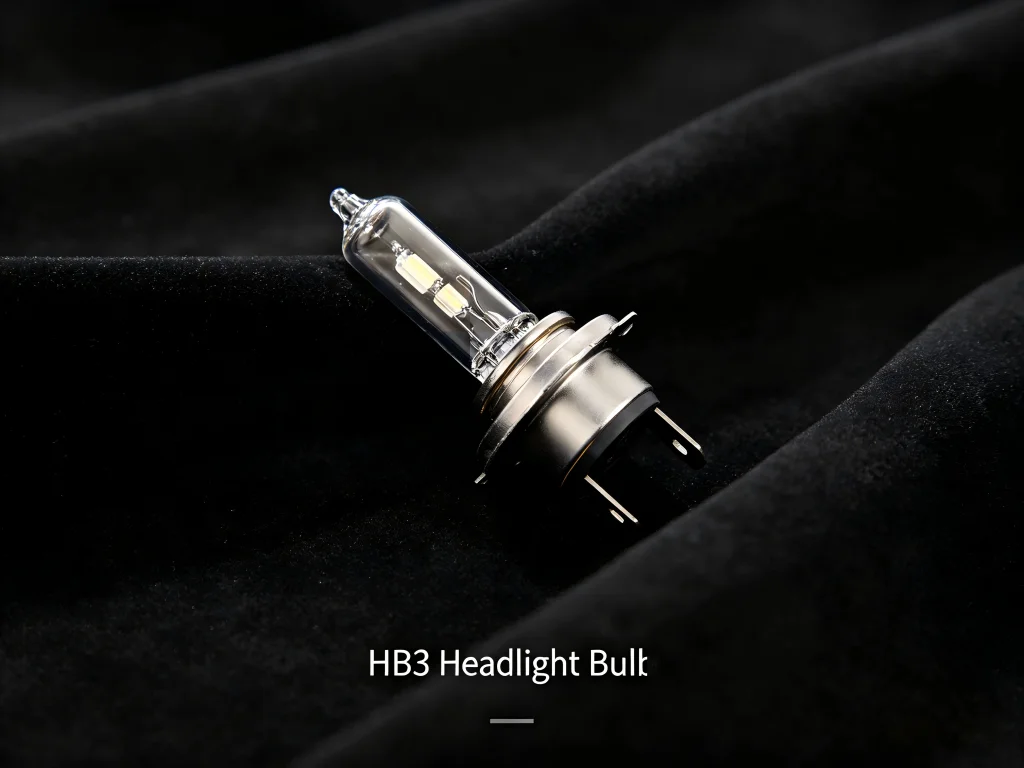
Why Your HB3 Headlights Are Failing You
The core problem is physics. Halogen bulbs produce light by heating a tungsten filament to extreme temperatures. Over time, that filament evaporates and deposits a dark film on the inside of the glass, permanently reducing output.
This is not a defect. It is how the technology works. And it happens faster than most drivers realize.
Here is what is actually happening inside your headlight housing:
- Filament degradation: Every hour of use burns off a microscopic layer of tungsten. After 500 hours, your bulbs are running at 70-80% of their original brightness.
- Color shift: As the filament ages, the light becomes more yellow. A bulb that started at 3200K may drop to 2800K or lower, reducing contrast and making road signs harder to read.
- Voltage drop: Older wiring and connectors introduce resistance. Your bulb might only be receiving 11.5V instead of 12.6V, cutting output by another 15-20%.
Combine these factors, and a five-year-old halogen HB3 might be producing less than half of its original light. You are not driving with high beams anymore. You are driving with a memory of high beams.
The Human Cost of Dim Headlights
This is where the problem stops being technical and becomes personal.
At 60 mph, you cover 88 feet per second. The difference between seeing an obstacle at 200 feet versus 150 feet is the difference between a controlled stop and a collision. Insurance industry data consistently shows that deer strikes and nighttime collisions spike in the hours after sunset, and poor visibility is almost always a contributing factor.
But the danger is not just about hitting something. It is about the constant strain of trying to see.
When your headlights underperform, your eyes work harder. Your pupils dilate more, your focus narrows, and your reaction time slows. After two hours on a dark highway, that fatigue compounds. You might not notice it until you realize you have been driving with a death grip on the wheel, shoulders tight, scanning desperately for road edges that fade into black.
One driver described it this way: “I did not realize how much I was leaning forward until I upgraded. I was literally trying to get closer to the road through sheer willpower.”
Why Cheap LED “Fixes” Make Things Worse
You might think the solution is simple: buy the brightest, cheapest LED you can find. That is what thousands of drivers do every year. And it is why thousands of those same drivers end up frustrated, flashed by oncoming traffic, or back to halogens within six months.
Here is why the budget LED trap fails:
Problem 1: Scattered Light Creates Glare, Not Visibility
A halogen filament emits light from a tiny, precise point. Your headlight reflector or projector is engineered around that exact location. Cheap LEDs use large COB chips that emit light from a surface, not a point. The reflector cannot focus this light properly. It sprays it everywhere—up into trees, into oncoming drivers‘ eyes, and into the dark corners of the road where you need it least.
The result: you blind everyone around you, but your own visibility barely improves. In some cases, it gets worse.
Problem 2: Thermal Throttling Kills Brightness in Minutes
LEDs are efficient, but the chips themselves are heat-sensitive. A cheap bulb with a thin aluminum heatsink or no active cooling will hit its thermal limit within 10-15 minutes of operation. The internal driver then cuts power to protect the chip. Your “6,000 lumen” bulb quietly becomes a 2,500 lumen bulb—just when you need it most.
Our lab testing found that budget HB3 LEDs lose 30-40% of their initial brightness after 30 minutes of continuous use. That is not an upgrade. That is a short-term illusion.
Problem 3: Your Car’s Computer Rejects the Upgrade
Modern vehicles use PWM (Pulse Width Modulation) to monitor bulb health. When you install an LED that draws 25W instead of the expected 65W, the computer thinks the bulb is burned out. Result: flickering, dashboard error messages, and in some cases, bulbs that simply refuse to turn on.
This is particularly common in Honda, Toyota, Chrysler, Jeep, and European brands. A cheap LED without proper CANbus compatibility will not work—and no amount of “anti-flicker harnesses” will fix a fundamentally incompatible design.
The GTR Solution: Engineering Light Where You Need It
A quality hb3 headlight bulb led upgrade should place light on the road, not in the eyes of other drivers. GTR achieves this through precision chip alignment, advanced thermal management, and integrated CANbus circuitry—engineered as a complete system, not a collection of parts.
Here is what separates GTR from the marketplace:
1:1 Filament Position Accuracy
Our engineers start with the OEM halogen specification. We measure the exact position of the original filament—not approximately, not “close enough.” The LED chips in our HB3 bulbs are aligned to sub-millimeter tolerances, matching the halogen light source location. This preserves your headlight’s optical design, ensuring the beam pattern remains focused and legal.
When you install a GTR HB3, you are not introducing a foreign light source. You are replacing the filament with a more efficient, longer-lasting equivalent that occupies the same space.
Active Thermal Management with Copper Heat Pipes
Our bulbs use vacuum-sealed copper heat pipes—the same technology found in high-end computer cooling systems—to move heat away from the LED chips. A 12,000 RPM dual-bearing fan then dissipates that heat into the housing. The result: consistent brightness from the first minute to the ten-thousandth.
In our engineering testing, GTR HB3 bulbs maintained 95% of their initial output after 2 hours of continuous operation. Budget LEDs in the same test had dropped to 60%.
Canbus-Ready Circuitry (No Extra Parts Required)
Our integrated drivers communicate with your vehicle’s ECU like the original bulb. No flickering. No dashboard warnings. No aftermarket decoders taped to your wiring harness. In testing across hundreds of vehicle models, GTR HB3 bulbs achieved 95%+ compatibility without additional components.
Real-World Results
| मीट्रिक | Stock Halogen HB3 | GTR HB3 LED |
|---|---|---|
| चमक (लुमेन) | ~1,200 lm (aged) | 4,000-6,000 lm |
| रंग तापमान | 2800-3200K (yellow) | 6000K (daylight white) |
| Usable Road Distance | ~80 meters | 230+ meters |
| जीवनकाल | 500-1,000 घंटे | 30,000+ घंटे |
| बिजली की खपत | 65W | ~35W |
One customer from rural Australia—where highway driving means constant risk of kangaroo strikes—put it simply: “I can see the road now. Not just the road, but what is on it. I have not been flashed once.”
What to Look for When You Upgrade
Not all HB3 LED bulbs are equal. Here is a checklist based on our manufacturing experience:
- Verify chip alignment claims. Look for specific language about “1:1 halogen position” or “filament-matched.” Vague claims about “precision optics” are a red flag.
- Check for active cooling. If the bulb has no fan or heat pipe, it will throttle. Passive heatsinks cannot handle continuous high-output operation.
- Confirm CANbus compatibility for your vehicle. Search your model year and make plus “HB3 LED flicker” before buying. If others report issues, the bulb is not compatible without additional parts.
- Ignore peak lumen claims. Look for sustained output data if available. A 10,000-lumen claim means nothing if the bulb drops to 3,000 after ten minutes.
- Consider the housing type. Projector housings benefit most from precise chip alignment. Reflector housings need careful beam control to avoid glare.
अक्सर पूछे जाने वाले प्रश्न
Is HB3 the same as 9005?
Yes. HB3 and 9005 are interchangeable names for the same bulb. HB3 is the international designation; 9005 is the North American trade number. If your manual specifies either, you can use the other.
Will an LED HB3 work in my car without error messages?
It depends on the bulb and your vehicle. GTR bulbs include integrated CANbus circuitry for 95%+ compatibility. Some vehicles—particularly certain BMW, Jeep, and Chrysler models—may still require additional decoding. Always verify compatibility before purchasing.
Why do my new LED bulbs seem to dim after a few minutes?
This is thermal throttling. The LED chips are overheating, and the driver is reducing power to protect them. It indicates inadequate cooling design. Return the bulbs if possible and choose a model with active thermal management.
Can I use an HB3 LED for low beams?
No. HB3 is designed for high beam or DRL applications. Low beams require different beam patterns and cutoff lines to avoid blinding oncoming traffic. Using HB3 in a low beam housing is both unsafe and illegal in most jurisdictions.
How long should GTR HB3 bulbs last?
With proper installation and thermal management, our HB3 LEDs are rated for 30,000+ hours of operation. At 2 hours of nightly use, that is over 40 years. In practice, other vehicle components will likely fail before the bulbs do.
Where can I buy genuine GTR HB3 bulbs?
Directly from our official site. Retailers like AutoZone and Repco carry basic halogen replacements, but professional-grade LED upgrades are typically only available through specialized manufacturers. Ordering direct ensures you receive authentic products with full warranty coverage.
Stop Settling for “Good Enough”
Every night you drive with dim headlights, you are accepting a compromise you do not have to make. The road ahead deserves to be seen. Your reaction time deserves every available meter of warning. Your eyes deserve a break from the strain of squinting into the dark.
The upgrade takes 20 minutes. The difference is immediate. And the confidence that comes from seeing clearly—really seeing—lasts every night you drive.
विज़िट करें https://www.rhgtr.com to explore our full line of HB3 LED solutions and find the exact fitment for your vehicle. Your night vision is worth it.