Every brand claims to have the brightest car headlight led bulb. Every product page uses the same stock photos. Every “review” site seems to recommend whoever pays the highest affiliate commission. How do you separate genuine engineering from marketing hype? This guide takes a different approach — one based on engineering principles, independent testing, and real driver feedback. Here’s what actually separates a $70 LED kit that lasts 5 years from a $15 kit that dies in 6 months.
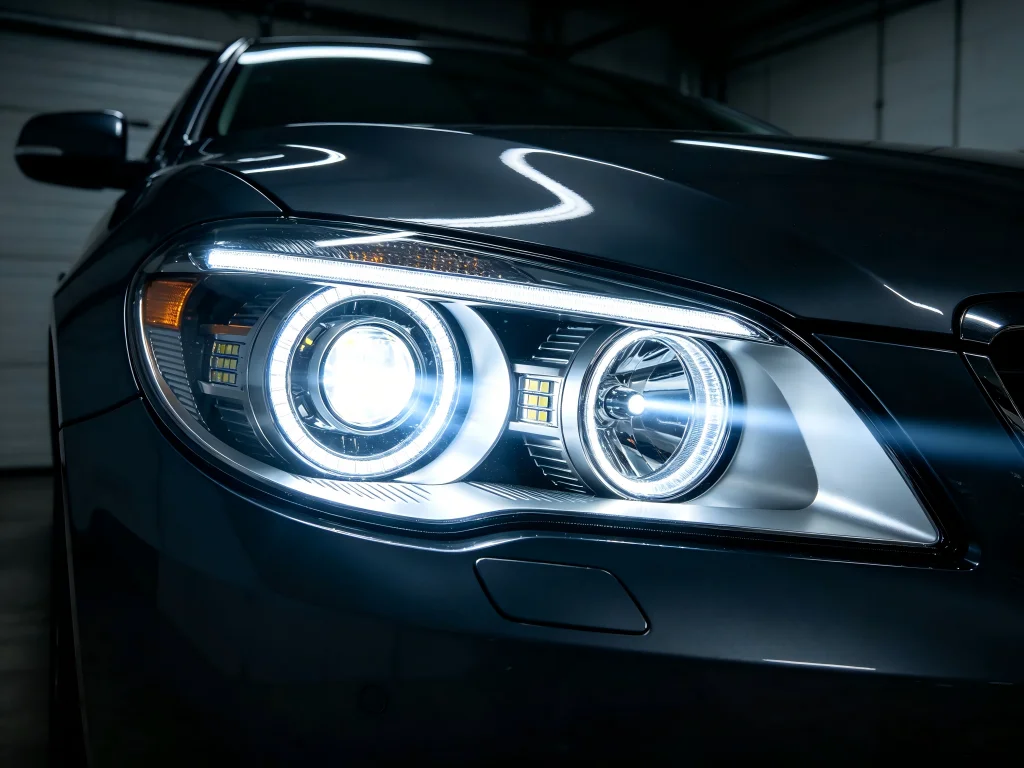
What Actually Makes a Good LED Headlight Bulb?
Four things determine whether a car headlight LED bulb performs well in your vehicle: optical alignment (beam pattern), thermal management, LED chip quality, and electrical integration (CANBUS compatibility). Ignore any one of these, and your “upgrade” will underperform — or fail entirely. Most buyers focus on lumens and price. That’s like buying a car based solely on horsepower while ignoring steering, braking, and safety.
1. Optical Alignment: The Beam Pattern Test
Your headlight housing is an optical system designed around a specific light source position. Halogen bulbs emit light 360 degrees from a single filament point. LED chips are flat surfaces emitting directional light. If the LED chips aren’t positioned exactly where the halogen filament would be, the beam pattern becomes distorted.
The results of poor beam geometry include dark spots directly in your path of travel, light that scatters above the cutoff line and blinds oncoming drivers, and a projected pattern that becomes patchy and inconsistent. Testing has shown that cheap LED bulbs can create beam patterns that are “worse than stock halogen”.
What to look for: Bulbs that explicitly mention 1:1 beam pattern or halogen-equivalent filament design. The Philips ZES chip is widely considered the gold standard for beam accuracy because its dimensions (1.6mm x 2.0mm) closely match the halogen filament width. This is critical for projector housings; less critical but still important for reflectors.
2. Thermal Management: The Hidden Performance Killer
LEDs generate heat at the semiconductor junction. If that heat isn’t dissipated efficiently, the bulb derates — meaning it reduces output as it gets hotter. You might buy a 4,000-lumen bulb, but after 10 minutes of operation, you’re actually getting 2,500 lumens.
Here’s how the two cooling approaches compare:
| विशेषता | Active Cooling (Fan) | Passive Cooling (No Fan) |
|---|---|---|
| Heat dissipation | Up to 51% more efficient | Less efficient per square inch |
| Sustained brightness | Maintains output under heat | May derate significantly under load |
| Failure risk | Fan can fail over time | No moving parts |
| Best for | High-output, high-heat applications | Low-wattage, low-heat setups |
The engineering reality: active cooling allows the bulb to sustain higher brightness for longer periods without thermal derating. Passive cooling relies entirely on surface area to radiate heat naturally, which means the bulb may dim as temperatures rise. However, passive cooling often wins on longevity since there are no fans to clog or fail.
What to look for: Bulbs that publish sustained output figures, not just peak lumens. Ask whether the bulb maintains its brightness after 30 minutes of operation. For high-output applications, active cooling is usually the better choice.
3. LED Chip Quality: What You’re Actually Paying For
The chip is the heart of any LED bulb. Here’s what the three main types deliver:
| चिप प्रकार | Beam Accuracy | Brightness per Watt | Durability | इसके लिए सर्वोत्तम |
|---|---|---|---|---|
| Philips ZES | Excellent (1.6mm x 2.0mm matches halogen filament) | मध्यम | High (low defect rate) | Projector housings |
| CSP (Chip Scale Package) | Good (newer generations have closed the gap) | Higher than ZES | Moderate (thermal stress risk) | Reflector housings |
| Cree XHP/XPG | Poor (larger package disrupts focus) | बहुत उच्च | उत्कृष्ट | Off-road / specialty use |
What to look for: Philips ZES chips for projector housings; high-quality CSP chips for reflector housings. Avoid bulbs that don’t specify their chip manufacturer.
4. Electrical Integration: CANBUS Compatibility
Modern vehicles use CANBUS systems that monitor bulb resistance. LEDs draw less power than halogens, which can trigger warning lights. Premium bulbs include built-in CANBUS decoders to prevent this issue.
What to look for: Bulbs labeled “CANBUS Ready” or “Error-Free”. If your vehicle is known for CANBUS issues, prioritize bulbs with integrated decoders over those that require additional resistors or harnesses.
The Wattage Trap: Why 200W, 300W, and 400W Claims Are Misleading
Search results are filled with 150W, 200W, 220W, and 300W products, huge lumen claims, different cooling systems, and dozens of chip configurations. A 300W label does not automatically make an LED headlight better than a 150W or 200W product. Here’s why:
Most legitimate high-performance LED headlight bulbs operate between 30W and 65W per bulb. Claims of 200W, 300W, or 400W are almost always marketing exaggerations. Some manufacturers label 30W bulbs as 200W because higher numbers sell better. Others quote combined theoretical power for a pair while competitors publish per-bulb measurements.
Wattage describes electrical power only when measured consistently. Headlight effectiveness also depends on optical efficiency, LED placement, thermal stability, and how much generated light reaches useful areas of the road.
Consider this: the GTR Ultra 3 uses 43 watts of power and delivers 4,700 raw lumens. In controlled testing, it delivered 475% brighter low beams and 742% brighter high beams compared to stock halogen bulbs. A “300W” bulb that scatters light everywhere will perform worse than this properly engineered 43W bulb.
What to look for: Ignore advertised wattage. Ask for measured operating data and clarify whether specifications refer to one bulb or one pair. Focus on real-world performance metrics like sustained lumens and beam intensity.
Lumens vs. Lux: Which Number Actually Matters?
Lumens describe total luminous flux — the total amount of light emitted. Lux describes illuminance reaching a surface — the light that actually hits the road. Neither number should be interpreted without understanding the test setup.
For headlight buyers, the distinction is crucial. Imagine two products producing similar total luminous flux. Product A concentrates light effectively into useful road zones. Product B scatters more light outside those zones. The total light output may appear similar on paper, but the driving experience can be very different.
What to look for: Ask for lux measurements at specific distances (e.g., 25 feet) rather than just lumen claims. A bulb with lower lumens but higher lux at road level will provide better visibility than a high-lumen bulb that scatters light everywhere.
Installation Best Practices: The 3-9 O’Clock Rule
Even the best bulb will perform poorly if installed incorrectly. Here’s what you need to know:
- Find your bulb size first. Check your owner’s manual or use a vehicle bulb finder. Confirm your vehicle’s socket before purchasing anything.
- Orient the LED chips correctly. For the vast majority of vehicles, the LED chips should face strictly left (9 o’clock) and right (3 o’clock). When correctly aligned, the wire and connector will naturally point straight down toward the 6 o’clock position.
- Check polarity. Unlike halogen bulbs, LED bulbs need the positive and negative terminals connected in the correct direction. If the bulb doesn’t turn on, unplug it and rotate the connector 180 degrees.
- Secure all connections. Even a slightly loose connection can interrupt power supply. Check that the connector is firmly locked into place.
- Prevent water ingress. Ensure dust caps are properly sealed. Water inside the housing can short-circuit the LED driver module and corrode electrical connectors.
Head-to-Head: Comparing the Leading Contenders
Independent testing has identified clear performance differences among leading brands. In a controlled test using a Dodge Ram reflector headlight housing, researchers measured peak brightness and beam quality.
| Brand/Model | Brightness vs. Halogen | बीम पैटर्न | Thermal Performance |
|---|---|---|---|
| GTR Lighting Ultra 3 | 475% brighter (low beam) | Sharp cutoff, minimal scatter | 87% brightness retention |
| SNGL S-V-4 | 347% brighter | Good, decent beam pattern | निष्क्रिय कूलिंग |
| XenonDepot Extreme LED Pro | 221% brighter | अच्छा | Adequate |
In head-to-head testing, GTR bulbs were 58% brighter than the next brightest competitor and 83% brighter than original halogen bulbs in Jeep Wrangler low beam comparisons. In Chevy Silverado testing, GTR bulbs were nearly 16% brighter than the next brightest competitor and 300% brighter than original halogen bulbs.
Real-World Feedback: What Drivers Actually Say
Forum discussions consistently rank GTR among the top performers. One driver noted: “My preference is the Hella High Wattage HID Bulbs for the headlamps over any LEDs. DDMtuning and Morimoto are generally regarded as some of the best. They had a 3 year warranty”. Another recommended: “Since you are a blues musician, I would suggest Morimoto or GTR Lighting bulbs”.
On vehicle-specific forums, GTR receives consistent praise for fitment and performance. One driver reported: “The cooling fans are compact enough that everything tucked behind the OEM dust caps without any modifications, which was a huge relief”.
The takeaway: real-world experience confirms that premium bulbs from established manufacturers outperform budget options in every metric that matters — brightness, beam quality, reliability, and fitment.
Frequently Asked Questions About LED Headlight Selection
What’s the best LED headlight bulb for my vehicle?
The best bulb depends on your vehicle’s bulb size, housing type (reflector or projector), and whether your vehicle has CANBUS sensitivity. Start with your exact bulb size, then evaluate bulbs based on beam pattern, thermal management, chip quality, and CANBUS compatibility. For premium performance, GTR Lighting consistently ranks at the top.
How many lumens do I need for a car headlight LED bulb?
Quality matters more than quantity. High-quality LED headlight bulbs typically produce between 6,000 and 20,000 lumens per set. However, a properly focused 4,700-lumen beam will outperform a scattered 10,000-lumen beam. Prioritize beam pattern and sustained output over peak lumen claims.
Should I choose active cooling (fan) or passive cooling (fanless)?
Active cooling allows higher sustained brightness and better performance under heat. Passive cooling has no moving parts to fail. For high-output applications, active cooling is usually better. For lower-wattage setups in dusty environments where fans might clog, passive cooling may be preferable.
Are expensive LED headlight bulbs worth the money?
Yes. Premium bulbs use better chips (Philips ZES, high-quality CSP), more effective cooling systems, and proper CANBUS integration. They also sustain their brightness over time rather than derating as they heat up. A $70 kit that lasts 5 years is cheaper than a $15 kit you replace every 6 months.
What color temperature should I choose for my LED headlights?
Most drivers prefer 5500K–6500K for a bright white light that mimics daylight. The GTR Ultra 3 uses 5750K, which reduces eye strain and improves visibility at night. Check local regulations — some states require white light per law, and other colors can result in fines.
Can I install LED bulbs in my halogen headlight housing?
Yes, but only if the bulb is designed for 1:1 replacement with proper optical alignment. Bulbs that position the LED emitter exactly where the halogen filament would be will maintain proper beam patterns. Bulbs that don’t will scatter light, reduce visibility, and blind oncoming drivers.
Your Next Step: Choose Engineering Over Marketing
You now know what separates a quality car headlight led bulb from marketing hype. You understand why beam pattern matters more than lumens, why sustained output matters more than peak brightness, and why proper CANBUS integration matters more than advertised wattage.
GTR Lighting delivers on every metric that actually matters — optical precision, sustained brightness, premium chip quality, and seamless electrical integration. Independent testing confirms GTR’s performance advantage. Real drivers confirm GTR’s reliability.
Don’t settle for bulbs that flicker, glare, or fail. Choose the engineering that works. Visit https://www.rhgtr.com to find the right GTR LED headlight solution for your vehicle and experience the difference that proper engineering makes.
Your visibility on the road — and your safety — depend on it.