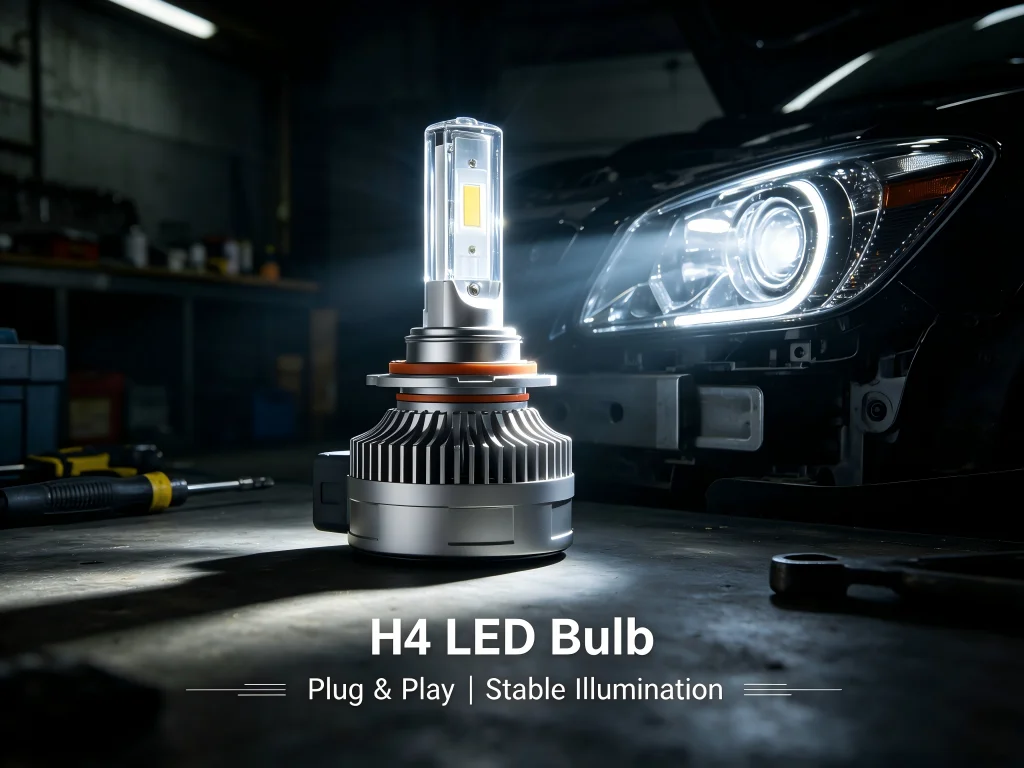
Vous rentrez chez vous sur une route sombre. Les ampoules halogènes de vos phares ressemblent à des bougies dans un ouragan. Vous vous penchez en avant, en plissant les yeux. Vos mains serrent le volant plus fort. Ce n'est pas ainsi que la conduite devrait se sentir. Pourtant, des millions de conducteurs acceptent cela chaque nuit. Le h4 lampe led existe pour une seule raison : vous redonner le contrôle de la route après la tombée de la nuit.
Le problème : les ampoules halogènes H4 n'ont jamais été conçues pour les routes modernes
Les ampoules halogènes H4 produisent environ 1 000 à 1 500 lumens par ampoule. En comparaison, une ampoule de phare LED H4 de qualité délivre 2 500 à 4 000+ lumens efficaces. Ce n'est pas une petite différence. C'est l'écart entre voir un cerf à 100 mètres et réagir à 50 mètres.
L'ampoule halogène H4 d'origine a été conçue dans les années 1970. Elle utilise un filament de tungstène chauffé à 2 500 °C. La technologie est simple. Elle est aussi inefficace. Plus de 80 % de l'énergie devient de la chaleur, pas de la lumière. Votre boîtier de phare cuit. Le filament vibre. Il s'affaiblit avec l'âge. Et vous vous retrouvez avec une visibilité inadéquate au moment précis où vous en avez le plus besoin.
Voici ce que les fiches techniques ne vous disent pas : les ampoules halogènes perdent jusqu'à 30 % de leur puissance avant de griller. L'affaiblissement se produit si progressivement que vous ne le remarquez pas. Vous vous adaptez simplement. Vous vous penchez un peu plus en avant. Vous conduisez un peu plus lentement. Vous acceptez le compromis.
Pourquoi les affirmations de “ luminosité ” vous trompent
Entrez dans n'importe quel magasin de pièces automobiles ou parcourez Amazon. Chaque h4 ampoule led prétend être “ 40 % plus lumineuse ” ou “ 60 % plus lumineuse ”. Ces chiffres sont de la fiction marketing. Ils comparent les lumens bruts de la puce LED à l'exigence légale minimale pour l'halogène—pas à ce que votre ampoule halogène réelle produit.
Voici la vérité : les chiffres de lumens bruts ne signifient rien si le motif du faisceau est mauvais. L'ampoule H4 utilise une conception à double filament. Un filament pour les feux de croisement. Un pour les feux de route. Votre boîtier de phare—qu'il soit à réflecteur ou à projecteur—est conçu autour de la position exacte de ces filaments. Déplacez la source lumineuse ne serait-ce que légèrement, et le motif du faisceau se brise.
Nous voyons cela constamment dans nos tests d'ingénierie. Une ampoule LED H4 bon marché peut produire 10 000 lumens bruts. Mais la lumière se disperse partout. Des points sombres apparaissent directement devant le véhicule. L'éblouissement aveugle le trafic venant en sens inverse. Le conducteur obtient moins de lumière utilisable que l'ancienne halogène fournie.
Le cauchemar du scintillement
Vous installez votre nouveau h4 lampe led. Tout fonctionne. Pendant trois mois. Puis le scintillement commence. Une ampoule s'éteint par intermittence. Le tableau de bord affiche un voyant d'avertissement. Votre indicateur de feux de route cesse de fonctionner.
Pourquoi cela se produit-il ? Les véhicules modernes surveillent les charges électriques. Une H4 halogène consomme environ 55 watts. Une LED consomme nettement moins. L'ordinateur du véhicule voit la consommation plus faible et suppose que l'ampoule est grillée. Certains fabricants ajoutent des décodeurs ou des résistances externes. Ceux-ci introduisent des points de défaillance supplémentaires.
Un client a écrit : “ Je les ai installées et elles ont commencé à mal fonctionner après 3 mois. Les ampoules ont commencé à clignoter en luminosité et ne fonctionnaient parfois pas du tout. Elles ont été installées correctement et ont bien fonctionné pendant 3 mois. J'attendais une bien meilleure durée de vie de la part d'ampoules LED. Je ne les recommanderais pas ”.
Un autre a rapporté : “ Après 5 mois, une ampoule a commencé à scintiller pendant que la voiture roule et elles ne sont plus aussi lumineuses qu'avant ”.
La dégradation thermique : le tueur silencieux
Les LED génèrent de la chaleur à la jonction de la puce. Si cette chaleur n'est pas dissipée, les puces se dégradent. La luminosité diminue. La couleur change. Puis l'ampoule tombe en panne.
Les ampoules LED H4 bon marché utilisent des dissipateurs thermiques sous-dimensionnés ou des ventilateurs mal conçus. Le ventilateur tombe en panne. L'ampoule surchauffe. La puissance lumineuse chute de 40 % ou plus en quelques mois. Vous vous retrouvez avec une ampoule à peine plus lumineuse qu'une halogène, mais vous avez payé trois fois le prix.
Le refroidissement actif avec ventilateurs introduit des pièces mobiles qui peuvent tomber en panne ou devenir bruyantes. Les ventilateurs de qualité utilisent des roulements étanches. Les ventilateurs bon marché sont bruyants et de courte durée. Le refroidissement passif avec dissipateurs thermiques n'a pas de pièces mobiles, est totalement silencieux, mais nécessite une surface suffisante. De nombreuses ampoules économiques n'ont tout simplement pas assez de métal pour dissiper la chaleur.
La solution : ce qui fonctionne réellement
Une ampoule de phare LED H4 correctement conçue doit faire quatre choses : correspondre à la position du filament halogène à 0,1 mm près, gérer la chaleur sans défaillance, intégrer la compatibilité CANBUS sans décodeurs externes, et s'adapter à votre boîtier existant sans modification.
C'est là que GTR Lighting entre en jeu. Nous ne nous contentons pas d'emballer des produits. Nous les concevons.
Positionnement du filament 1:1 — la différence de faisceau
Les ampoules LED GTR Ultra 3.0 H4/9003 utilisent un placement de puces numériquement précis qui reflète l'emplacement du filament halogène. Le résultat est un faisceau qui correspond aux spécifications OEM. Pas de zones sombres. Pas d'éblouissement excessif. Juste une lumière propre et utilisable exactement là où vous en avez besoin.
Un utilisateur de forum a résumé parfaitement : “ Les GTR Ultra 3.0 sont fantastiques. La largeur du faisceau est plus large que celle des Morimoto, je ne trouve aucune zone sombre dans l'éclairage ”.
Gestion thermique qui dure
Les ampoules GTR Lighting Ultra 3.0 disposent d'une gestion thermique avancée avec un module d'interface PWM. La série CSP Mini fonctionne à seulement 16 watts tout en délivrant 2 500 lumens bruts par ampoule. Une puissance inférieure signifie moins de chaleur. Moins de chaleur signifie une durée de vie plus longue.
Les puces LED haut de gamme comme les Philips ZES utilisées dans les produits GTR mesurent 1,6 mm x 2,0 mm, ce qui correspond étroitement à la largeur du filament halogène. Faible taux de défauts. Excellente constance de couleur à 6000K.
Compatibilité CANBUS intégrée
Pas de décodeurs externes. Pas de résistances à câbler. Pas d'avertissements au tableau de bord. Les ampoules GTR intègrent la compatibilité CANBUS directement dans le circuit du pilote. Branchez-les. Elles fonctionnent. L'ordinateur du véhicule voit la charge appropriée et reste silencieux.
Performances réelles : ce que disent les conducteurs
“ Par rapport à mes anciennes ampoules halogènes, la différence est comme le jour et la nuit. Les phares LED offrent un faisceau beaucoup plus clair et plus large, améliorant la visibilité et la sécurité lors de la conduite de nuit ”.
“ Les GTR Mini s'adaptent mieux sans bricoler à l'intérieur du support de phare et elles n'ont pas de ventilateur. La couleur est la même entre les deux ”.
Ce ne sont pas des témoignages payants. Ce sont de vrais conducteurs qui ont fait le changement et ont expérimenté la différence.
Qui a besoin de cette mise à niveau ?
- Motocyclistes naviguant sur des routes rurales avec un éclairage public limité
- Propriétaires de voitures classiques dont les boîtiers H4 d'époque nécessitent des performances modernes
- Camionneurs et exploitants de flottes parcourant de longues distances de nuit
- Navetteurs quotidiens qui conduisent avant le lever du soleil ou après le coucher du soleil
- Amateurs de tout-terrain qui ont besoin d'un éclairage fiable dans des conditions extrêmes
Questions fréquemment posées
Puis-je remplacer les ampoules halogènes H4 par des versions LED ?
Oui. Les ampoules LED H4 modernes sont conçues comme des remplacements directs de type plug-and-play pour les modèles halogènes. Cependant, assurez-vous que la version LED respecte les exigences légales de votre région et s'adapte à votre boîtier spécifique.
Les ampoules LED H4 sont-elles beaucoup plus lumineuses que les halogènes ?
Une ampoule de phare LED H4 de qualité produit 2 500 à 4 000 lumens efficaces, contre 1 000 à 1 500 lumens pour une halogène. L'amélioration de la lumière utilisable est substantielle—mais seulement si le motif du faisceau est correct.
Les ampoules LED H4 fonctionneront-elles dans mon boîtier de projecteur ?
Oui, mais le choix de la puce compte. Les puces Philips ZES avec leur format compact de 1,6 mm x 2,0 mm correspondent étroitement à la position du filament halogène et fonctionnent exceptionnellement bien dans les boîtiers de projecteurs.
Pourquoi mes phares LED scintillent-ils ?
Le scintillement indique généralement des problèmes de compatibilité CANBUS ou de tension. Certains véhicules avec des systèmes d'arrêt au ralenti ou des batteries faibles peuvent présenter des scintillements au démarrage du moteur. Des ampoules de qualité avec des pilotes CANBUS intégrés résolvent ce problème.
Combien de temps durent les ampoules LED H4 ?
Les LED de qualité peuvent durer de 30 000 à 50 000 heures. Les LED bon marché échouent souvent en quelques mois en raison d'une mauvaise gestion thermique ou de la qualité des composants. Les produits GTR sont couverts par des garanties à vie.
Quelle température de couleur dois-je choisir ?
Pour une visibilité maximale, 5000K à 6000K (blanc pur) est la référence absolue. Des indices Kelvin plus élevés se déplacent vers le bleu et réduisent la sortie de lumière utile dans des conditions humides.
Les ampoules LED H4 s'adapteront-elles à mon véhicule ?
La plupart des ampoules LED H4 utilisent le connecteur standard 9003/HB2. Cependant, vérifiez l'espace de votre cache anti-poussière. Certaines ampoules ont des dissipateurs thermiques volumineux qui ne s'adaptent pas. La conception mini 1:1 de GTR assure une compatibilité avec la plupart des boîtiers.
Votre conduite de nuit ne devrait pas être un pari
Vous avez vécu le problème. Vous comprenez pourquoi les alternatives bon marché échouent. Maintenant, vous savez ce qui fonctionne réellement.
Les ampoules LED GTR Lighting Ultra 3.0 H4/9003 délivrent 2 900 lumens bruts à 5750K avec des modules d'interface PWM pour une compatibilité parfaite. La série CSP Mini fonctionne à seulement 16 watts avec des puces haute efficacité Philips Z ES. Les deux options incluent des garanties limitées à vie.
N'attendez pas d'avoir une quasi-collision sur une route sombre. Améliorez vos h4 lampe led phares aujourd'hui.