Vous avez acheté une ampoule de phare LED H11 en espérant une meilleure vision nocturne. Au lieu de cela, vous avez eu du scintillement, de mauvais motifs de faisceau ou des ampoules qui sont mortes en quelques mois. Vous n'êtes pas seul. Nous avons testé des dizaines de kits d'ampoules de phare LED H11 dans notre laboratoire d'ingénierie, et le taux de défaillance parmi les options économiques est stupéfiant. Voici ce qui se passe réellement—et le seul chemin de mise à niveau qui offre vraiment des résultats.
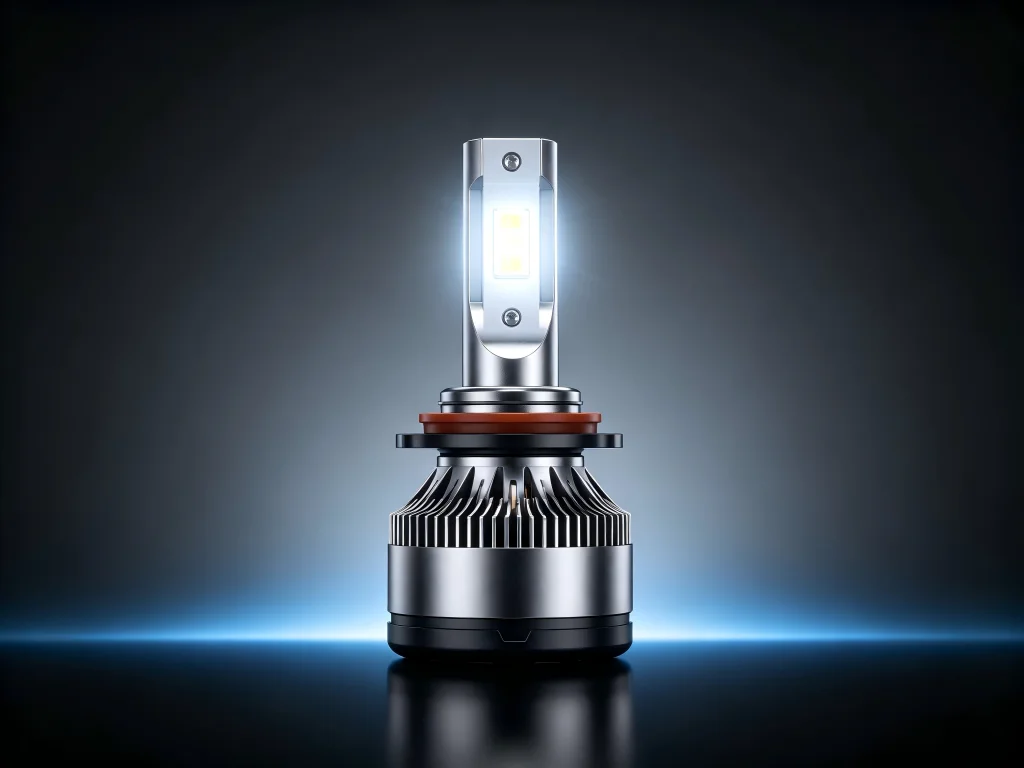
Vous conduisez à moitié aveugle sans le savoir
Votre ampoule de phare halogène H11 d'origine produit environ 1 000 à 1 400 lumens—à peine assez pour repérer un cerf à 60 mph avant qu'il ne soit trop tard. Cette lueur jaunâtre peut sembler “ normale ”, mais normale ne signifie pas sûre. À vitesse autoroutière, votre distance d'arrêt dépasse souvent la portée d'éclairage effective de votre halogène.
Maintenant, considérez ceci : la plupart des conducteurs qui passent à une ampoule de phare LED H11 le font en s'attendant à une amélioration instantanée de la visibilité. Et ils l'obtiennent—pendant environ deux semaines. Puis les problèmes commencent. Scintillement. Hyperflash. Codes d'erreur au tableau de bord. Des motifs de faisceau qui dispersent la lumière vers la circulation en sens inverse au lieu de la projeter sur la route là où vous en avez besoin.
Nous constatons ce schéma constamment dans nos tests. Les conducteurs dépensent $40 pour un kit d'ampoules de phare LED H11 bon marché chez Walmart ou Amazon, pour découvrir ensuite que le ventilateur de refroidissement est assez bruyant pour être entendu dans l'habitacle. Ou pire—l'ampoule ne s'adapte pas du tout au boîtier parce que le fabricant a ignoré l'exigence de taille OEM 1:1.
Un utilisateur de Reddit l'a dit sans détour : “ Ne lésinez pas. Les modèles bon marché donneront certainement des problèmes de mise au point. ‘ Ce n'est pas une opinion. C'est de la physique.
Les coûts cachés d'une mauvaise mise à niveau LED H11
Soyons précis sur ce qui ne va pas lorsque vous choisissez la mauvaise ampoule de phare LED H11.
Désastre du faisceau lumineux
Les ampoules halogènes émettent de la lumière à partir d'un seul filament dans une position spécifique. Les puces LED se trouvent à un emplacement différent, sauf si le fabricant reproduit précisément la position du filament halogène. Lorsque les puces LED ne sont pas positionnées correctement, le motif de faisceau se brise. Vous obtenez de la lumière au premier plan—une chaussée brillante juste devant votre pare-chocs—mais une vision à distance réduite. Trop de lumière au premier plan rend en fait plus difficile pour voir loin devant.
Pire encore, la lumière diffusée aveugle les conducteurs venant en sens inverse. Ce n'est pas seulement gênant : c'est dangereux et, dans de nombreuses juridictions, illégal. De nombreux kits LED vendus chez les grands détaillants portent une mention ‘ For Off Road Use Only ‘ précisément parce qu'ils ne respectent pas les exigences de motif de faisceau du DOT.
Erreurs de bus CAN et scintillement
Les véhicules modernes utilisent des systèmes de bus CAN pour surveiller le fonctionnement des ampoules. Une ampoule de phare LED H11 consomme moins d'énergie qu'une ampoule halogène, de sorte l'ordinateur du véhicule pense que l'ampoule est grillée. Le résultat ? Scintillement, clignotement rapide ou voyants d'avertissement au tableau de bord.
Certains fabricants incluent des décodeurs de bus CAN. Beaucoup ne le font pas. Et lorsqu'ils le font, le décodeur ajoute souvent $40–$50 au coût, soit plus que l'ampoule elle-même.
Défaillance de la gestion thermique
Les LED génèrent une chaleur importante à la jonction où la puce rencontre la carte de circuit imprimé. Sans une gestion thermique adéquate — dissipateurs en aluminium de qualité, bases en cuivre ou ventilateurs silencieux — l'ampoule surchauffe. La surchauffe provoque une dépréciation rapide des lumens et une défaillance prématurée. Cette affirmation de “ durée de vie de 50 000 heures ” ? Elle suppose des conditions thermiques parfaites. Dans un boîtier de phare scellé par une nuit d'été, vous êtes loin de conditions parfaites.
Cauchemars d'installation
Nous avons entendu des clients qui ont dû limer leur douille de phare pour faire rentrer une ampoule de phare LED H11. D'autres n'ont pas pu remettre le cache-poussière parce que le ventilateur de refroidissement de l'ampoule dépassait trop. Et certaines ampoules ne se sont tout simplement pas allumées après l'installation en raison de problèmes de polarité.
Une mise à niveau ne devrait pas nécessiter de modification. Elle devrait être plug-and-play.
Ce qu'une ampoule de phare LED H11 adéquate offre réellement
Une ampoule de phare LED H11 correctement conçue offre 300% à 500% de lumens utilisables de plus qu'une halogène, avec un motif de faisceau qui correspond à l'optique de votre boîtier et zéro scintillement ou code d'erreur.
Voici à quoi cela ressemble en pratique :
- Conception véritable 1:1— les puces LED occupent la position exacte du filament halogène, de sorte que le motif de faisceau reste net et concentré
- Compatibilité intégrée avec le bus CAN— pas de codes d'erreur, pas de scintillement, pas de clignotement rapide
- Gestion thermique avancée—un refroidissement silencieux et efficace qui maintient une température de jonction optimale, même dans des boîtiers scellés
- Installation plug-and-play—aucune découpe, aucun limage, aucune bague adaptatrice nécessaire
Un client passé à l'ampoule de phare LED H11 de GTR l'a résumé simplement : “ Les lumières sont si brillantes que je n'ai pas besoin d'utiliser les pleins phares. Ça a donné un nouveau look à ma voiture. ‘ Un autre a noté : “ Elles éclairent les côtés près de l'avant pour que vous ne manquiez rien venant de la droite ou de la gauche. ‘
C'est la différence entre deviner et concevoir.
Ce qu'il y a réellement à l'intérieur d'une ampoule de phare LED H11 de qualité
Fort de nos années d'expertise en fabrication, les composants comptent bien plus que le nombre de lumens affiché sur la boîte. Voici ce que nous recherchons :
Les puces LED elles-mêmes déterminent la luminosité et la longévité. Les LED CSP (Chip Scale Package) de haute qualité offrent une puissance lumineuse constante avec de meilleures performances thermiques que les anciennes conceptions COB. Nous testons chaque lot pour la constance des couleurs et le maintien du flux lumineux à des températures ambiantes de 25 °C, 50 °C et 85 °C.
L'électronique du driver gère la régulation de tension et la communication du bus CAN. Un driver médiocre provoque un scintillement, des interférences radio et une défaillance prématurée. Un driver bien conçu fournit un courant stable quelles que soient les particularités du système électrique de votre véhicule.
La solution thermique — ventilateur ou passive — détermine la durée de vie. Les ventilateurs évacuent plus de chaleur mais introduisent du bruit et un point de défaillance potentiel. Le refroidissement passif (dissipateurs en cuivre tressé ou en aluminium) est silencieux mais nécessite une plus grande surface. Les meilleures conceptions utilisent des approches hybrides : des ventilateurs efficaces qui ne tournent qu'en cas de besoin, combinés à une masse de dissipateur substantielle.
Ampoule de phare LED H11 : ce que les spécifications signifient réellement
| Spécifications | Halogène H11 | LED économique | LED haut de gamme (GTR) |
|---|---|---|---|
| Lumens (par ampoule) | 1 000–1 400 | 3 000–5 000 (souvent surestimé) | 5 000+ lumens réels, testés |
| Température de couleur | 3 200 K (jaune) | 6 000–6 500 K (blanc froid) | 6 000 K (blanc pur, testé) |
| Précision du faisceau | Norme OEM | Souvent dispersé | Position du filament halogène 1:1 |
| Compatibilité du bus CAN | N/A | Nécessite souvent un décodeur séparé | Intégré, sans erreur |
| Installation | Montage direct | Peut nécessiter une modification | Véritable plug-and-play |
| Durée de vie (réelle) | 500 à 1 000 heures | Tombe souvent en panne en quelques mois | Plus de 50 000 heures |
Les chiffres ne mentent pas. Une véritable ampoule de phare LED H11 n'est pas seulement plus lumineuse—elle est plus fiable, plus sûre pour les autres conducteurs, et vous fait réellement économiser de l'argent au fil du temps en éliminant les remplacements fréquents.
Questions fréquemment posées sur les ampoules de phare LED H11
Les ampoules de phare LED H11 sont-elles légales pour un usage routier ?
Oui, mais seulement si elles respectent les exigences de motif de faisceau DOT ou ECE. De nombreux kits LED bon marché portent des avertissements “ usage hors route uniquement ” parce qu'ils échouent à ces tests. Vérifiez toujours que l'ampoule que vous achetez est homologuée pour la route dans votre région.
Quelle devrait être la luminosité d'une bonne ampoule de phare LED H11 ?
Recherchez 5 000+ lumens réels par ampoule auprès d'un fabricant réputé. Soyez sceptique face aux affirmations comme “ 600% plus lumineux ” ou “ 100 000 lumens ”—ce sont des chiffres marketing, pas une puissance mesurée. Une ampoule de phare LED H11 de qualité doit fournir 3 à 5 fois la lumière utile d'une halogène.
Une ampoule de phare LED H11 s'adaptera-t-elle à ma voiture ?
La plupart des véhicules utilisent H11 pour les feux de croisement ou les feux antibrouillard. Consultez votre manuel du propriétaire ou utilisez un outil de recherche par véhicule pour confirmer. La taille de l'ampoule fait référence au type de douille et à la configuration de la base, pas au modèle du véhicule.
Pourquoi mon ampoule de phare LED H11 scintille-t-elle ?
Le scintillement signifie généralement que le système CAN bus de votre véhicule ne détecte pas la charge électrique appropriée. Un décodeur CAN bus intégré résout ce problème. Certains véhicules peuvent également nécessiter des résistances de charge.
Puis-je installer moi-même une ampoule de phare LED H11 ?
Oui—l'installation prend généralement 15 à 30 minutes avec des outils à main de base. Cependant, certains véhicules ont des boîtiers de phare serrés qui nécessitent une orientation soigneuse de l'ampoule. Vérifiez toujours que les puces LED sont orientées vers les positions 3 heures et 9 heures (ou suivez l'orientation spécifique de votre véhicule) pour un motif de faisceau correct.
Quelle est la différence entre H11 et 9005 ?
H11 est généralement utilisé pour les feux de croisement et les feux antibrouillard ; 9005 est généralement utilisé pour les feux de route. De nombreux véhicules utilisent les deux—H11 pour les feux de croisement et 9005 pour les feux de route. Vérifiez la configuration spécifique de votre véhicule.
Combien de temps durent les ampoules de phare LED H11 ?
Une ampoule de phare LED H11 de qualité devrait durer 30 000 à 50 000 heures dans des conditions normales. Cela représente environ 10 à 15 ans de conduite moyenne. Cependant, une mauvaise gestion thermique réduit considérablement cette durée de vie.
Dois-je choisir une ampoule de phare LED H11 avec ventilateur ou sans ventilateur ?
Cela dépend du boîtier de votre véhicule. Les conceptions sans ventilateur sont silencieuses et comportent moins de pièces mobiles susceptibles de tomber en panne, mais elles nécessitent un espace de refroidissement passif adéquat. Les conceptions avec ventilateur évacuent plus de chaleur mais peuvent être audibles et introduire un point de défaillance potentiel. La meilleure approche est une ingénierie thermique efficace, quel que soit le mode de refroidissement.
Cessez de compromettre votre vision nocturne
Vous méritez de voir clairement la nuit sans vous soucier d'une défaillance d'ampoule, de l'éblouissement des véhicules venant en sens inverse ou des témoins d'avertissement du tableau de bord. Vous méritez une ampoule de phare LED H11 qui fonctionne du premier coup, à chaque fois.
Les ampoules de phare LED H11 de GTR sont conçues dès le départ pour la performance et la fiabilité. Nous ne surestimons pas les lumens. Nous ne négligeons pas la compatibilité CAN bus. Et nous ne faisons aucune concession sur la gestion thermique.
Visitez GTR Lighting aujourd'hui pour trouver l'ampoule de phare LED H11 qui offre réellement ce que vous avez payé. Votre conduite de nuit—et les conducteurs venant vers vous—vous remercieront.