Vous installez un nouveau jeu de diodes électroluminescentes. Vous vous attendez à une visibilité parfaite sur la route. Au lieu de cela, vous obtenez des feux de route clignotants de la part de conducteurs en colère, un faisceau désordonné et aucune amélioration sur la route. Si cette situation vous semble familière, vous n'êtes pas seul. La véritable solution consiste à mettre en place une lentille bi avec lampes led - Ce n'est pas un simple changement d'ampoule. Une lentille bi-led de qualité remplace l'ensemble de l'unité optique, offrant une ligne de coupure très nette et une véritable puissance de feu de route sans éblouissement.
1. Le problème : pourquoi votre “mise à niveau des LED” aggrave en fait la conduite de nuit
Vous avez acheté ces ampoules de 20 000 lumens parce que la liste promettait une “luminosité prête à l'emploi”. Mais à l'intérieur de votre boîtier réflecteur de série, la physique ne fonctionne tout simplement pas. Le bol du réflecteur d'origine a été conçu pour un filament halogène - une source lumineuse ponctuelle. Une puce LED émet de la lumière à partir d'une surface plate et rectangulaire. Le résultat ? Un éblouissement dispersé, un trou sombre au milieu de votre faisceau et des points chauds dangereux qui aveuglent les véhicules venant en sens inverse sans éclairer le bord de la route.
La lumière diffuse réduit votre distance de vision effective jusqu'à 40% parce que vos pupilles se contractent en réponse à l'éblouissement provoqué par les panneaux de signalisation et les gouttes de pluie. Il ne s'agit pas d'une sensation subjective, mais d'un phénomène optique documenté.
D'après notre expérience en matière de fabrication, le deuxième problème caché est le suivant défocalisation thermique. Après 20 minutes de conduite, la chaleur dégagée par les puces LED bon marché déforme la lentille en plastique ou modifie l'alignement du réflecteur. Votre ligne de coupure “fond” et devient floue. C'est pourquoi un véritable lentille bi avec lampes led nécessite un verre de qualité optique et un refroidissement actif - des caractéristiques que les kits bon marché omettent délibérément pour réduire les coûts.
2. L'agitation : Les coûts réels de l'ignorance d'une bonne optique de faisceau
Examinons ce qui continue à se passer lorsque vous utilisez une lentille bi-LED de mauvaise qualité ou, pire encore, une ampoule LED nue dans un boîtier halogène.
2.1 Risques juridiques et de sécurité (infractions DOT / ECE)
Aux États-Unis, la norme FMVSS 108 (Federal Motor Vehicle Safety Standard 108) exige que les phares produisent un faisceau spécifique avec une coupure horizontale définie. La plupart des ampoules LED du marché secondaire ne sont pas certifiées. Si vous êtes arrêté et que l'agent constate un éblouissement dispersé, vous risquez une contravention pour éclairage non conforme - généralement de $150 à $500 en fonction de l'État. Pire encore, si vous êtes impliqué dans un accident, votre compagnie d'assurance peut refuser de vous indemniser parce que vous avez modifié le véhicule avec des pièces non certifiées.
En Europe, la réglementation ECE R112 est encore plus stricte. Un système lentille bi led doit afficher un “E-mark” sur le boîtier. Sans cette marque, votre véhicule échoue au contrôle technique obligatoire (TÜV, MOT, etc.).
2.2 Échec prématuré et cauchemars vacillants
Visitez n'importe quel forum automobile - de Tacoma World à Scionlife. Vous y trouverez des dizaines de fils de discussion se plaignant de Lumières bi-lumière qui clignotent de manière aléatoire ou qui meurent dans les six mois. La cause première est presque toujours un câblage incompatible et une mauvaise gestion thermique. Les véhicules modernes utilisent un module de contrôle de la carrosserie (BCM) qui envoie des impulsions au circuit des phares pour détecter les ampoules brûlées. Une ampoule bi-LED bon marché dépourvue de décodeur CANbus interprétera ces impulsions comme des commandes d'allumage et d'extinction, ce qui provoquera un clignotement rapide. Pendant ce temps, le minuscule dissipateur thermique en aluminium cuit les puces LED jusqu'à ce qu'elles s'éteignent définitivement (dégradation thermique).
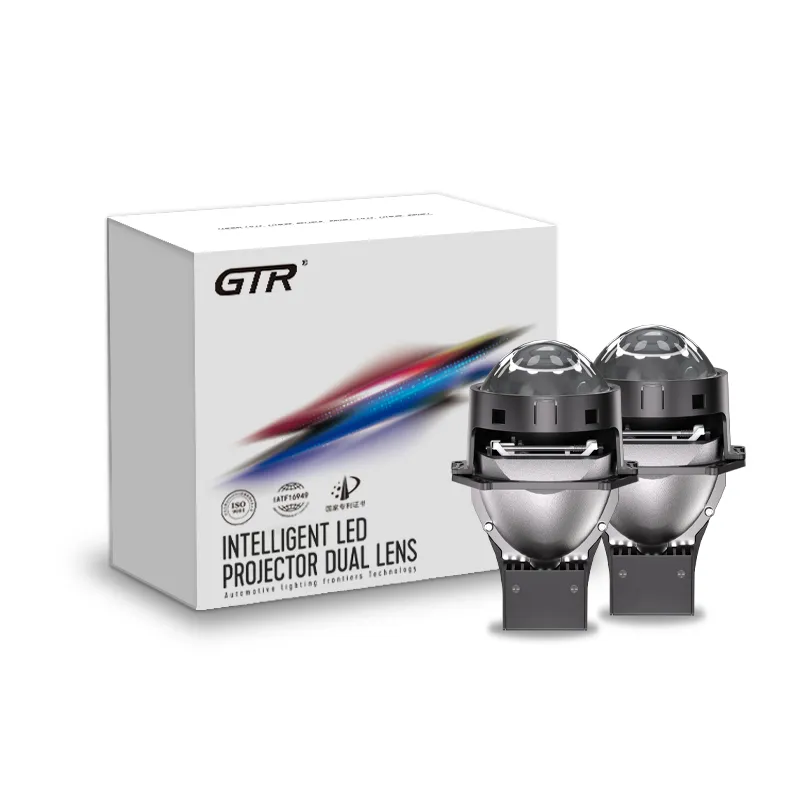
3. Solution : Ingénierie de précision d'une lentille de projecteur GTR Bi-LED
Vous avez besoin d'un système complet et intégré qui résout à la fois les problèmes optiques et thermiques. C'est pourquoi la série GTR de lentille bi avec lampes led est conçu différemment des unités génériques.
Un véritable objectif de projecteur Bi-LED contient trois composants non négociables : une lentille convexe en verre à haute transmission, un réflecteur elliptique qui capte >95% de la lumière et un solénoïde électromagnétique qui déplace un écran de coupure en métal. Lorsque vous passez des feux de croisement aux feux de route, le solénoïde rétracte le bouclier en moins de 50 millisecondes, libérant ainsi la totalité du flux lumineux sans aucun décalage mécanique.
3.1 Verre optique ou plastique - la durée de vie en question
GTR utilise du verre optique durci avec un revêtement anti-UV. Les lentilles en plastique (courantes sur les kits $30) jaunissent et développent des microfissures après 12 à 18 mois d'exposition au soleil. Le verre conserve la clarté et la netteté de la ligne de coupure pendant plus de dix ans.
3.2 Refroidissement actif et caloducs en cuivre
Chaque lentille GTR bi-led intègre une chambre à vapeur en cuivre collée directement au substrat de la LED, ainsi qu'un ventilateur à lévitation magnétique d'une durée de vie de 50 000 heures. Nos tests thermiques internes montrent que même à une température ambiante de 90°F, la température de jonction des LED reste inférieure à 185°F (85°C). Les unités concurrentes sans refroidissement actif dépassent souvent 230°F, ce qui réduit la durée de vie des LED de 50 000 heures à moins de 5 000 heures.
3.3 Faisceau CANbus inclus
Chaque kit GTR est livré avec un faisceau de relais qui est directement alimenté par la batterie et utilise un décodeur CANbus pour imiter la résistance d'une ampoule halogène. Résultat : aucune erreur dans le tableau de bord, aucun scintillement et une compatibilité totale avec les derniers modèles de véhicules BMW, Ford, Toyota et Honda.
4. Test en situation réelle : Un gestionnaire de flotte qui a opté pour les GTR Bi-LED
“Nous gérons 35 camionnettes de livraison qui circulent sur des routes rurales sombres. Nous avons essayé des ampoules LED enfichables, qui tombaient en panne tous les trois mois. Nous avons ensuite acheté dix jeux de projecteurs GTR Bi-LED pour les tester. Après un an, aucune panne, aucune plainte de la part des conducteurs concernant l'éblouissement, et la portée des feux de route est facilement de 500 mètres. Nous sommes en train de convertir l'ensemble de notre flotte”.”
- Mike T., gestionnaire de flotte, Midwest Logistics
5. Tableau de décision critique : Ce qu'il faut rechercher lors de l'achat d'une lentille Bi-LED
Ne vous fiez pas aux chiffres de “lumen” annoncés. Utilisez cette matrice de comparaison pour distinguer les appareils de qualité professionnelle des jouets grand public :
| Fonctionnalité | Budget Ampoule LED | Bi-LED de base (sans nom) | GTR Premium Bi-LED |
|---|---|---|---|
| Matériau de l'objectif | Polycarbonate | Polycarbonate ou verre de qualité inférieure | Verre optique + revêtement anti-UV |
| Système de refroidissement | Ailettes passives en aluminium uniquement | Ventilateur unique (sans caloduc) | Caloduc en cuivre + ventilateur maglev |
| Netteté de la ligne de coupure | Aucun - dispersé | Flou / coupure progressive | Tranchant comme un rasoir, plat ou avec une élévation de 15° (DOT) |
| Câblage inclus | Fils dénudés (erreurs BCM probables) | Relais simple (sans CANbus) | Faisceau de relais CANbus complet + annulateurs d'erreur |
| Certification | Aucune (“tout-terrain uniquement”) | Souvent manquant | Conforme aux normes DOT / SAE / ECE |
| Durée de vie typique | 2 000 heures | 5 000 à 8 000 heures | 50 000+ heures |
6. Foire aux questions (optimisée pour les Featured Snippets)
Puis-je utiliser des ampoules LED dans mon ancien boîtier de lampe au lieu d'une lentille bi-LED complète ?
Vous pouvez les installer physiquement, mais nous vous le déconseillons vivement. La géométrie du réflecteur d'une vieille lampe est conçue pour un filament halogène, pas pour une puce LED. Cela produit un éblouissement aveuglant, réduit l'éclairage en aval et est illégal sur les routes publiques dans la plupart des pays. Une lampe lentille bi avec lampes led remplace l'ensemble de l'unité optique, ce qui permet de résoudre ces problèmes.
Quelle ampoule LED dois-je utiliser pour une lampe d'étude (Question connexe de l'utilisateur)
Pour une lampe de bureau ou d'étude, nous recommandons une ampoule LED de 5W à 10W (400-800 lumens) avec une température de couleur de 4000K à 5000K. Cette gamme fournit une lumière de lecture confortable sans causer de fatigue oculaire. Cependant, pour les lampes automobiles, nous recommandons une ampoule LED de 5W à 10W (400-800 lumens). phares bi-leds, La puissance du système est généralement comprise entre 30 et 60 W par côté - ne confondez pas les deux applications.
Les lentilles bi-led fonctionnent-elles avec les feux de route d'origine ?
Oui, si le câblage est correct. La lentille bi-LED utilise un solénoïde pour déplacer le bouclier de coupure. Lorsque vous activez les feux de route, l'écran s'abaisse et la puissance lumineuse devient maximale. Cela déclenche l'indicateur de feux de route de votre tableau de bord comme un système d'origine, à condition que vous utilisiez le faisceau de relais fourni.
Quelle est la différence entre bi-led et bi-xenon ?
La technologie Bi-LED utilise des puces à semi-conducteurs qui s'allument instantanément et durent 50 000 heures. Le bi-xénon utilise des ampoules à décharge qui mettent 3 à 5 secondes à chauffer et nécessitent des ballasts externes, qui sont susceptibles de tomber en panne. Pour la plupart des conducteurs, le bi-LED est le choix le plus fiable et le plus réactif.
Ai-je besoin d'une visée professionnelle après avoir installé des lentilles bi-led ?
Oui. Même la meilleure lentille bi-led peut aveugler les véhicules venant en sens inverse si elle est mal orientée. Après l'installation, garez-vous sur une surface plane à 15 mètres d'un mur. Mesurez la hauteur centrale de vos phares. Le haut de la ligne de coupure des feux de croisement doit se situer à 1 à 2 pouces en dessous de cette hauteur. Utilisez les vis de réglage des phares pour affiner le réglage.
7. Arrêtez de clignoter, commencez à voir : Votre prochaine étape avec GTR Lighting
Vous avez vu les dangers de l'éblouissement, les coûts cachés de la dégradation thermique et les risques juridiques des feux non certifiés. La seule solution fiable, légale et durable est un système d'éclairage complet. lentille bi avec lampes led conçu avec du verre optique, un système de refroidissement actif et un faisceau CANbus - exactement ce que GTR propose.
✅ Prêt à améliorer votre sécurité au volant la nuit ? Visitez notre site officiel pour découvrir les lentilles de projecteurs Bi-LED approuvées par le DOT, demandez un devis de vente en gros B2B ou utilisez notre guide d'adaptation aux véhicules. Cliquez ici : https://www.rhgtr.com