You are driving home on a rainy night. The road ahead looks dimmer than it did six months ago. You squint. You lean forward. You wonder if your eyes are getting worse.
Your halogen bulb is dying — and it has been for weeks. You just didn’t notice.
Unlike a burnt-out household bulb that fails instantly, an automotive halogen bulb degrades gradually. The tungsten filament evaporates atom by atom with every drive. The quartz envelope darkens. Light output drops by up to 30% before the bulb finally fails. You are not imagining things. Your headlights are genuinely less effective than when you installed them.
Here is what most drivers miss: by the time you notice dimming, your night vision safety margin has already been compromised for hundreds of miles.
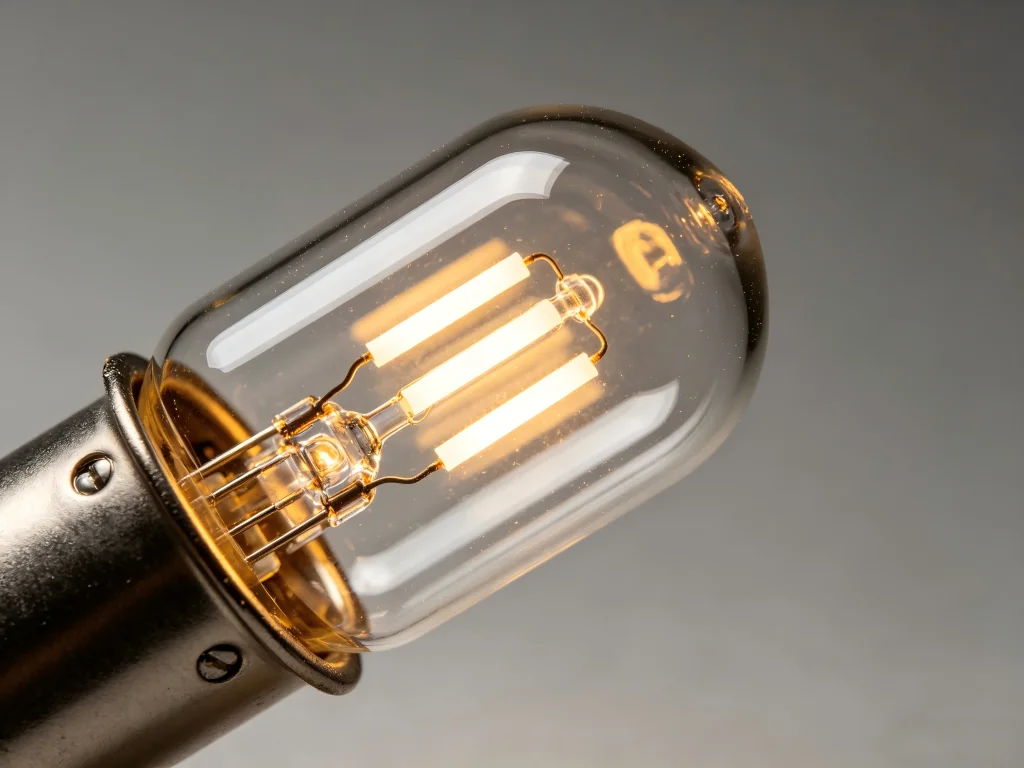
What Makes a Halogen Bulb Work — and Why That Work Ends Prematurely
A halogen bulb produces light by heating a tungsten filament to approximately 2,700°C inside a quartz envelope filled with halogen gas. The halogen gas reacts with evaporated tungsten and redeposits it back onto the filament — a process called the halogen cycle. This cycle extends bulb life beyond standard incandescent technology and delivers crisp, 100 CRI light with instant start-up.
But the halogen cycle is not perfect. It requires extremely high operating temperatures — typically 250°C to 300°C at the glass surface. Every time you turn the bulb on and off, the filament undergoes thermal shock. The tungsten crystallizes. The quartz envelope gradually devitrifies. And the halogen gas eventually becomes depleted, allowing tungsten to deposit on the glass instead of returning to the filament.
The result? A bulb that started at 1,500 lumens may be delivering just 1,000 lumens after 400 hours of use — long before it actually burns out.
Five Warning Signs Your Halogen Bulb Is Failing (That Most Drivers Ignore)
- One headlight appears dimmer or a different color than the other — this indicates uneven filament wear.
- Flickering when driving over bumps — loose connections or a failing filament.
- A burnt spot or dark haze inside the glass — tungsten deposition that cannot be reversed.
- You notice yourself using high beams more frequently — a subconscious compensation for reduced low-beam output.
- Oncoming drivers flash their lights at you — often caused by mis-seated bulbs or degraded optics, not just glare from LEDs.
Each of these signs points to the same root cause: your halogen bulb is past its prime. And the cost of ignoring these warnings extends far beyond a replacement bulb.
The Real Cost of a Failing Halogen Bulb
Most drivers think: “It’s just a bulb. I’ll replace it when it burns out.”
That thinking is dangerously incomplete.
Consider what happens when one headlight fails completely at night on an unlit rural road. Your remaining halogen bulb is now shouldering the entire visibility burden — and it is already degraded. Your stopping distance at 60 mph is approximately 120 feet. With one headlight, your effective illuminated distance drops by nearly half. That deer on the shoulder? You will see it one second later — which is the difference between stopping and impact.
Beyond safety, there are financial and compliance costs. Some bulbs tested by independent labs exceeded maximum permitted wattage and lumens by up to 49%, creating risks of overheating vehicle wiring. Non-compliant bulbs have been found to fail color and beam pattern tests, further increasing glare and reducing usable road illumination. And in many jurisdictions, driving with a non-functioning headlight invites traffic citations that cost more than a premium replacement bulb.
Yet the most overlooked cost is the cumulative effect of driving with degraded bulbs for months. Reduced visibility increases cognitive load. Your eyes work harder. You arrive home more fatigued. Over thousands of miles, that fatigue compounds into measurable risk.
Why the “Cheap Bulb” Trap Costs You More
The average halogen bulb lasts between 500 and 2,000 hours depending on usage and quality. But “average” hides a critical detail: premium halogen bulbs and budget alternatives are not the same product.
Substandard bulbs are a growing safety concern, even according to major manufacturers like Osram. Their UK testing laboratory found that non-compliant halogen bulbs are becoming increasingly common, with some exceeding legal limits while others fail to meet essential performance and safety standards set out in ECE Regulation 37. This regulation governs light output, filament geometry, voltage, and wattage — parameters designed to ensure headlights illuminate the road effectively without dazzling oncoming traffic.
When you buy a cheap halogen bulb, you are not saving money. You are gambling with visibility, safety, and compliance.
The filament may be poorly aligned. The quartz may be lower grade. The halogen gas fill may be imprecise. And the result is a bulb that dims faster, burns out sooner, and produces an inferior beam pattern from day one.
What Automotive Professionals Know About Halogen Bulb Replacement
Professional technicians follow a simple rule: replace headlight bulbs in pairs. When one halogen bulb fails, the other is typically within 80% of its rated life. Replacing only the failed bulb creates an asymmetric beam pattern — one side bright, one side dim — which reduces overall visibility and strains the driver’s eyes.
Here is what the installation process looks like for a typical halogen bulb replacement:
- Park the vehicle, turn off the engine, and open the hood.
- Locate the bulb holder behind the headlight assembly.
- Disconnect the wiring plug and remove any retaining clips or screw caps.
- Remove the old bulb by gripping the base — never touch the glass.
- Insert the new bulb without touching the glass; use gloves or a clean cloth.
- Reconnect the wiring and test the bulb before closing the hood.
Simple enough. Yet even professional technicians report that up to 30% of halogen bulb replacements are done incorrectly — mis-seated bulbs, contaminated glass, or mismatched wattages that create hot spots and premature failure.
When Halogen No Longer Makes Sense: The Case for Upgrade
The automotive lighting landscape has shifted. LED technology now delivers 5,000 to 30,000 hours of life — up to 15 times longer than halogen. LEDs produce more lumens per watt, generate significantly less heat, and maintain consistent brightness throughout their lifespan. They are dimmable, instant-on, and available in color temperatures from 3,200K to 6,000K to match any application.
But here is what the comparison charts do not tell you: not all LED replacements are created equal.
Installing an LED bulb in a halogen reflector housing without proper optical matching creates scatter, hot spots, and glare — the exact problems that give LED headlights a bad reputation. The solution is not simply “switch to LED.” The solution is to use LED bulbs engineered specifically for your housing geometry, with precise emitter placement that mimics the halogen filament position.
This is where GTR’s engineering philosophy makes the difference.
GTR’s Approach: Engineering That Respects Your Vehicle’s Optics
Based on our years of manufacturing expertise in automotive lighting, we have learned that the halogen-to-LED transition fails when manufacturers treat it as a simple bulb swap. It is not. The filament position, the reflector geometry, and the beam cutoff all interact in ways that require precision engineering.
GTR LED replacement bulbs are designed with emitter placement that replicates the exact optical center of the original halogen filament. This ensures the reflector or projector optics shape the beam into the intended pattern with a clean cutoff — no scatter, no glare, just more usable light on the road.
Our bulbs undergo rigorous testing against ECE Regulation 37 parameters. We test for light output, color consistency, thermal management, and vibration resistance. Every batch is validated before shipment. We do not sell bulbs that compromise safety for cost savings.
And we back every product with technical support that helps B2B buyers select the right fit for their vehicle fleet, application, and regulatory environment.
Frequently Asked Questions About Halogen Bulb Replacement
How long does a halogen bulb typically last?
Most automotive halogen bulbs are rated for 500 to 2,000 hours. Premium bulbs may reach the higher end, but all halogen bulbs degrade gradually. Performance bulbs that produce extra brightness typically have shorter lifespans. Replace headlight bulbs in pairs to maintain symmetric output.
Can I replace a halogen bulb with an LED bulb?
Yes, but the LED bulb must be designed for your specific housing type. Using a mismatched LED in a halogen reflector creates glare and poor beam patterns. Look for LED replacements with emitter positioning that matches the original halogen filament location.
Why do my halogen bulbs keep burning out?
Common causes include: touching the glass (skin oils create hot spots), loose bulb holders causing vibration damage, voltage fluctuations, or using bulbs with wattages that exceed your vehicle’s specifications. Replace bulbs in pairs and check your headlight assembly for secure mounting.
What is the color temperature of a standard halogen bulb?
Standard halogen bulbs typically produce 2,700K to 3,200K — a warm, yellowish light. “White light” halogen upgrades may reach 4,200K, but true white or blue-white light requires LED or HID technology.
How many lumens does a halogen headlight bulb produce?
A standard 55W halogen bulb produces approximately 1,000 to 1,500 lumens. High-performance halogen bulbs may reach 2,000 lumens but typically have shorter lifespans. By comparison, a quality LED replacement can produce 2,000 to 3,000 lumens at the same or lower wattage.
Is it illegal to use LED bulbs in halogen housings?
Regulations vary by country. In many jurisdictions, LED replacements are legal only if they comply with ECE Regulation 37 or equivalent standards. Always verify that your chosen LED bulb meets local regulatory requirements for beam pattern, color, and output.
Should I replace halogen bulbs myself or use a professional?
Halogen bulb replacement is generally DIY-friendly. However, if your vehicle requires bumper removal or has restricted access, professional installation may be advisable. LED upgrades often require additional considerations for CANbus compatibility and heat management, making professional guidance valuable.
Your Next Step: Upgrade Before Your Next Night Drive
You have been driving with degraded halogen bulbs longer than you realize. The dimming was gradual. The risk was invisible. But now you know what to look for — and what to do about it.
Do not wait for a bulb to fail on a dark road. Do not settle for cheap replacements that compromise safety. And do not assume that all LED upgrades are the same.
Choose GTR LED replacement bulbs — engineered for optical precision, tested for compliance, and backed by technical expertise that understands your vehicle’s lighting system.
Visite https://www.rhgtr.com to explore our full range of halogen bulb replacement solutions. Contact our team for application-specific recommendations and bulk B2B pricing.
Your visibility is not optional. Neither is your safety.