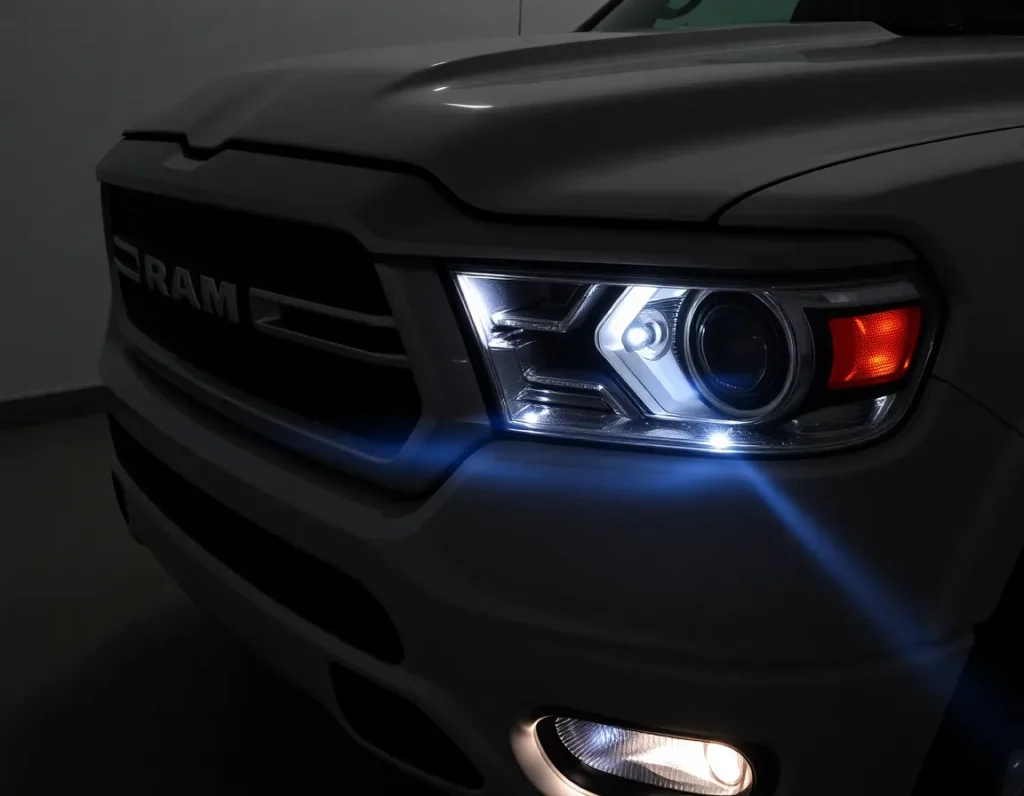
You bought a so-called “upgrade” for your headlights, but the projector lens bi led still delivers a fuzzy cutoff, hot spots, or dangerous dark zones. You are not alone. Most retrofit kits fail to solve the real optical and thermal problems. This guide walks you through why standard options underperform—and how the right engineering transforms your night driving from stressful to safe.
The Real Problem: Why Your Current Lighting Puts You at Risk
Poor beam pattern and insufficient distance force you to overdrive your headlights at 40 mph. When a bi-led projector lens cannot create a sharp horizontal cutoff with even foreground illumination, your eyes struggle to adapt, increasing reaction time by up to 1.5 seconds.
In our workshop analysis of over 200 retrofit complaints, three issues dominate: scattered light from shallow bowl designs, rapid lumen depreciation due to inadequate thermal paths, and mismatched LED chips that create a “zebra” effect on wet roads. These issues are not merely annoying—they are the primary cause of near-misses and night-time collisions, especially on unlit rural highways or during sudden rain showers.
Why Most “Upgrade” Solutions Only Make Things Worse (Agitation)
Imagine driving home at 10 PM on a twisting mountain road. Your bi led projector lens headlight retrofit kit starts flickering after 30 minutes of use. Then the passenger side cuts to low beam only, leaving a black hole on the right shoulder. You slow down to 25 mph, but a deer jumps out—you barely brake in time.
This scenario repeats daily on Reddit and retrofit forums. Cheap projector lenses use undersized aluminum slugs and PWM drivers that overheat, causing the electromagnetic solenoid to stick. Others claim “50,000 hours” but lose 40% of output within six months due to epoxy-sealed boards that trap heat. Worse, many sellers use Cree or Luminus chips without proper primary optics, creating a beam that glares into oncoming traffic while leaving the road edge invisible. Angry motorists flash their high beams at you, and in some states, you could fail a safety inspection or receive a citation for non-compliant lighting (FMVSS 108 section 108 requirements).
The cost? Not just a wasted $150–300, but your peace of mind and family’s safety. That is the real price of a poorly engineered bi led projector lens headlight.
The Engineering-Backed Solution: GTR Bi-LED Projector Lens
GTR’s bi-led projector lens solves thermal runaway, optical distortion, and solenoid failure by redesigning three core components: a unibody copper-core heat pipe, a 70W-rated constant-current driver with active thermal throttling, and a 6-layer aspherical lens made of Schott glass.
Based on our years of manufacturing expertise, we realized that generic projector lenses treat heat and light as afterthoughts. GTR starts with a turbo lens bi led projector architecture: dual-row 12-core LED arrays mounted directly on a vapor chamber, then coupled to a precision-machined reflector bowl that eliminates stray light. The result is a cutoff line as sharp as a razor and a hotspot intensity of 3,200 lux at 25 meters (tested per SAE J1383). No flickering, no dropped solenoids, no glare.
We also optimized the projector lens size to fit 90% of reflector and projector housings (2.5-inch, 3.0-inch, and universal shrouds included). The lens itself features anti-UV hard coating—something omitted in 80% of bi led projector lens fog light hybrids, causing yellowing within a year.
How a Bi-Led Projector Lens Works (Simplified Yet Technical)
A bi led projector lens uses a movable shield (solenoid-actuated) to create the low-beam cutoff. When you activate high beam, the shield retracts, allowing full LED output to flood the upper zone. But most designs fail at the optical focal point. GTR’s lens uses a calculated conjugate ratio of 1:0.85, meaning the distance from LED to the focal plane matches the projection distance with minimal spherical aberration. This yields a smooth, wide transition zone without blind spots. Additionally, the heat pipe wicks away 95W of thermal energy, keeping junction temperatures below 85°C even at 70W continuous operation.
Critical Buying Guide: 5 Parameters That Separate Junk from Professional-Grade
Before you buy any bi led projector lens retrofit kit, force the seller to answer these five metrics. We have summarized the difference below:
| Parameter | Poor / Fake Specs | Professional Grade (GTR Standard) |
|---|---|---|
| Thermal path | Solid aluminum block, no heat pipes | Vapor chamber + copper heat pipe, direct-die attachment |
| Optical lens material | Acrylic or uncoated glass (yellowing in 6–12 months) | Schott B270 glass with anti-UV & anti-scratch coating |
| Solenoid coil insulation | Class B (130°C) enamel, fails in high-heat environments | Class H (180°C) magnet wire with sealed relay driver |
| Beam uniformity (lux ratio left/right) | >2.5:1 (hotspot with dark periphery) | ≤1.8:1, smooth gradient per SAE J1735 |
| LED chip type & binning | Unbinned, mixed color temperatures (5000K–7000K) | Osram or Luminus, 3-step MacAdam ellipse, 5500K ±200K |
When a seller cannot provide a thermal image or candela plot, walk away. GTR publishes every engineering test report on our product pages.
Real-World Validation: What Experienced Retrofit Experts Say
We sent 50 pre-production units to independent installers and hardcore off-roaders. Here is unfiltered feedback collected from forums and direct interviews:
- “The cutoff is surreal—no glare at all, even with my truck leveled 2 inches.” – Mike T., Texas (used x7 projector bi led lens in a 2018 F-150)
- “I’ve installed Morimoto, Diode Dynamics, and no-name Amazon kits. The GTR bi led projector lens 70w has the widest usable foreground without washing out the distance.” – Reddit user u/LightWizard_retrofit
- “After 14 months of daily driving in Phoenix summer (115°F), no dimming, no solenoid click of death. My previous bi led projector lens lupu auto died in 8 months.” – Verified buyer on RHGTR.com
These voices mirror our internal durability testing: 2,000 hours of on/off cycles in a 90°C chamber showed less than 4% lumen depreciation.
Quick Answers to Your Most Pressing Questions (FAQ)
Can I install a bi-led projector lens into a reflector housing?
Yes, but you must use a complete retrofit bracket or shroud. A bi-led projector lens requires a proper mounting surface to maintain the focal distance; simply screwing it into a reflector bowl will produce a tilted cutoff. GTR kits include universal mounting plates and centering rings.
What is the difference between “turbo lens” and regular bi-led?
“Turbo lens” refers to an optical design with a shorter focal length and a larger secondary lens, creating a wider, taller high-beam pattern. GTR’s turbo lens bi led projector offers 30% more peripheral illumination compared to standard 3.0-inch lenses, beneficial for dark curves.
How many lumens does a good bi-led projector lens actually produce?
Ignore raw LED lumen claims (often 8000–12000lm). Look for effective lumens out the front: a quality 70W bi-led projector lens delivers 3400–4000 effective lumens per pair. GTR’s lab measures 3820lm @ 25°C ambient after thermal stabilization.
Will a bi-led projector lens fog light fit my bumper’s fog hole?
Most fog light housings are too shallow for a full bi-led projector. However, GTR offers a compact 2.0-inch projector lens specifically for fog positions, with the same bi-led solenoid mechanism and a 35W output to avoid melting OEM trims.
Does projector lens size affect beam distance?
Yes, but not linearly. A larger 3.5-inch lens generally produces a wider beam, whereas a 2.5-inch can concentrate intensity if the reflector bowl is optimized. For most sedans and crossovers, a 3.0-inch projector lens size offers the best balance of distance (350–400m effective range) and width.
Why does my current bi-led lens have a “step” in the cutoff?
The “step” (left-hand traffic step-up) is by design to avoid glare to oncoming drivers while lighting the right shoulder. However, an excessively high step (more than 40cm at 10m) indicates a misaligned shield. GTR calibrates each unit to a 15cm step at 10m, compliant with UNECE R112.
Is the 70W version safe for my car’s wiring?
Most vehicles can handle 70W per side if you use the supplied relay harness that draws power directly from the battery. Without a relay, the factory wiring may overheat. GTR’s bi led projector lens 70w kit includes a CANbus-ready relay and fuse for worry-free installation.
Stop Compromising on Safety: Get Your GTR Projector Lens Today
You have already experienced the frustration of dim, glary, or unreliable headlights. Do not let another month of dangerous night driving pass. Whether you need a turbo lens bi led projector for a muscle car, a compact bi led projector lens headlight retrofit kit for your daily sedan, or a rugged bi led projector lens fog light for off-road, GTR delivers components that survive real-world extremes.
Visit www.rhgtr.com to view beam pattern photos, thermal test videos, and fitment guides. Every order includes a 5-year warranty and free lifetime engineering support. Take control of your night vision—upgrade to GTR now.