You finally swapped your dim halogen H4 LED headlight bulb for something brighter. Three months later, you are squinting through a flickering mess on a dark highway. The beam scatters everywhere except the road. Oncoming drivers flash their high beams at you. And that annoying dashboard warning light will not go away.
This is not a rare story. Based on our engineering testing and years of manufacturing expertise in automotive LED lighting, we have analyzed thousands of H4 LED headlight bulb failures. The problem is rarely the LED chips themselves. It is everything else the budget brands refuse to tell you.
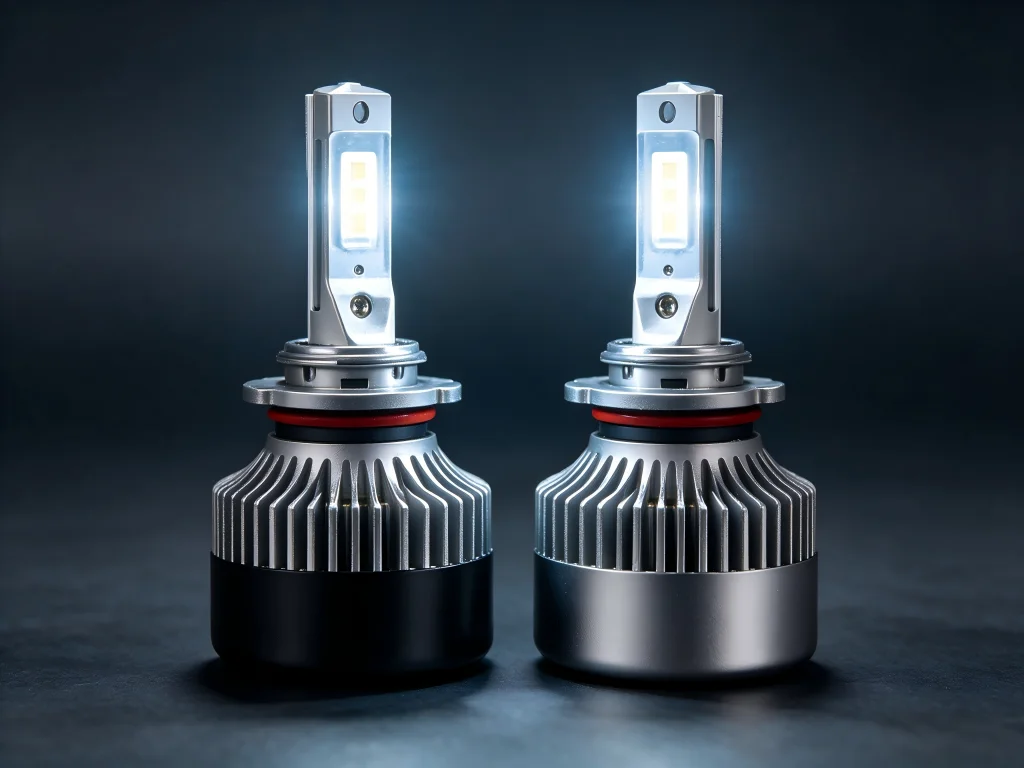
The Real Problem: Your H4 LED Headlight Bulb Is Not What It Claims to Be
Most H4 LED headlight bulbs fail within 6 to 12 months of real-world use — not because the LEDs burn out, but because of heat, incompatible electronics, and fundamentally flawed optical design.
Here is what actually happens. The H4 halogen bulb it replaces uses two filaments positioned at precise locations to create low and high beam patterns. The reflector housing in your car is engineered around that exact filament geometry. When you drop in an LED bulb with chips placed even a millimeter off, the beam pattern breaks. Light goes everywhere except where you need it.
The result? You get less usable light on the road than your old halogens delivered — despite the marketing claims of “600% brighter.” Brighter does not mean better if the light is aimed at trees, oncoming drivers, or the sky.
Why Your Dashboard Is Screaming at You
Modern vehicles use CANBUS systems that monitor electrical loads to detect bulb failures. A halogen H4 draws 55 to 60 watts. Many cheap H4 LED headlight bulbs draw 16 to 30 watts. The CANBUS sees this lower draw and assumes your bulb is dead. So it throws a warning light and, in some vehicles, cuts power to the headlight entirely.
Budget brands tell you to buy separate “CANBUS decoders” or “anti-flicker harnesses”. These are band-aids that introduce another failure point — more connections, more heat, more things to break.
The Hidden Killer: Heat
LEDs produce heat. A lot of it. Unlike halogen bulbs that radiate heat through the glass envelope, LEDs generate heat at the chip junction. If that heat is not pulled away efficiently, the chips degrade. Brightness drops. Color shifts from white to ugly blue. Then the chips fail entirely.
We have seen aftermarket H4 LED headlight bulbs with cooling fans so loud you can hear them inside the cabin when the engine is off. We have seen fanless designs that rely on passive heat sinks — adequate for 10 watts, not for the 50-watt chips some brands claim to run. We have even seen bulbs where plastic components outgas under heat, fogging the headlight lens from the inside.
This is not speculation. This is what real customers report after 9 to 11 months of use.
The Agitation: What Cheap H4 LED Headlight Bulbs Cost You
Let us paint the full picture of what you lose when you buy the wrong H4 LED headlight bulb.
Your Safety
Poor beam pattern means you cannot see hazards until it is too late. Flickering bulbs mean intermittent visibility at the exact moment you need it most. Premature failure means you are driving home in the dark with one headlight — or none.
Your Time
Installation should take five minutes. Instead, you spend hours researching decoders. You swap bulbs twice. You return products that do not fit. You argue with customer support. One forum user described ordering and returning two different H4 LED bulbs — the first did not fit, the second only worked on low beam.
Your Money
A $40 H4 LED headlight bulb that lasts six months costs more per year than a $120 bulb that lasts five years. But the price tag is only the beginning. If the bulb triggers CANBUS errors, you pay a mechanic to diagnose a “problem” that does not exist. If the beam pattern blinds other drivers, you risk a ticket. If the heat damages your headlight housing, you pay for a replacement assembly.
Your Reputation
Every driver you blind with scattered light remembers your car. Every time your flickering headlight draws attention, it reflects on you. You become that driver. The one everyone hates on the road.
This is the reality of the H4 LED headlight bulb market in 2026. Most brands are selling you a promise they cannot keep.
The Solution: What a Proper H4 LED Headlight Bulb Actually Delivers
The right H4 LED headlight bulb gives you more usable light on the road, flawless compatibility with your vehicle’s electronics, and reliable performance for 30,000+ hours — without flicker, without glare, and without dashboard warnings.
This is not magic. It is engineering done right.
1. Beam Pattern That Matches Halogen Geometry
The LED chip placement must mirror the exact position of the halogen filament — within fractions of a millimeter. This is the only way to produce a clean cutoff line in projector housings and proper light distribution in reflector housings. Premium manufacturers use digitally precise LED placement to achieve this. Cheap brands approximate. The difference is visible on the road.
2. Active Thermal Management That Actually Works
Heat must be pulled away from the LED junction and dissipated into the air. This requires either a high-quality fan with sealed bearings or a passive heat sink with sufficient surface area. Both approaches work when designed properly. Both fail when cost-cut.
3. Built-In CANBUS Compatibility
A proper H4 LED headlight bulb includes an internal driver that mimics the electrical load of a halogen bulb. No external decoders. No additional wiring. No dashboard errors. Just plug it in and drive.
4. 1:1 Physical Dimensions
The bulb must fit inside your headlight housing without modifying dust covers or cutting wires. If the heat sink or fan assembly is too large, installation becomes a project instead of a five-minute swap.
Real-World Testing: What Drivers Actually Say
We do not just test H4 LED headlight bulbs in a lab. We track real customer feedback across thousands of installations.
One driver who upgraded to properly engineered H4 LEDs noted: “Much better cutoff, even light spread on the road and really quiet fans.” Another reported: “Compared to my previous halogen bulbs, the difference is night and day. The LED headlights provide a much clearer and wider beam, enhancing visibility and safety while driving at night.”
The common thread? Drivers who buy quality stop thinking about their headlights. The bulbs just work. Every night. Every drive. No drama.
Contrast that with the complaints about cheap H4 LED headlight bulbs: flickering after five months, fans so loud they are heard in the cabin, bulbs that light up then turn off after two minutes. The gap between cheap and quality is not subtle. It is the difference between an upgrade and a headache.
Frequently Asked Questions About H4 LED Headlight Bulbs
Will an H4 LED headlight bulb fit my car?
H4 is a standard bulb size used in countless vehicles worldwide. However, fitment depends on the physical dimensions of the specific LED bulb you choose. Some have bulky heat sinks or fans that may not fit inside your headlight housing. Always check the dimensions against your vehicle’s dust cover clearance.
Why is my H4 LED headlight bulb flickering?
Flickering typically indicates a CANBUS compatibility issue. Your vehicle’s computer detects the lower power draw of the LED and pulses power to check if the bulb is working. A proper H4 LED headlight bulb includes a built-in driver that resolves this without external adapters.
How bright should an H4 LED headlight bulb be?
Raw lumen numbers are largely meaningless without beam pattern quality. A 2,000-lumen bulb with perfect focus can outperform a 20,000-lumen bulb with scattered light. Look for bulbs that prioritize beam accuracy over inflated lumen claims.
Are H4 LED headlight bulbs legal?
Legality varies by jurisdiction. In many regions, aftermarket LED bulbs are only legal if they produce a beam pattern that meets regulatory standards. Bulbs that scatter light or lack a proper cutoff line may fail inspection or attract police attention.
How long do H4 LED headlight bulbs last?
Quality H4 LED headlight bulbs are rated for 30,000 to 50,000 hours. Cheap bulbs often fail within 6 to 12 months due to inadequate cooling or poor electronics.
Do I need CANBUS decoders for H4 LED headlight bulbs?
You should not need them if you choose a bulb with built-in CANBUS compatibility. External decoders are a workaround for poorly designed products.
Can I install H4 LED headlight bulbs myself?
Yes. Installation typically takes 5 to 10 minutes. Remove the old halogen bulb, insert the new LED bulb, and secure it. The process is plug-and-play for properly designed bulbs.
What is the difference between H4, 9003, and HB2?
These are different designations for the same bulb base. H4, 9003, and HB2 are interchangeable in most applications. Always verify compatibility with your specific vehicle.
Your Next Step: Stop Compromising on Your H4 LED Headlight Bulb
You have read the problems. You understand the stakes. Now you face a choice.
You can keep rolling the dice with cheap H4 LED headlight bulbs — hoping each new set lasts longer than the last, praying the beam pattern is acceptable, ignoring the dashboard warning light until it becomes a real problem.
Or you can do what thousands of drivers have already done. Upgrade to an H4 LED headlight bulb engineered to work correctly from day one. One that delivers usable light where you need it. One that plugs in without adapters or decoders. One that stays bright for years, not months.
GTR Lighting builds H4 LED headlight bulbs the right way — with precision LED placement, active thermal management, and built-in CANBUS compatibility. No shortcuts. No marketing gimmicks. Just better light.
Visit https://www.rhgtr.com to find the H4 LED headlight bulb that fits your vehicle and your driving needs.
Do not let another night drive be a gamble. Get the visibility you deserve.