Sie haben ein Set LED headlight bulbs because you wanted to see better at night. Instead, you got flickering, scattered light that blinds oncoming traffic, and a dashboard lit up like a Christmas tree with error codes. You are not alone. Based on our engineering testing and thousands of customer conversations, this is the most common experience with aftermarket LED headlights for car upgrades. And it is almost never the driver’s fault.
The Problem: Your LED Headlight Upgrade Is Failing You
Most LED headlight bulbs on the market today are designed to look good on a spec sheet, not to perform inside your actual headlight housing. The fundamental issue is optical mismatch. Your vehicle’s headlight system — whether reflector or projector — was engineered around a halogen filament positioned at a very specific focal point. Drop an LED emitter into that same housing, and if the emitter placement is off by even a millimeter, the beam pattern falls apart.
What does that mean in real-world driving? You get a beam that is bright in all the wrong places. Light scatters upward into the eyes of oncoming drivers. Dark spots appear where you need illumination most. The led headlights vs halogen comparison becomes irrelevant because you are not comparing performance — you are comparing two completely different optical systems that were never designed to work together.
The Flickering Nightmare
Then there is the flickering. You install your new led headlight bulbs, turn them on, and they pulse like a disco strobe. Or they shut off randomly while you are driving. Or your vehicle’s computer throws a “bulb out” warning even though the lights are clearly working.
This is not a defect in the LED technology itself. It is an electrical compatibility problem. Modern vehicles use CANbus networks to monitor bulb status. LEDs draw significantly less power than halogens — typically 15-20 watts versus 55 watts per bulb. The vehicle’s computer interprets this lower power draw as a failed bulb and responds by either cutting power (flickering) or triggering a dashboard warning. Some drivers spend weeks chasing this problem, buying resistors, decoders, and CANbus adapters — only to find the issue persists.
The Installation Gauntlet
And let us talk about installation. You open the box and find a bulb with a massive heatsink or fan assembly that barely fits through the dust cap opening. You wrestle with the locking ring. You drop the bulb into the housing and pray you aligned it correctly because there is no visual indicator for proper orientation. You close everything up, turn on the lights, and … the beam is pointing at the treetops.
This is not how an upgrade should feel. You spent good money on led headlights for trucks or your daily driver, and now you are spending your weekend troubleshooting a lighting system that is objectively worse than the halogen setup you replaced.
Why Most LED Headlight Kits Fail — The Engineering Reality
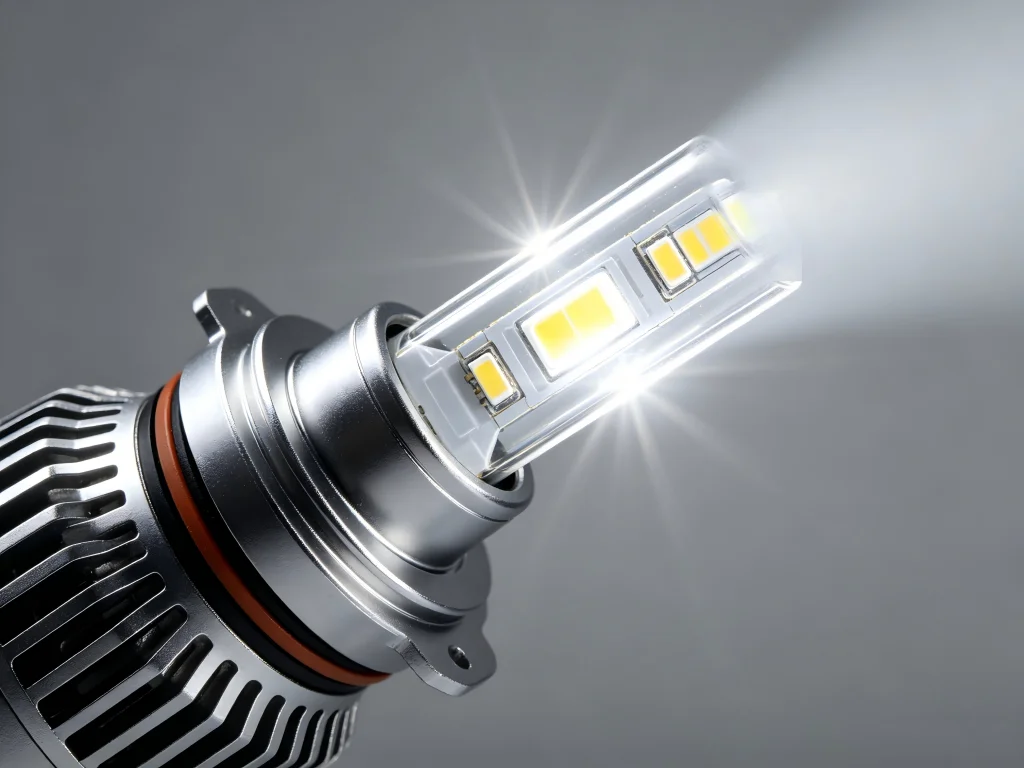
To understand why so many led headlight conversion kit options underperform, you need to look at how LED chips are designed and positioned. The industry standard for beam accuracy is the Philips ZES (Luxeon Z ES) chip, which measures just 1.6mm by 2.0mm — closely matching the width of a halogen filament. This chip produces a razor-sharp beam pattern with minimal scatter.
Many budget kits use CSP (Chip Scale Package) chips instead. These are cheaper to manufacture and produce higher brightness per watt, but the bond between the silicone layer and the chip substrate is weaker, making them more susceptible to thermal stress over time. Worse, larger chip packages like the Cree XHP series (5.0mm by 5.0mm) make filament position matching nearly impossible.
Thermal management is another critical failure point. LEDs generate heat at the semiconductor level. Without proper heat dissipation — through high-quality heat sinks, active cooling fans, or copper-core heat pipes — the bulb will reduce its output to prevent damage. This thermal throttling means you lose brightness over time, often within the first few months of use. The led headlight bulbs that started bright and impressive gradually dim to the point where you are back to squinting at the road ahead.
Real Customer Experiences
One driver on a Ford truck forum summed it up: “By the time you buy four GTR Ultra 3 bulbs, you’re at $650 or more after taxes and shipping, and now you are firmly approaching full-blown housing upgrades that have LED tech and halo lighting built in”. The frustration is palpable — and entirely justified. Another forum member noted that after trying multiple brands, the GTR Ultra 3 produced a beam “broader than the Morimoto, can’t find any dark spots in the lighting”.
These are not isolated complaints. They reflect a market flooded with products that prioritize marketing claims over engineering integrity.
The Solution: GTR Lighting — Engineered for Real-World Performance
GTR Lighting builds LED headlight bulbs that actually work inside your vehicle’s existing housing. The GTR Ultra 3 series is designed with a singular focus: emitter placement that matches halogen filament geometry. This means the beam pattern stays clean, the cutoff remains sharp, and the light goes exactly where it needs to go — on the road, not into the eyes of oncoming drivers.
Independent testing confirms the difference. The GTR Ultra 3 low beams reached 1,498 lux in testing — a 302% increase over standard halogen bulbs. High beam performance was even stronger, with a clean, focused beam, sharp cutoff lines, and excellent width. Another test on a 2016-2021 Honda Civic showed 920 max lux at the brightest point — 475% brighter than stock, while retaining the sharp cutoff line the projector housing was designed to produce.
Our engineering team has spent years refining the Ultra series to address every pain point drivers experience with led headlight for car upgrades:
- Optische Präzision: LED chips are positioned to within 0.1mm of the halogen filament location, ensuring your existing optics work as designed.
- Aktives Wärmemanagement: A high-speed fan and aviation-grade aluminum heatsink pull heat away from the chips, maintaining consistent brightness over thousands of hours.
- CANbus compatibility: Built-in drivers communicate with your vehicle’s computer, eliminating flickering, error codes, and hyper-flash issues.
- Plug-and-Play-Installation: No cutting, no splicing, no external resistors or decoders. The bulb fits through standard dust caps and locks into place with clear orientation markers.
Ob Sie led headlights for trucks, a compact car, or a motorcycle, the GTR Ultra 3 delivers consistent, reliable performance. And for drivers in Malaysia concerned about led headlight malaysia jpj compliance, GTR bulbs are engineered to produce a beam pattern that minimizes glare and scatter — reducing the risk of违规 modifications that can lead to fines.
Frequently Asked Questions About LED Headlights
Warum flackern meine LED-Scheinwerfer nach der Installation?
Flickering is almost always caused by a CANbus compatibility issue. Your vehicle’s computer monitors bulb power draw. LEDs draw less power than halogens, so the computer thinks the bulb is burned out and either pulses power or shuts it off entirely. A CANbus-compatible driver — like the one built into every GTR Ultra 3 bulb — resolves this by communicating properly with the vehicle’s electrical system.
Are LED headlights brighter than halogen?
Yes, significantly — but only if the beam pattern is correct. A quality LED headlight produces 2,400 to 4,000 lumens per bulb compared to 700-1,500 lumens for halogen. However, raw lumens mean nothing if the light is scattered. Beam pattern integrity is what determines whether you actually see better on the road.
Wie lange halten LED-Scheinwerferlampen?
High-quality LEDs can last 30,000 to 50,000 hours under ideal conditions. Real-world lifespan depends on thermal management, electrical design, and operating environment. Poor thermal design causes thermal throttling — the bulb dims itself to prevent damage, reducing effective lifespan significantly.
Can I install LED headlights in my car myself?
Yes — with the right kit. A plug-and-play LED headlight conversion kit like the GTR Ultra 3 installs in under 30 minutes with basic hand tools. The key is choosing a bulb that matches your vehicle’s bulb size (H11, 9005, H4, etc.) and is designed to fit through your housing’s dust cap.
Do LED headlights blind oncoming drivers?
Poorly designed LEDs do — properly engineered ones do not. Glare occurs when light scatters upward instead of projecting forward in a controlled beam. GTR bulbs maintain a sharp cutoff line that keeps light on the road, not in the eyes of other drivers.
Was ist die beste Farbtemperatur für LED-Scheinwerfer?
5,500K to 6,500K is the ideal range. This produces a crisp, daylight-white light that enhances contrast, making it easier to spot obstacles and read road signs at night.
Why do LED headlights cost more than halogen?
Because the engineering is more complex. LEDs require precision emitter placement, active thermal management, CANbus-compatible drivers, and durable housings — all of which cost more to design and manufacture than a simple halogen filament. The higher upfront cost is offset by a lifespan 30 to 50 times longer than halogen.
Hören Sie auf, sich mit minderwertiger Beleuchtung zufriedenzugeben
You did not upgrade to LED headlights so you could deal with flickering, scattered beams, and dashboard warnings. You upgraded because you wanted to see the road clearly and drive with confidence at night. GTR Lighting delivers that experience — not through marketing hype, but through engineering precision that respects how your vehicle was designed to work.
Every GTR Ultra 3 bulb is tested in real headlight housings, not just on a lab bench. We know what works because we have spent years manufacturing and refining automotive LED lighting for drivers who refuse to compromise on safety or performance.
Besuchen Sie www.rhgtr.com to find the right GTR Ultra 3 kit for your vehicle. Stop troubleshooting. Start seeing.