A proper bi LED fog light projectoris engineered for one job only: put controlled, wide light where you need it, keep it away from where you don’t. But most aftermarket units don’t deliver that. They give you glare, dark spots, or beams that bounce right back at you.
Aufrüstung Ihrer bi led fog light should mean better visibility. Instead, many drivers end up with lights that look brighter when parked but fail catastrophically when fog, rain, or snow hits. You know the feeling—you turn them on, and suddenly the road ahead becomes a wall of white. That’s not a failure of LED technology itself. That’s a failure of execution. In our years of manufacturing expertise, we have seen this pattern repeat: drivers buy on lumen numbers alone, skip the optical engineering, and get exactly what they paid for.
The Problem: Your “Brighter” Fog Lights Don’t Help You See
A fog light that creates glare or disperses light upward defeats its entire purpose. Instead of cutting through fog, it illuminates the water particles right in front of you, creating a blinding white wall that reduces visibility further.
This happens more often than you think. Aftermarket bi led fog light for car setups frequently use low-quality optics or mismatch bulb type with housing design. The light scatters rather than projecting a focused, low-aimed beam. According to automotive lighting professionals, when fog lights scatter upward, the light reflects off moisture and snow particles directly back to the driver’s eyes—the exact opposite of what fog lights should do[reference:0].
The technical term for this is Rückstreuung. In a properly designed bi led fog light projector, the beam stays low and wide. In a poorly designed one, stray light bounces off fog droplets and blinds you. That wall of white isn’t in your imagination. It’s a physics problem your fog light failed to solve.
Glare That Oncoming Drivers Hate—And You Can’t See Past
Glare works both ways. It blinds oncoming traffic, and it reduces your own usable vision. Studies from the National Highway Traffic Safety Administration indicate that glare-related complaints have increased significantly with the rise of aftermarket LED retrofits. The problem usually comes from one source: an uncontrolled beam pattern.
A forum user on JL Wrangler Forums described exactly this: “Very powerful bright spot with noticeable bleed above the cutoff (that’s glare for oncoming drivers) and very weak width to the beam… you have worse spread than the stock halogens but a ton more brightness which creates a ‘light tunnel’”[reference:1]. Another driver on the same platform noted that “if you put LED bulbs into a circuit that’s not designed for them, they will quite often malfunction”[reference:2].
This isn’t a niche complaint. It’s the predictable outcome of prioritizing lumen numbers over optical engineering.
The “Dim at the Edges” Dark Zone Problem
A different but equally dangerous issue shows up when fog lights throw a narrow spot instead of a wide spread. In dense fog, you need peripheral illumination to see road edges, pedestrians, and hazards approaching from the side. A narrow spot beam creates a “tunnel” effect—bright straight ahead, pitch black on the sides.
In an ideal bi led fog lamp setup, the beam pattern creates a wide, flat oval that sits below the headlight cutoff line. This gives you road-edge visibility without reflecting off airborne particles. When the beam is too narrow or too high, that benefit disappears. You get the illusion of brightness without the usable coverage.
Why This Keeps Happening: Three Engineering Failures
These problems don’t occur by accident. They result from specific engineering shortcuts that cheap manufacturers take. Understanding these failures helps you avoid them.
Failure 1: Using a Reflector Housing Instead of a Projector Lens
A reflector housing scatters light in all directions. A projector lens focuses it through a convex lens and cut-off shield, creating a sharp, controlled beam with minimal glare.
The difference matters enormously in real-world fog. A 2012 thread on VW Vortex comparing reflector versus projector fog lights noted: “The intensity and output of reflector versus projector will be very similar. The difference is that the projector will control the beam pattern more efficiently. When fogs are used as intended (in heavy fog or snowy conditions) the projectors should outperform the reflector housings”[reference:3]. The reason comes down to the cut-off shield. Reflectors have no shield. Light goes wherever physics sends it.
A proper Bi-LED-Nebelscheinwerfer-Projektorlinse uses a solenoid-actuated cut-off shield that physically blocks upward light during low-beam operation, then moves for high beam activation[reference:4]. That mechanical precision is what separates a professional-grade fog light from a cheap drop-in bulb that scatters everywhere.
Failure 2: Active Cooling That Fails (Or Doesn’t Exist)
LEDs generate heat at the junction where light is produced. If that heat isn’t removed, the LED overheats, loses output, and eventually fails. The industry refers to two cooling approaches: active cooling (fans) and passive cooling (heat sinks).
Active cooling with a small fan works well in open headlight housings where airflow exists. But fog lights sit low on the bumper, directly in the path of road debris, water, salt spray, and mud. A fan in that environment will eventually clog, fail, or seize. When the fan stops, the LED overheats. Output drops, and the light may start flickering as thermal protection circuits engage[reference:5].
Passive cooling through a properly sized aluminum heat sink avoids this failure mode entirely. No moving parts means nothing to break. But passive cooling requires enough surface area to dissipate heat effectively. Many cheap units cut corners on heat sink size, leading to chronic overheating and shortened lifespan.
One G8board user documented exactly this failure: “Bought a set of LED fogs little over a year ago and noticed last night one was flickering. For the most part they stay dimmed at about 10% brightness but then will flicker to full brightness then back down”[reference:6]. Another forum member responded: “Personally I wouldn’t bother checking connections… that’s just the nature of low quality knockoffs dying a slow death”[reference:7].
Failure 3: CANbus Compatibility Issues That Cause Flicker
Modern vehicles monitor bulb circuits for faults. Halogen bulbs draw around 55 watts. LED fog lights often draw only 15-30 watts. The vehicle’s computer sees the lower power draw and thinks the bulb is burned out. So it sends a low-voltage test pulse to check the circuit. That test pulse makes the LED flicker.
This isn’t a sign of a bad product—it’s a sign of an incompatible one. Quality manufacturers integrate CANbus decoders into their fog lights or offer them separately. These decoders mimic the electrical resistance of a halogen bulb, fooling the computer and eliminating flicker. According to industry sources, CANbus decoders solve “error messages on the dashboard, fix aftermarket bulb flickering problems, and cancel radio interference”[reference:8].
But budget manufacturers skip this step entirely. The result is bi led fog light installations that flicker constantly or randomly shut off during driving. One Jeep Renegade owner on a forum reported: “Just put LED fogs in my 2016 latitude, and noticed my fog lites would flash once, intermittently through-out the day/nite dimly”[reference:9]. Another member correctly identified the cause: “their electrical resistance is much less current than halogen bulbs, and the vehicle’s computer doesn’t know how to handle that”[reference:10].
The Cost You Can’t See: Why “Cheap” Actually Costs More
A $50 set of bi led fog lights might seem like a bargain. But that upfront saving comes with hidden costs: reduced night vision, increased accident risk, and repeated replacement when cheap units fail. In contrast, a properly engineered bi led fog light projector from a reputable manufacturer delivers 30,000–50,000 hours of service life, often outlasting the vehicle itself[reference:11].
Let’s do the math. A halogen fog light bulb emits approximately 1,000–1,500 lumens[reference:12]. It runs hot, consumes 55–70 watts, and lasts only 500–1,000 hours. A quality bi-LED fog light emits 3,000+ lumens, consumes 15–30 watts, and lasts 50,000 hours. Over the life of the vehicle, the LED option pays for itself in energy savings and replacement costs alone. According to a comprehensive comparison study, “LED fog lights are the best overall option for most drivers because they are brighter, more efficient, and last much longer than halogen bulbs”[reference:13].
But not all LEDs are equal. A cheap LED that fails after six months offers worse value than a halogen that lasts two years. The key difference lies in build quality, optical design, and thermal management.
The Solution: GTR Bi LED Fog Lights—Engineered to Solve What Others Ignore
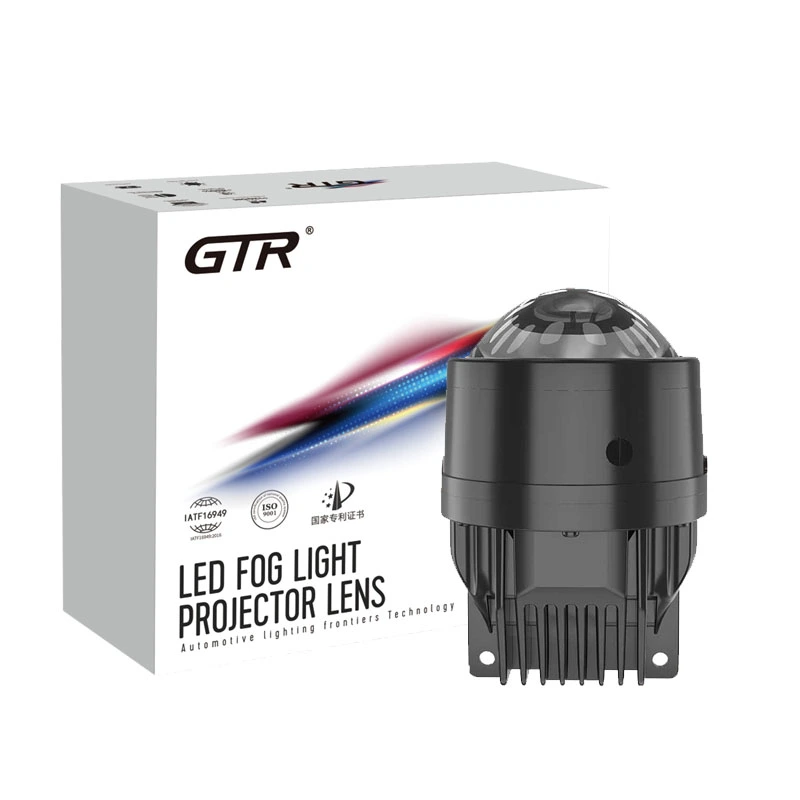
GTR’s bi LED fog light projector lens combines a precision convex lens, a solenoid-actuated cut-off shield for zero glare, passive cooling with no moving parts, and integrated CANbus compatibility. The result is a fog light that works exactly where you need it: in real fog, real rain, and real night driving.
We didn’t build GTR fog lights to win spec-sheet battles. We built them to solve the actual problems drivers face. Every engineering choice we made targets a specific failure point identified in thousands of customer conversations and our own field testing.
What GTR’s Bi LED Fog Light Delivers That Others Don’t
- Projector lens with mechanical cut-off shield. The shield blocks upward light during low-beam operation, eliminating glare and backscatter. A solenoid moves the shield for high beam when you need longer-distance visibility. This dual-function design transforms your fog lights into auxiliary high beams for dark roads.
- Passive aluminum heat sink cooling. No fan means nothing to clog, corrode, or seize. The heat sink is machined from billet aluminum and engineered with sufficient surface area to keep junction temperatures within spec even in extreme conditions.
- Integrated CANbus decoder. Plug-and-play compatibility with modern vehicle computers. No flicker, no error codes, no dashboard warnings. The decoder ensures the vehicle sees proper electrical load.
- IP67 water and dust ingress protection. Sealed against rain, snow, pressure washing, and road spray. According to professional retrofit guidelines, “fog projectors work in harsh conditions. They may face water, dust, mud, heat, vibration, and road debris. This is why IP rating matters”[reference:14].
- High borosilicate glass lens. Resists thermal stress, UV damage, and scratching. Plastic lenses yellow and degrade over time. Glass maintains optical clarity for the life of the product.
- 3000K–6000K selectable color temperature. Amber (3000K) cuts through fog and snow better than white light. Cool white (6000K) delivers maximum apparent brightness. GTR gives you both options because different conditions call for different solutions.
When you install GTR’s bi led fog light for car, you get what you originally wanted: clear visibility in fog, wide peripheral coverage without glare, and reliability that lasts.
Real Drivers, Real Results: What GTR Customers Say
“I had three different sets of fog lights fail on me over two years—flickering, water intrusion, terrible beam patterns. Installed GTR bi LED fog lights six months ago. The cutoff line is razor sharp. No glare. No flicker. Went through the worst winter storm I’ve seen in years and could actually see the road.” — Mike T., Tacoma owner
“Was skeptical about spending more on fog lights. My previous cheap set lasted eight months before one fan died and started flickering. GTR’s passive cooling design sold me. No moving parts. Installed them and haven’t thought about them since—they just work. The high beam function is a game-changer on rural roads.” — Sarah K., 4Runner owner
“The difference in beam pattern is night and day. The GTR Bi-LED-Nebelscheinwerfer-Projektorlinse puts a wide, flat beam exactly where it should be. My old LEDs scattered light everywhere and made fog worse. These cut right through. Oncoming drivers no longer flash their high beams at me.” — David R., Jeep Wrangler owner
Bi LED Fog Light FAQ: Answers to the 8 Questions Drivers Ask Most
1. Are bi LED fog lights legal for road use in North America?
Yes, when they meet SAE or DOT standards for beam pattern and cutoff. However, the National Highway Traffic Safety Administration (NHTSA) notes that “Standard No. 108 imposes no requirements per se for driving lamps and fog lamps—states regulate auxiliary devices in various ways”[reference:15]. Always verify local regulations, but a properly aimed fog light with a sharp cutoff line will comply with most state requirements.
2. What’s the difference between bi LED fog lights and regular LED fog lights?
A standard LED fog light has one function: low beam. A bi LED fog light has both low beam and high beam, controlled by a solenoid-actuated shield inside the projector. When the high beams activate, the shield moves, allowing full light output for extended distance visibility. This dual-function design gives you two lights in one housing.
3. Why do my LED fog lights flicker after installation?
Flicker almost always comes from CANbus incompatibility. Modern vehicles expect a certain electrical load from each bulb. LED fog lights draw less current than halogen, triggering the vehicle’s computer to send test pulses. A CANbus decoder or load resistor solves the problem. Quality bi LED fog lights include this decoder internally.
4. What color temperature works best for fog lights?
3000K amber cuts through fog, rain, and snow most effectively because yellow light scatters less in moisture. 4300K warm white offers a balance of visibility and comfort. 6000K cool white looks brighter but reflects more in dense fog[reference:16]. For pure fog performance, amber is superior.
5. Do bi LED fog lights need special wiring or adapters?
Most modern bi LED fog lights use plug-and-play connectors (H8, H11, 9005, 9006, etc.) and work with factory wiring. However, some vehicles require relay harnesses to supply full power. GTR’s product line includes vehicle-specific adapters for most Toyota, Jeep, Ford, and BMW models.
6. How do I aim bi LED fog lights correctly?
Proper aiming is critical. Park on a level surface 25 feet from a wall. The top of the fog light beam should sit 2–3 inches below the center height of the fog light lens. The beam should be level left-to-right. Many drivers aim fog lights too high, which creates glare and reduces effectiveness. According to lighting expert Daniel Stern, fog lights “should be aimed downward a bit”[reference:17].
7. Can I replace just the bulb in my existing fog light housing?
Technically yes, but we don’t recommend it. Installing an LED “bulb” into a reflector housing designed for halogen almost never produces a correct beam pattern. The optics don’t match. You’ll get scattered light, glare, and poor road coverage. A complete projector assembly ensures the beam pattern matches the lens design[reference:18].
8. How long should a bi LED fog light last?
A quality bi LED fog light with proper thermal management lasts 30,000–50,000 hours, which typically exceeds the life of the vehicle[reference:19]. Cheap units with active cooling fans often fail within 5,000–10,000 hours due to fan failure or overheating. Passive cooling designs (no fans) generally outlast active cooling designs in the harsh environment of a vehicle’s front bumper.
Stop Fighting Your Fog Lights. Upgrade to Something That Actually Works.
You didn’t buy fog lights to look cool. You bought them to see the road when conditions turn dangerous. If your current setup creates glare, flickers, scatters light, or leaves dark edges, it’s not working as designed. That’s not your fault. That’s the predictable result of choosing flash over function.
GTR’s bi led fog light projector was designed by engineers who actually drive in fog, rain, and snow. Every component—from the solenoid-actuated cut-off shield to the passive aluminum heat sink to the integrated CANbus decoder—exists to solve a specific problem we observed in real-world failures.
See the road you’ve been missing. Besuchen Sie https://www.rhgtr.com to browse GTR’s complete line of bi LED fog lights and find the model that fits your vehicle. Free technical support. Vehicle-specific fitment guides. A full satisfaction guarantee. Because you deserve fog lights that actually work.