You flick the switch. The road ahead barely changes. That dull, yellow haze that used to feel “good enough” now feels like a liability—especially when an unlit stretch of highway stretches out in front of you and your high beams feel more like a suggestion than a solution. If you are searching for the best halogen headlight bulbs because you are tired of squinting, guessing, and white-knuckling every night commute, you are not alone. And more importantly, you are not stuck.
The halogen segment has quietly improved. Modern performance halogens can deliver significantly more usable light on the road without the glare, legality headaches, and beam-scatter chaos of cheap LED drop-ins . The catch? Most of those gains only show up when the bulb is engineered for your specific housing—not just marketed with big numbers on a shiny card.
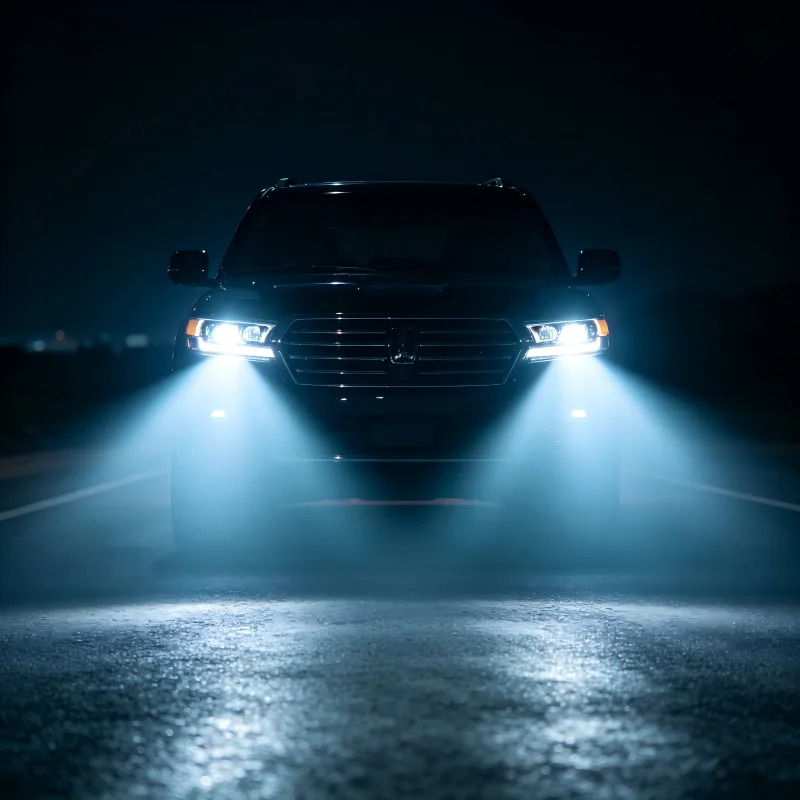
The Real Problem: Why Your Factory Halogens Fail You at Night
Factory halogen bulbs are built for cost and longevity, not visibility. They prioritize a long service life over downroad reach, leaving most drivers with a dim, yellow beam that struggles to illuminate obstacles beyond 75–100 meters.
Here is what that actually feels like behind the wheel. You are driving home after dark. The lane markings blur into the asphalt. A cyclist in dark clothing appears at the edge of your low beam with barely enough time to react. You switch to high beams, and the improvement is marginal—a slightly less depressing shade of beige.
This is not a you problem. It is a design trade-off baked into the bulb sitting in your housing right now. Standard halogens prioritize hours of service over photons on the road. The filament is optimized for durability, not intensity. The gas mixture is mild. The result is a bulb that will last for years but will never make you feel confident at night.
And here is the part that stings: many “upgrade” bulbs sold at parts counters are not much better. They add a blue coating that filters out usable light, then overdrive the filament to compensate. You get a whiter look for a few months, followed by a premature failure and a faint burnt smell from your headlight connector . That cycle of disappointment is exactly why so many drivers end up on forums asking whether best halogen headlight bulbs reddit recommendations are actually real—or just marketing noise.
Why Cheap LED “Upgrades” Make the Problem Worse
Before we talk about the solution, we need to clear the elephant out of the garage. If you have considered swapping your halogens for LEDs, you are not wrong to be tempted. They look bright in photos. They promise thousands of lumens. And they are cheap.
But here is what happens in a halogen reflector or projector housing designed for a filament bulb: the LED chip places light in the wrong physical location. The optics cannot focus it. The beam pattern scatters upward into oncoming traffic and sideways into the trees. You get more glare and less usable road illumination. In rain or fog, that scattered light reflects back into your eyes, making visibility worse, not better .
This is why so many experienced drivers stick with halogens—not out of nostalgia, but because a well-engineered halogen bulb respects the housing’s optics. It puts light where the reflector or projector was designed to send it. No glare. No legality anxiety. No angry flashes from other drivers.
The Solution: What the Best Halogen Bulbs Actually Do Differently
The best halogen headlight bulbs for night driving use optimized filament geometry, higher-pressure gas filling, and precision coatings to extract more usable light from the same 55W or 60W wattage—without exceeding legal brightness limits or stressing your wiring.
In our engineering testing and manufacturing work at GTR, we have seen the difference between a “bright” halogen and a *useful* halogen come down to three variables: filament placement, gas pressure, and optical coating discipline.
Filament placement is the quiet hero. A filament positioned even a fraction of a millimeter off the optical center of the housing sends light into the wrong part of the reflector. The beam looks bright from outside the car but illuminates nothing useful on the road. Premium halogens hold tighter tolerances here, which is why a good H4 or H7 upgrade can transform a projector beam while a cheap one makes it worse .
Gas pressure matters too. Higher-pressure xenon or krypton fills allow the filament to burn hotter and brighter without increasing wattage. That extra intensity translates directly into more downroad reach—the distance between “I see it” and “I can stop in time” . This is the difference between a bulb that claims “+130% brightness” and one that actually delivers it in a beam pattern you can use.
Coatings are where marketing often lies. A blue-tinted bulb filters out yellow light, which can make the beam *look* whiter and more modern. But filtering light removes usable output. The better approach is a selective coating that shifts color temperature slightly upward—toward a clean white—while maximizing transmission. A 3,500–3,700K halogen with high transmission will outperform a 5,000K coated bulb in actual road illumination every time .
Matching the Bulb to Your Housing: H4, H7, H11, and 9005
One of the most common mistakes we see is buying a bulb based on a forum recommendation without confirming the housing type. A bulb that transforms a reflector housing can underperform in a projector, and vice versa.
Für best halogen headlight bulbs H4 applications—common in older trucks, dual-sport motorcycles, and many Asian and European vehicles—the dual-filament design means the low beam and high beam share a single bulb base. Filament alignment between the two modes is critical. A sloppy H4 will have a low beam that points down and a high beam that points into the trees. A precision H4 keeps both beams usable.
Für best halogen headlight bulbs H7 und H11 fitments, the single-filament design allows tighter optical tolerances. These are the darlings of projector housings because the projector lens can focus a well-placed filament into a sharp cutoff with bright, even illumination below the line. If you drive a vehicle with halogen projectors and feel like your low beams are “polite but useless,” a high-quality H7 or H11 performance halogen is often the single most satisfying upgrade you can make without touching the housing .
Für best halogen headlight bulbs 9005 (also called HB3) applications, the larger base and higher-output filament need careful thermal management. This size is common in trucks and SUVs where the headlight housing is larger and airflow is better, but cheap 9005 bulbs can still run hot enough to scorch connectors over time. A quality bulb with proper UV-quartz glass and a robust base design protects both the bulb and your wiring.
What Reddit and Real Drivers Get Right (and Wrong)
Forums are full of opinions about best halogen headlight bulbs reddit threads. Some of the advice is excellent. Some of it is recycled from a decade ago. Here is what the experienced voices tend to agree on:
- Brightness and lifespan trade off. A bulb pushing maximum output will not last as long as a standard long-life bulb. That is physics, not a defect. If you drive with low beams on as daytime running lights, expect shorter service from any high-performance halogen .
- Sylvania SilverStar Ultras have a loyal following for good reason—they deliver noticeably whiter, brighter light than stock. But multiple users note the lifespan hit, especially when used as DRLs .
- Philips X-tremeVision and Osram Night Breaker consistently earn praise for beam quality and road-legal output. The recurring complaint is price and the same lifespan trade-off .
- Cheap no-name “200% brighter” bulbs on marketplace sites are the most common source of disappointment. The filament is rarely aligned, the coating is often cosmetic, and the lifespan is measured in months, not years.
The forum wisdom that holds up best: buy from a manufacturer that publishes real specifications, not just a percentage claim on the package. If the bulb does not list lumen output, color temperature, and a realistic lifespan estimate, you are buying a lottery ticket.
What GTR Does Differently for Halogen Performance
At GTR, we build halogen bulbs for drivers who need the output to be real—not just bright on the packaging. Our engineering process starts with filament geometry validation against common reflector and projector housings, not just a bench test in open air. We use higher-pressure gas fills and precision quartz glass to extract more usable light from standard wattages, keeping your wiring, connectors, and vehicle warranty intact.
Unser best halogen headlight bulbs for night driving line is available in the fitments that matter most: H4, H7, H11, and 9005. Each bulb is tested for beam pattern consistency, not just raw lux output. We also publish real specifications—color temperature, lumen range, and expected service life under normal use—because we believe you should know what you are buying before you climb under the hood.
For drivers who want a clean white beam without the blue-filter gimmick, our performance halogens deliver a 3,600–3,800K color temperature that cuts through rain and fog better than higher-Kelvin bulbs. For projector housing owners tired of dim, fuzzy low beams, our H7 and H11 options are specifically validated for sharp cutoff and even beam distribution.
Installation and Handling: The Two-Minute Habit That Saves Your Bulbs
Even the best halogen bulb will fail early if you touch the glass during installation. The oils from your skin create hot spots on the quartz envelope. Those hot spots become cracks. The bulb dies. It is that simple.
- Wear clean nitrile gloves. Latex or bare hands are not enough. The oil transfer is invisible but real.
- Disconnect the battery or the headlight connector before you start. A accidental short can blow a fuse or damage the housing.
- Do not force the bulb. If it does not seat flush, the base is wrong or the retaining clip is misaligned. Forcing it cracks the ceramic insulator.
- Ersetzen Sie paarweise. A new bulb next to an old one creates uneven beam color and output. You will notice it immediately, and so will oncoming drivers.
- Check the rubber dust cover. If the boot behind the bulb is torn or seated poorly, moisture will kill the bulb and fog the lens.
Häufig gestellte Fragen
Are the best halogen headlight bulbs for 2025 and 2026 different from older models?
Not fundamentally. The physics of halogen filaments has not changed. What has improved is manufacturing consistency—tighter filament alignment and better coating durability. A quality halogen from a reputable brand today will outperform a premium bulb from five years ago, but the core technology remains the same. The “best” bulb is still the one that matches your housing and prioritizes beam pattern over marketing claims.
Can I use a higher-wattage halogen for more brightness?
You can, but you probably should not. Higher-wattage bulbs (100W and above) generate significantly more heat. They can melt plastic connectors, scorch reflectors, and overwhelm factory wiring. They are also not road-legal in many regions. A well-engineered standard-wattage performance halogen will give you usable gains without the risk .
What is the best halogen headlight bulbs for projector headlights?
For projector housings, filament precision matters more than raw output. A slightly lower-output bulb with perfect alignment will outperform a “brighter” bulb that sits off-center. Bosch Gigalight Plus and similar precision-engineered halogens are good reference points for projector use, though fitment availability varies by size . GTR’s H7 and H11 performance halogens are validated specifically for projector cutoff and beam evenness.
How long do high-performance halogen bulbs last?
Expect 250–450 hours of service from most performance halogens, compared to 500–800 hours from standard long-life bulbs . The trade-off is real. If you drive primarily during the day with lights on, a standard bulb may be the smarter financial choice. If you drive at night and visibility matters more than replacement interval, the shorter lifespan is a reasonable cost.
Muss ich meine Scheinwerfer nach dem Einbau neuer Glühbirnen justieren?
If you installed the correct size and seated it properly, no. The bulb base indexes into the housing, so the beam pattern should remain aligned. However, if your old bulbs were so dim that you had unconsciously aimed the lights higher to compensate, you may notice the cutoff is now too high. A quick aim check against a wall at 25 feet is worth the five minutes.
| Bulb Size | Common Applications | Key Consideration for Upgrade |
|---|---|---|
| H4 | Older trucks, motorcycles, dual-sport vehicles | Dual-filament alignment is critical; low and high beam must both be usable |
| H7 | European cars, many projector housings | Filament precision matters most; sharp cutoff and even beam distribution |
| H11 | Asian and domestic vehicles, projector and reflector | Thermal management; quality glass prevents connector damage |
| 9005 (HB3) | Trucks, SUVs, larger housings | Higher output potential but watch for heat and wiring stress |
Stop Driving in the Dark
You do not need to spend a fortune on a full headlight retrofit to see better tonight. You need the right bulb for your housing, installed correctly, from a manufacturer that publishes real numbers instead of marketing fog. The difference between a dim, yellow commute and a confident, well-lit drive is often one pair of bulbs away.
If you are ready to stop guessing whether that next curve hides a pothole or a deer, explore the GTR halogen performance line at https://www.rhgtr.com. Tell us your vehicle and housing type, and we will point you to the fitment that actually works—not the one with the biggest claim on the box. Your night vision is not a marketing metric. It is the difference between arriving home and arriving home safely.