You’re cruising down an unlit highway at 60 mph. Your H7 headlight bulb casts a weak, yellowish glow that barely reaches 50 meters ahead. A deer steps onto the road. You hit the brakes late. Your heart pounds. This isn’t just an inconvenience — it’s a safety hazard that plays out every single night on roads across the world.
The standard H7 headlight bulb that came with your vehicle was designed to meet minimum legal requirements, not to keep you safe in real-world driving conditions. And if you’ve already tried upgrading, you’ve probably discovered that most replacement options come with their own set of headaches.
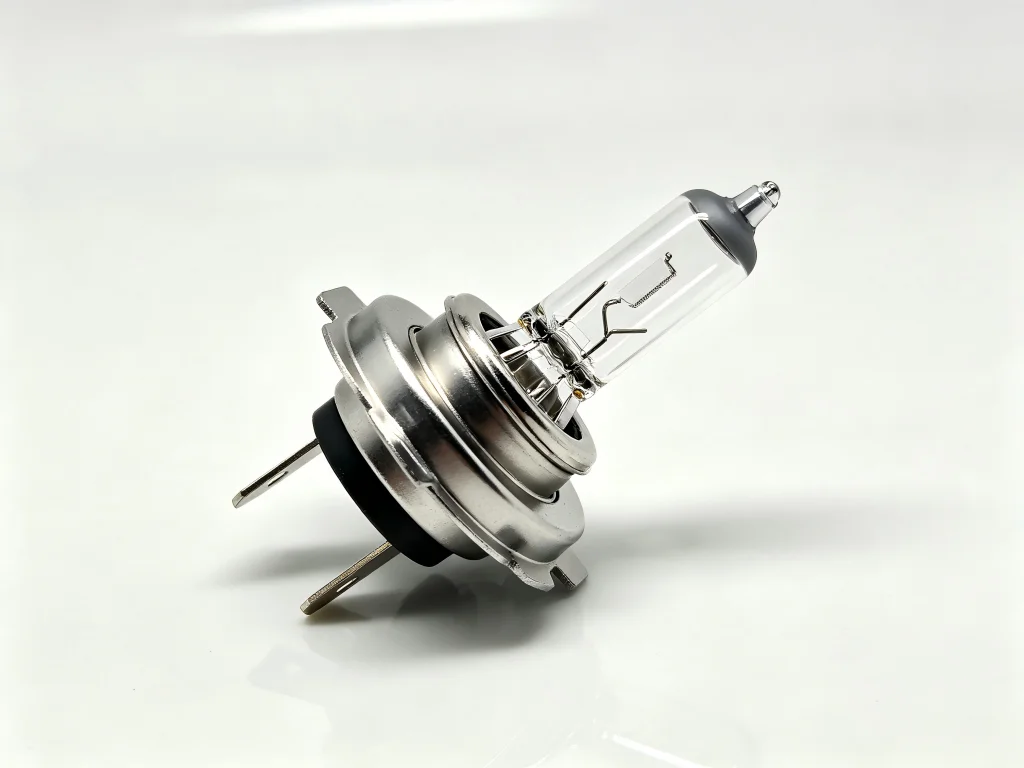
The Hidden Dangers of Your Factory H7 Headlight Bulb
Most drivers don’t realize their H7 halogen bulb loses up to 30% of its light output before it actually burns out. This gradual dimming happens so slowly that you don’t notice it — until you’re suddenly struggling to see road hazards at night.
Here’s what’s actually happening inside your headlight assembly:
Why Halogen Technology Falls Short
The standard H7 headlight bulb operates at 55 watts and produces roughly 1,500 lumens. That sounds adequate on paper. But halogen bulbs generate light by heating a tungsten filament until it glows — a process that wastes approximately 80% of energy as heat rather than usable light. The yellowish color temperature (around 3200K) actually reduces contrast and makes it harder to distinguish objects on the road.
In our engineering testing at GTR, we’ve measured factory H7 halogen bulbs that tested below 1,200 lumens after just 200 hours of use. That’s a 20% drop in visibility that most drivers never notice until an emergency situation forces them to.
Why Most H7 Headlight Bulb Upgrades Make Things Worse
You’ve probably seen the claims: “500% brighter!” “Plug and play!” “Fits all vehicles!” Here’s what the marketing materials don’t tell you.
The CANBUS Nightmare
Modern vehicles use CANBUS (Controller Area Network) systems to monitor electrical loads. When you replace your factory H7 headlight bulb with an LED option that draws less power, the CANBUS detects this variance and assumes a bulb has failed. The result? Flickering lights, dashboard error warnings, or bulbs that simply won’t turn on.
One frustrated driver on a forum described it perfectly: “I couldn’t see well and got very stressed driving at night. I won’t recommend this product”. Another reported that after installing cheap H7 LED bulbs, “the bulb has already lost its shelf life after 1.5 months of usage”.
The Fitment Disaster
H7 bulbs use a specific PX26d base with two exposed spade terminals. But not all H7 headlight bulb options are created equal. Some aftermarket bulbs are physically too large to fit into factory housings. One Amazon reviewer described installing an H7 LED upgrade: “The bulb is thicker and won’t fit the socket!!! Ended up filing the socket to make it larger so can push through the bulb”.
Another buyer found that “the plastic base is different from the halogen metal original in 2 respects — the plastic H11 locating baseplate is much thicker than the halogen metal original so the LED light could not be locked in”.
The Glare Problem
This is perhaps the most dangerous issue. When an H7 headlight bulb isn’t designed with the exact same filament position as the original halogen, the beam pattern scatters incorrectly. You might think you’re seeing better — but you’re actually blinding oncoming traffic while creating dangerous dark spots in your own field of vision.
This isn’t just an inconvenience. In many countries, using non-compliant LED bulbs in halogen housings is illegal. One Canadian buyer discovered this the hard way: “The biggest warning is that it’s illegal in Canada to put LED bulbs in vehicle light housings originally designed for halogen bulbs”.
What an H7 Headlight Bulb Should Actually Deliver
After analyzing thousands of customer complaints and testing dozens of products, we’ve identified five non-negotiable requirements for a proper H7 headlight bulb upgrade:
- True 1:1 dimensional accuracy — The bulb must match the exact dimensions of the factory halogen so it fits without modification and maintains the correct beam pattern
- Integrated CANBUS compatibility — Built-in error cancellation that prevents dashboard warnings without requiring external resistors or adapters
- Proper thermal management — LEDs generate heat; without adequate cooling, they fail prematurely
- Legal compliance — ECE or DOT certification ensures the bulb meets safety standards
- Consistent output — No flickering, no dimming over time, and a color temperature (5000K-6000K) that improves contrast without appearing blue or harsh
Real Driver Experiences: What Works and What Doesn’t
We’ve followed forum discussions and review threads where drivers share their H7 headlight bulb experiences. The pattern is clear:
The Good: “Installed this on my 2019 Outlander and it made a huge difference. Very bright white light”.
The Bad: “These bulbs put out almost no light at all. They are unbranded and very weak”.
The Ugly: “There is no high/low beam, just high beam all the time, and the alignment is terrible. These things are a danger to every other vehicle on the road”.
One driver in rural Australia captured the stakes perfectly: “I live in a regional area where highway night driving is very dangerous due to the risk of hitting kangaroos. For this reason, good visibility at night is ESSENTIAL”.
The GTR Solution: An H7 Headlight Bulb Engineered for Safety and Performance
Based on our years of manufacturing expertise in automotive lighting, we designed the GTR H7 LED headlight bulb to solve every problem outlined above.
Precision Engineering That Fits
Our H7 headlight bulb uses a 1:1 mini-size design that matches factory halogen dimensions exactly. It fits into your existing housing without modification, adapters, or filing down sockets. The PX26d base with two spade terminals connects directly to your factory wiring.
Built-In CANBUS Intelligence
We integrated CANBUS error cancellation directly into the bulb’s driver circuitry. No external resistors. No additional adapters. Just plug it in and drive — no dashboard warnings, no flickering.
Advanced Thermal Management
Our H7 headlight bulb features aerospace-grade aluminum heat sinks with intelligent temperature regulation. This prevents the premature failure that plagues cheaper LED options — especially in sealed headlight housings where heat dissipation is critical.
Legal and Certified
Every GTR H7 headlight bulb meets ECE standards for road legality. We don’t cut corners on compliance because your safety — and the safety of other drivers — depends on proper beam patterns.
Frequently Asked Questions About H7 Headlight Bulbs
What vehicles use an H7 headlight bulb?
H7 bulbs are commonly found in European and Korean vehicles including Audi, BMW, Volkswagen, Hyundai, and Kia. They’re typically used for low beams, though some vehicles use them for high beams or fog lamps. Always check your owner’s manual or the markings on your existing bulb to confirm fitment.
Is H7 a high beam or low beam bulb?
H7 is a single-filament bulb that can serve as either high beam or low beam — but not both simultaneously. Unlike H4 bulbs which have dual filaments, H7 bulbs are designed for a single function. Your vehicle may use H7 for low beams and a different bulb type for high beams.
Can I replace my H7 halogen with LED?
Yes, but only if the LED bulb is specifically designed as a 1:1 replacement that maintains the correct beam pattern and includes CANBUS compatibility. Cheap, poorly designed LEDs will cause glare, fitment issues, and dashboard errors. Always choose an ECE-certified option.
How many lumens should an H7 headlight bulb have?
A standard H7 halogen produces about 1,500 lumens. A quality H7 LED upgrade can deliver 4,000+ lumens while drawing less power. However, raw lumen numbers don’t tell the whole story — beam pattern and focus matter just as much for actual visibility.
What’s the difference between H7 and H11?
H7 uses a PX26d base with two exposed spade terminals; H11 uses a keyed plastic connector that clicks into place. They are not interchangeable. H7 bulbs are typically held by a spring clip, while H11 twist-locks into the housing.
Why does my H7 LED bulb flicker?
Flickering usually indicates a CANBUS compatibility issue. The vehicle’s computer detects the lower power draw of the LED and pulses power to check if the bulb is present. A quality H7 LED with built-in CANBUS cancellation eliminates this problem.
How long do H7 LED bulbs last compared to halogen?
Quality H7 LED bulbs can last 20,000+ hours compared to 500-1,000 hours for halogen. This means you could replace your H7 headlight bulb once and never touch it again for the life of the vehicle.
Can I install an H7 headlight bulb myself?
Most H7 bulb replacements take 5-20 minutes with basic hand tools. The hardest part is usually accessing the headlight housing behind the bumper or wheel well. A 1:1 designed LED like GTR’s H7 headlight bulb requires no wiring modifications or special tools.
Stop Compromising on Nighttime Safety
Every night you drive with a dim, failing, or poorly designed H7 headlight bulb, you’re gambling with your safety — and the safety of everyone on the road with you.
Don’t wait until you have a close call to upgrade. The GTR H7 LED headlight bulb delivers the brightness, beam pattern, and reliability that your factory bulbs should have provided from day one.
قم بزيارة https://www.rhgtr.com to see our complete H7 headlight bulb lineup and find the perfect fit for your vehicle. Your night drives will never be the same.