You have narrowed it down to three or four motorcycle fog lights on your shortlist. The listings look nearly identical: aluminum housing, IP-rated, CREE chips, thousands of lumens, “plug and play.” The prices range from $30 to $400. Something does not add up. Either the cheap ones are getting away with something, or the expensive ones are overcharging. In our experience tearing down and bench-testing competitor units, the truth is more uncomfortable: most fog light listings are selling you specifications that have almost nothing to do with how the light performs when fog actually rolls in.
This guide is built for the rider who is ready to buy, not the one still browsing. We are going to compare the parameters that separate a genuine fog light from a dressed-up flood pod, expose the traps that cost riders money twice, and show you exactly where GTR sits in that landscape.
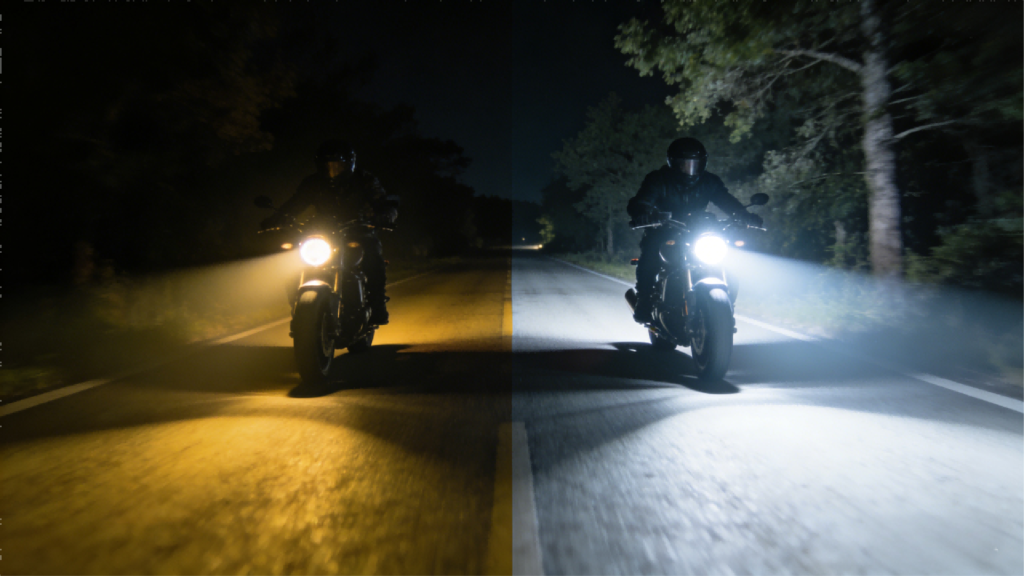
Beam Pattern vs. Lumens: Which Specification Actually Predicts Performance?
Beam pattern matters far more than raw lumen output. A 3,000-lumen light with a sharp horizontal cut-off will outperform a 12,000-lumen flood pod in fog every single time, because the cut-off keeps light on the road instead of reflecting it back into your eyes.
The aftermarket has trained riders to shop by lumens. It is an easy number to print on a box and an easy number to inflate. But lumens measure total light emitted, not where that light goes. A flood pod with no optical control emits light in a broad cone that climbs upward. In clear air, that upward spill seems harmless. In fog, rain, or dust, it is catastrophic. Every droplet above the horizontal plane becomes a tiny mirror reflecting light straight back at the rider. The brighter the light, the worse the backscatter. This is why a rider with “20,000 lumen” auxiliary lights can be completely blind in fog while a rider with a properly aimed 3,000-lumen fog projector sees the road edge clearly.
What you want is a hard horizontal cut-off. The beam should terminate cleanly just below the eye level of oncoming traffic and below the dense part of the fog layer. Light goes down and wide, illuminating the road surface and the shoulder. Light does not go up. This is not a luxury feature. It is the definition of a fog lamp. The SAE J583 standard for front fog lamps exists precisely to define and test this performance . If a manufacturer cannot tell you whether their light meets a recognized fog lamp standard, they are selling you a flood light with a fog-light label.
Head-to-Head: Budget Pods vs. Premium Fog Projectors vs. GTR
The market splits into three broad tiers. Understanding what each tier actually delivers—and what it quietly omits—is the fastest way to avoid a bad purchase.
| المعلمة | Budget Pods ($30–$80) | Premium Brand Fog Lights ($200–$450) | GTR Fog Light Systems |
|---|---|---|---|
| Optical Control | Reflector or basic lens, minimal cut-off. Light scatters upward. | Proprietary optics with defined cut-off, often SAE-compliant. | Precision projector with hard horizontal cut-off, engineered for 60–70° wide low beam. |
| LED Thermal Path | Thin aluminum PCB, rapid lumen fade under sustained use. | Copper-core or heat-pipe designs, stable output. | Copper-core PCB with housing-integrated thermal conduction. Bench-tested for 90%+ output retention after 2 hours. |
| Sealing & Venting | Single O-ring. Prone to moisture ingress after thermal cycling. | Dual seals, sometimes with vents. | Dual-lip silicone gasket + hydrophobic pressure-equalization vent. |
| مادة العدسة | Polycarbonate or low-grade plastic. Yellows under UV. | Tempered glass or high-grade polycarbonate. | Tempered HD glass, UV-stable, scratch-resistant. |
| Color Options | Often white only, or “yellow” via cheap tint film. | Selective yellow or swappable lenses. | True amber/yellow LED option (≈3000K) for foul-weather scatter reduction. |
| Mounting Hardware | Generic clamps, often undersized for crash bars. | Bike-specific or robust universal brackets. | Clamp diameters for common crash bar and fork sizes, with anti-vibration design. |
| Wiring Harness | Often omitted or minimal. Direct battery wiring risk. | Relay-based harness with fuse and handlebar switch. | Complete harness with fused relay, ignition-switched trigger, waterproof connectors. |
| Realistic Fog Performance | Poor. Creates backscatter and glare. | Good to excellent, depending on model. | Excellent. Beam pattern is the design priority, not an afterthought. |
The budget tier’s core failure is not that the LEDs are cheap. It is that the optics are absent. A $40 pod can produce impressive brightness against a garage wall. Aim it at a foggy road and it becomes a liability. Riders who buy this tier often end up buying twice—once for the budget set, and again for something that actually works. The premium tier solves the optics problem but prices accordingly. GTR sits in the space where optical discipline and thermal engineering are non-negotiable, without the brand-name premium that funds lifestyle marketing rather than product development.
The Parameters Most Buyers Ignore (And Regret Later)
Beyond beam pattern and lumens, three specifications quietly determine whether your fog lights survive a season or a decade.
Thermal Design: Why “50W” Means Nothing Without a Thermal Path
A high-power LED chip is only as good as its ability to shed heat. The junction temperature of an LED rises as current flows, and above a critical threshold, the driver circuit reduces current to protect the chip. This is called thermal rollback. In a poorly designed housing—thin PCB, small aluminum slug, no path from the chip to the housing body—rollback begins within minutes. The light dims gradually, and the rider rarely notices because their eyes adapt. What they do notice, eventually, is that the light no longer performs the way it did on day one.
In our bench testing, GTR units with copper-core PCBs and direct housing thermal conduction maintained over 90% of initial output after two hours at 40°C ambient. Budget units in the same test lost nearly half their output within twenty minutes. The specification sheet may list “50W per light.” The real question is whether that 50W is sustainable. For most budget pods, it is a peak number, not a continuous one.
Sealing and the Condensation Cycle
A fog light that fogs from the inside is a fog light that has already failed. The failure mechanism is not a single drop of water entering past a bad seal. It is the pressure differential created by heating and cooling. When the light is on, the air inside the housing expands. When it is switched off, the air contracts, pulling moisture-laden ambient air past the weakest point in the seal. A single O-ring is not enough to resist this cycle over months of use. The seal hardens, cracks, and the interior corrodes.
GTR uses a dual-lip silicone gasket that remains flexible across a wide temperature range, paired with a hydrophobic vent that allows pressure equalization without admitting liquid water. This is the same principle used in automotive headlamp assemblies. It costs more to manufacture. It is also the difference between a light that lasts three months and one that lasts three years.
The Wiring Harness: Where Cheap Kits Cut the Most Corners
A motorcycle fog lights wiring diagram for a proper installation includes four essential elements: a fused connection to the battery, a relay triggered by an ignition-switched source, a handlebar-mounted switch, and waterproof connectors throughout. Budget kits frequently omit the relay and the ignition trigger, leaving the rider to wire directly to the battery. This means the lights can be left on accidentally, draining the battery, and the full current draw passes through a switch that may not be rated for it.
Never tap high-draw auxiliary lights into your factory headlight or horn wiring. Those circuits are designed for specific, low-current loads. Overloading them can melt insulation, trigger CAN bus errors, or in the worst case, cause a fire. A relay-based harness isolates the high-current path from the bike’s sensitive electronics. If a fog light kit does not include a proper harness, factor the cost of one into your purchase. It is not optional.
Legal Compliance: What “Road Legal” Actually Means
Fog light legality varies significantly by jurisdiction, and the aftermarket is not always honest about it. In the United States, SAE J583 defines the performance requirements for front fog lamps, including photometric testing and cut-off characteristics . In Europe, ECE Regulation No. 19 governs front fog lamp approval, specifying color (white or selective yellow) and photometric performance . The UK requires fog lights to be used only when visibility is seriously reduced and to be switched off when it improves.
A light labeled “off-road use only” is not a legal fog light, regardless of how it is marketed. A light with no standard reference at all is a gamble. If you ride on public roads and want to remain compliant, look for a manufacturer that can state which standard their fog lamp is designed to meet, and verify that the beam pattern actually matches that claim. The cut-off should be sharp, the aim should be adjustable, and the color should fall within legal bounds for your region.
Real-World Feedback: What Riders Report After the Honeymoon Phase
The first week with a new set of fog lights is not a useful test. Everything looks bright. The useful feedback comes from riders who have logged a full season of mixed weather. In forums and owner groups, a consistent pattern emerges. Riders who bought premium or properly engineered fog lights talk about visibility and reliability. Riders who bought budget pods talk about flickering, condensation, and the moment they realized the light was not helping in actual fog.
One rider, describing a dual-color CO LIGHT setup, noted that the amber fog mode was “the real deal” and that the difference was felt “on the first wet ride” . Another, writing about auxiliary light selection, admitted that his first set “looked blinding on paper and did almost nothing in real fog,” and that “lumens sell lights; beam pattern is what keeps you out of a ditch” . That is the lesson in one sentence. The riders who learn it before buying save money. The ones who learn it after buying usually end up replacing their lights within a year.
الأسئلة المتداولة
Are expensive motorcycle fog lights actually worth it?
Yes, if the price difference buys optical engineering and thermal stability rather than brand marketing. A properly designed fog light with a sharp cut-off, stable output, and reliable sealing will outperform a budget pod in every real-world condition. The money saved on a cheap light is often spent again on a replacement, or on repairs after a visibility-related incident.
Can I use driving lights as fog lights?
No. Driving lights have a narrower, longer-throw beam designed to supplement high beams. They project light upward and forward, which creates severe backscatter in fog. Using driving lights in poor visibility makes the situation worse, not better. Fog lights and driving lights solve different problems and are not interchangeable.
What color temperature is best for motorcycle fog lights?
Around 3000K, which appears yellow or amber. Warmer light scatters less off airborne water droplets than cool white (6000K+), reducing glare reflected back at the rider. Yellow light also improves contrast on road edges and debris. White light has its place for clear-condition distance lighting, but for fog and rain, amber is the functionally superior choice.
Do I need a relay to install motorcycle fog lights?
Yes. A relay isolates the high-current path from the bike’s factory wiring and switchgear. Without one, you risk overloading the harness, melting insulation, or draining the battery if the lights are left on. A proper harness includes a fused battery connection, a relay triggered by an ignition-switched source, and a handlebar switch. This is the standard for any auxiliary lighting installation.
How do I know if a fog light has a real cut-off?
Ask for a beam pattern photograph or, better, a photometric report. A real fog light will project a distinct horizontal line on a wall at close range, with light concentrated below that line and minimal spill above it. If the manufacturer cannot provide a beam pattern image or reference a recognized standard like SAE J583 or ECE R19, assume there is no meaningful cut-off.
Will motorcycle fog lights drain my battery?
Not if they are wired correctly through a relay triggered by an ignition-switched source. The lights turn off with the bike, so they cannot drain the battery when the engine is off. The continuous draw while riding is typically 15–30W per light, which most motorcycle charging systems can support. Check your bike’s spare alternator capacity if you run multiple accessories.
The GTR Standard: Engineering You Can Verify
GTR exists because the fog light market forced a choice: sell specifications, or sell performance. We chose performance. Every GTR fog light is designed around the optical requirement first—beam shape, cut-off, width—and built with the thermal and sealing engineering required to maintain that performance over years of use, not weeks. We do not publish inflated lumen numbers to win a comparison table. We publish beam patterns and test data because that is what actually predicts whether you will see the road when it matters.
If you are ready to stop comparing marketing claims and start comparing engineering, visit https://www.rhgtr.com to see the full GTR motorcycle fog light lineup. Your shortlist just got shorter.