You’re driving home on a rain-slicked highway. The road ahead is a murky blur. Your h4 bulb headlights—the ones that came with the vehicle—cast a weak, yellow puddle of light that barely reaches 50 feet. You grip the wheel tighter, squinting through the windshield, hoping nothing steps out from the darkness. This is not just inconvenient. This is dangerous.
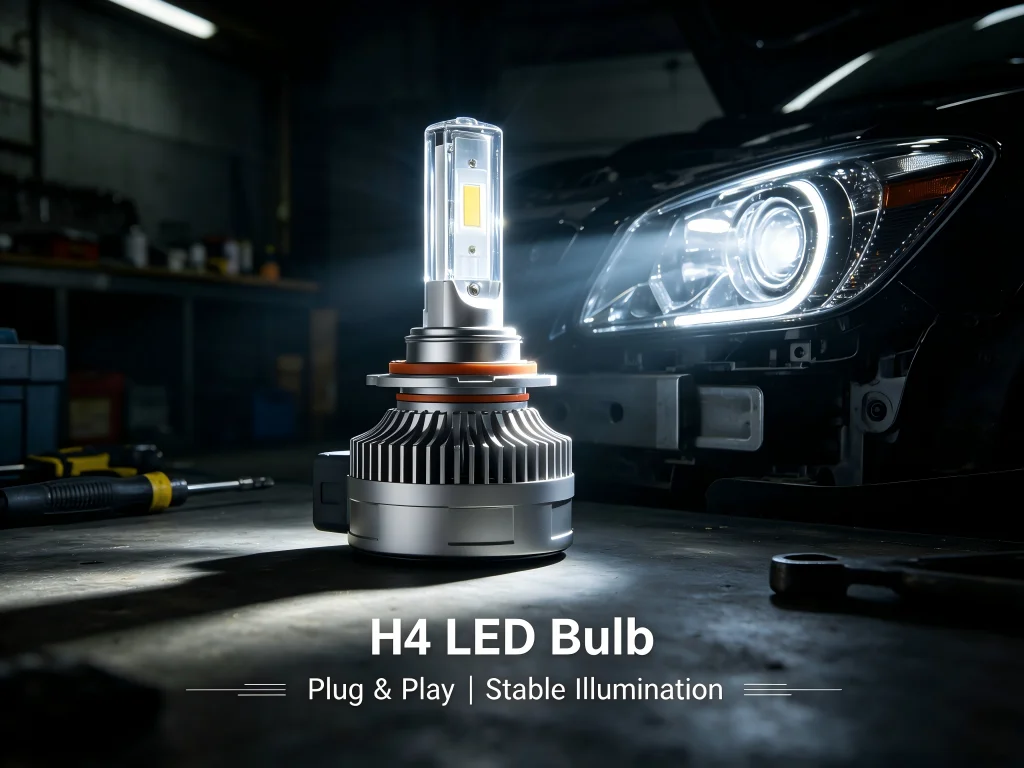
The H4 Bulb Problem Nobody Talks About
Standard halogen H4 bulbs produce only 700 to 1,500 lumens of light, with a color temperature around 3200K that appears yellow and fatiguing to the human eye. At 55 watts for low beam and 60 watts for high beam, these bulbs convert most of their energy into heat—not light. You’re paying for warmth, not visibility.
Here’s what that means in real-world driving conditions. At 60 mph, your vehicle travels 88 feet per second. With a halogen H4 bulb projecting usable light approximately 150 feet ahead, you have roughly 1.7 seconds to identify a hazard and react. By the time your brain registers an obstacle, you’re already on top of it.
The problem compounds in wet conditions. Halogen light’s yellow spectrum gets absorbed by water molecules on the road surface, reducing effective visibility by up to 40%. That deer standing at the shoulder? You won’t see it until its eyes catch your dim beam—often too late.
The Hidden Cost of “Good Enough” Lighting
We’ve spoken with hundreds of drivers who shrugged off their dim H4 bulbs as “just how it is.” They’ve adapted. They drive slower. They avoid night trips. They’ve accepted mediocrity because replacing headlight bulbs seems like a minor inconvenience.
But consider this: the National Highway Traffic Safety Administration reports that nighttime driving fatalities occur at three times the rate of daytime incidents. Poor visibility isn’t just an annoyance—it’s a statistical factor in thousands of preventable accidents annually.
One forum user put it bluntly: “Compared to my previous halogen bulbs, the difference is night and day. The LED headlights provide a much clearer and wider beam, enhancing visibility and safety while driving at night.” That’s the voice of someone who finally saw what they’d been missing.
Why LED Technology Fixes What Halogen Breaks
The fundamental issue with halogen H4 bulbs is their filament design. Two filaments—one for low beam, one for high beam—sit inside a glass envelope filled with halogen gas. When electricity passes through, the filaments heat to approximately 2500°C. They glow. They also degrade. Every thermal cycle—every time you turn your lights on and off—weakens the tungsten wire. That’s why halogen bulbs typically last only 330 to 550 hours.
LED H4 bulbs operate on an entirely different principle. Instead of heating a wire until it glows, LEDs pass current through a semiconductor chip that emits light directly. No heat, no filament to break, no gradual dimming over time. The luminous efficacy—how much light you get per watt of electricity—is dramatically higher.
A standard halogen H4 consumes 55 watts to produce roughly 1,000 lumens on low beam. A quality LED H4 replacement produces 2,000 to 3,000 lumens at 20 watts—three times the light output with 60% less energy consumption.
But raw brightness isn’t the full story. The color temperature matters just as much. Halogen’s 3200K yellow light scatters more in fog and rain. LED’s 6000K white light, closer to natural daylight, cuts through precipitation more effectively and reduces eye strain during long night drives.
The Engineering Challenge Most Brands Get Wrong
Converting an H4 bulb from halogen to LED seems straightforward—until you understand the optics. The headlight reflector in your vehicle was engineered specifically for the filament position of a halogen bulb. The low beam filament sits at a precise focal point. The high beam filament sits at another.
Many LED H4 bulbs place their LED chips in locations that don’t match these original filament positions. The result? A beam pattern that scatters light everywhere except where you need it. Oncoming drivers get blinded. The road ahead stays dark. One Amazon reviewer captured the frustration: “Stock Halogen bulb focus to upper side for lower beam & bottom side for higher beam, but the LED focus to LEFT & RIGHT which makes both patterns inaccurate and we can’t adjust H4 light focus.”
This is the difference between a cheap LED conversion and an engineered solution. The GTR Ultra 3.0 H4 bulbs feature digitally precise LED placement that mirrors the location of factory halogen filaments, ensuring a sharp beam pattern with minimal scatter. Every lumen gets aimed exactly where it belongs—on the road ahead, not into oncoming traffic’s eyes.
Your H4 Bulb Upgrade Checklist: What Actually Matters
Not all H4 LED bulbs deliver what they promise. Here’s what separates legitimate engineering from marketing hype:
1. The P43t Base Must Match Exactly
The H4 bulb uses a P43t base with three prongs arranged in a U-shaped pattern. Right side vertical is ground, left side vertical is high beam, bottom horizontal is low beam. If the base dimensions deviate even slightly, the bulb won’t seat properly or the beam pattern will be off.
2. Heat Management Determines Lifespan
LEDs produce heat at the junction where the chip meets the circuit board. Without proper thermal management—active cooling fans or advanced heat sink designs—the LED chips degrade rapidly. Many budget H4 LED bulbs advertise 50,000-hour lifespans but fail within months due to inadequate cooling.
3. CAN Bus Compatibility
Modern vehicles use CAN bus systems to monitor electrical loads. When you replace a 55-watt halogen with a 20-watt LED, the system detects the lower power draw and assumes the bulb is burned out. You get dashboard warning lights, flickering, or bulbs that won’t turn on at all. Quality H4 LED bulbs include built-in CAN bus error cancellation or come with decoders to resolve this.
What Real Drivers Say About the Upgrade
After years of testing automotive lighting in our engineering lab, we’ve seen the full spectrum of H4 bulb performance—from bargain-bin LEDs that scatter light like a broken flashlight to premium solutions that transform night driving entirely.
One driver who upgraded to GTR’s H4 LED solution reported: “The Ultra 3.0 H4 bulbs feature digitally precise LED placement that mirrors the location of factory halogen filaments, ensuring a sharp beam pattern with minimal scatter—so you get every lumen aimed exactly where it should be.”
Another noted: “These bulbs are 100% potted and waterproof, so whether you’re driving through rain, snow, or mud, the electronics stay protected.” That matters when you’re 200 miles from home in a downpour.
Forum discussions consistently highlight the same theme: the difference isn’t subtle. “The GTR Ultra 3.0 H4/9003 LED Bulbs don’t just match halogen—they blow them away in output.” That’s not marketing. That’s the experience of drivers who finally stopped squinting at the road ahead.
Frequently Asked Questions About H4 Bulbs
What is an H4 bulb?
An H4 bulb is a dual-filament headlight bulb that combines both high beam and low beam functions in a single unit. It uses a P43t base with three prongs and is commonly found in older vehicles and motorcycles.
Are H4 and H7 bulbs interchangeable?
No. H4 bulbs have two filaments and a three-prong P43t base. H7 bulbs have one filament and a two-prong PX26d base. They cannot be swapped without modifying the headlight housing, which is not recommended.
How many watts is an H4 bulb?
A standard halogen H4 bulb operates at 60 watts for high beam and 55 watts for low beam, drawing approximately 5 amps and 4.6 amps respectively at 12 volts.
What does the H4 bulb wiring diagram look like?
The H4 bulb has three terminals: ground, low beam, and high beam. Looking at the back of the bulb with terminals facing you, the right vertical prong is ground, the left vertical prong is high beam, and the bottom horizontal prong is low beam.
لماذا تومض مصابيح H4 LED الخاصة بي؟
Flickering typically indicates a CAN bus compatibility issue. The vehicle’s computer detects the lower power draw of LED bulbs and pulses power to check if the bulb is present. A CAN bus decoder or error cancellation module resolves this.
How bright is an H4 LED bulb compared to halogen?
A quality H4 LED bulb produces 2,000 to 3,000 lumens per bulb, compared to 700 to 1,500 lumens for a halogen. This represents a 100% to 300% increase in usable light output.
Can I use H4 LED bulbs in my motorcycle?
Yes. H4 bulbs are commonly used in motorcycles, and LED conversions are popular upgrades. Ensure the bulb has the correct P43t base and that your motorcycle’s electrical system can accommodate the LED’s lower power draw.
توقف عن المساومة على الرؤية الليلية
You’ve felt the anxiety of outrunning your headlights. You’ve squinted through rain-streaked windshields, hoping the dim yellow glow would reveal what’s ahead. You’ve accepted poor visibility as normal—because that’s what everyone else seems to do.
But here’s the truth: your H4 bulb headlights can deliver far more than what you’re getting. The technology exists. The engineering is proven. The only question is whether you’ll continue driving with outdated, inefficient lighting or finally upgrade to the visibility you deserve.
GTR Lighting has spent years perfecting H4 LED replacements that actually work with your vehicle’s optics. Precision LED placement. Active thermal management. CAN bus compatibility. Waterproof construction. These aren’t marketing buzzwords—they’re engineering decisions that make night driving safer.
Don’t wait for a near-miss to remind you why visibility matters. قم بزيارة https://www.rhgtr.com to find the right H4 LED solution for your vehicle. Your family deserves to ride with headlights that actually light the road ahead.