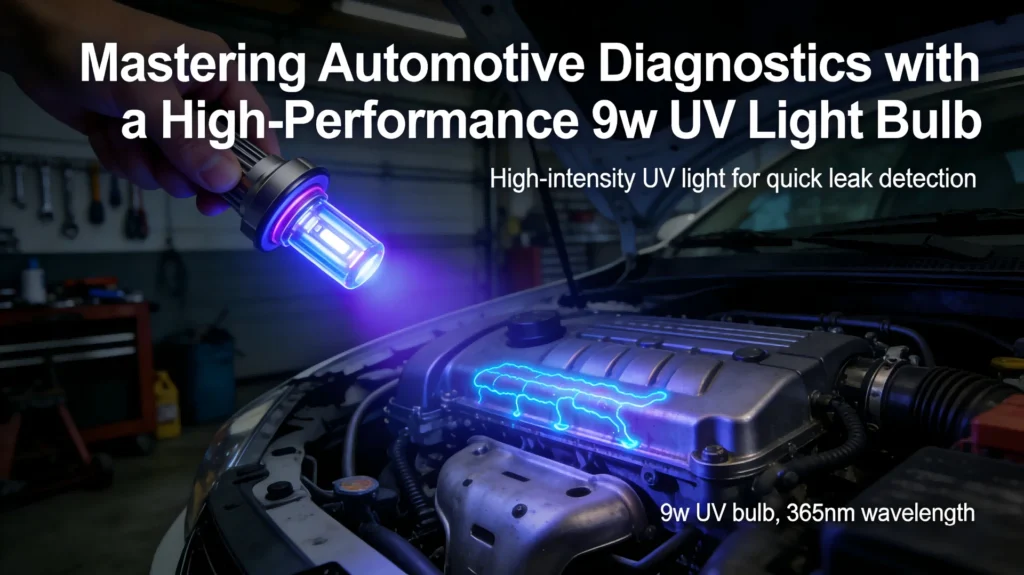
In the world of professional automotive repair and detailing, visibility is everything. Whether you are tracking down an elusive refrigerant leak in a vintage BMW or curing the protective coating on a freshly restored headlight lens, the quality of your light source dictates the quality of your work. While standard work lights illuminate the surface, a specialized 9w uv light bulb reveals what the naked eye cannot see.
For years, mechanics relied on dim, battery-draining UV flashlights that barely illuminated the dye. Today, the shift toward high-intensity 9w led light bulb technology has revolutionized diagnostics. This article dives deep into how the 9-watt UV standard is transforming automotive maintenance, specifically focusing on AC leak detection and adhesive curing applications widely discussed in professional circles.
The Science of Visibility: Why 9 Watts?
To understand the application, we must first define the tool. A 9w uv light bulb utilizing LED technology is a significant upgrade from older fluorescent tubes. In the context of LEDs, 9 watts represents a high-output consumption that, when converted efficiently, produces intense ultraviolet radiation, typically in the UVA spectrum.
Discussions on mechanic forums often highlight a common confusion: wattage vs. output. A 9W LED emits a focused beam that is often equivalent to a 40W+ incandescent UV source. This intensity is crucial because ambient garage lighting can wash out the fluorescence of leak dyes. A high-output 9W source cuts through the background noise, making the dye “pop” with a brilliant neon glow.
Deep-Dive Application: The A/C Leak Detection Protocol
The most critical application for a 9w 400 nm uv light bulb (or the more precise 365nm variant) in a workshop is Air Conditioning system diagnostics. When a vehicle like a Tesla or Toyota enters the shop with a failing AC, the leak is often microscopic.
The Workflow
Professional technicians typically follow this protocol using high-performance lighting:
- Injection: A specific UV-reactive dye is injected into the low-pressure port of the AC system.
- Circulation: The system is run to circulate the dye through the compressor, condenser, and evaporator.
- Inspection: This is where the 9w led bulb becomes critical. The technician scans the engine bay.
Users on automotive lighting forums frequently note that lower wattage pens (3W or 5W) fail to illuminate leaks hidden in deep crevices or covered in road grime. The 9W threshold provides the “throw” necessary to reach the firewall or the underside of the condenser without physically dismantling the entire front end.
Secondary Application: Headlight Restoration and Curing
Beyond diagnostics, the uv light bulbs 9w 365nm spectrum is essential for the modern restoration of polycarbonate headlight lenses. When GTR lenses or other aftermarket modifications are installed, UV-curable adhesives and sealants are often used to ensure a watertight bond.
UV-sensitive resins require a specific energy density to initiate polymerization (hardening). If the light is too weak, the resin remains tacky. A 9W UV source provides sufficient irradiance to cure these optical adhesives rapidly, ensuring that the new lens is sealed against moisture before the car even leaves the bay.
Key Selection Factors for Automotive UV
Not all lights are created equal. When selecting a 9w uv light bulb for your shop, consider these three variables:
1. Wavelength Accuracy (365nm vs. 400nm)
This is the most debated topic in technical reviews. A 9w 400 nm uv light bulb emits a lot of visible purple light. While cheaper, it can obscure the fluorescence of certain dyes. Conversely, a uv light bulbs 9w 365nm variant emits almost no visible light but causes reactive materials to fluoresce brilliantly. For precision leak detection, 365nm is superior.
2. Thermal Management
Running 9 watts of power through compact LED chips generates significant heat. High-quality units feature aluminum housings and copper substrates (similar to those found in GTR’s premium lighting solutions) to dissipate heat. Poorly designed bulbs will dim rapidly as they overheat.
3. Lens Optics
A quartz or glass lens that focuses the UV energy is preferred over plastic lenses, which can degrade and yellow over time under UV exposure, blocking the very light they are supposed to transmit.
Installation and Maintenance of UV Tools
Treating your diagnostic tools with care ensures longevity. Here are maintenance tips derived from experienced shop managers:
- Clean the Lens: Oil and grease on the lens of your 9w led light bulb will block UV output. Wipe it daily with isopropyl alcohol.
- Duty Cycle: While LEDs are durable, allowing the unit to cool down after 10-15 minutes of continuous use can extend the lifespan of the driver circuitry.
- Eye Safety: Never look directly into a 9W UV emitter. The radiation is invisible but can damage the retina. Always wear yellow-tinted UV safety glasses, which also enhance contrast.
FAQ: Common Questions from the Garage
Can I use a 9W UV bulb for sanitization?
It depends on the wavelength. 365-400nm (UVA) is great for curing and detection but has minimal germicidal properties. Sanitization usually requires UVC (254nm), which is dangerous and distinct from standard blacklights.
Why does my 9W UV light look dim to the naked eye?
If you have a 365nm bulb, this is a sign of quality. The energy is in the ultraviolet spectrum, which humans cannot see. It only becomes “bright” when it hits a reactive surface (like dye or white fabric).
Will this work for curing UV nail polish?
Yes, a 9w led bulb in the UV spectrum is often used in nail salons. However, automotive grade lights may be too intense for close-range skin exposure without protection.
How long do these bulbs last?
A high-quality LED unit should last between 30,000 to 50,000 hours, provided it has adequate heat dissipation.
Why Professionals Choose GTR
When your reputation depends on accurate diagnostics and durable repairs, generic tools fall short. GTR understands the rigorous demands of the automotive environment. Our commitment to optical precision ensures that our lighting solutions—whether for road illumination or workshop diagnostics—deliver consistent, high-intensity performance. By integrating superior thermal management and verified wavelength outputs, GTR provides the reliability that professionals trust.