Driving at night shouldn’t feel like a guessing game. If you have noticed your headlights losing their punch, or if one side keeps flickering during your commute, you are likely dealing with the common degradation of xenon and hid systems. While these lights were once the gold standard of luxury automotive lighting, age and low-quality components can turn a premium safety feature into a nighttime hazard. At GTR, we have spent years engineering lighting solutions that bridge the gap between factory underperformance and professional-grade clarity.
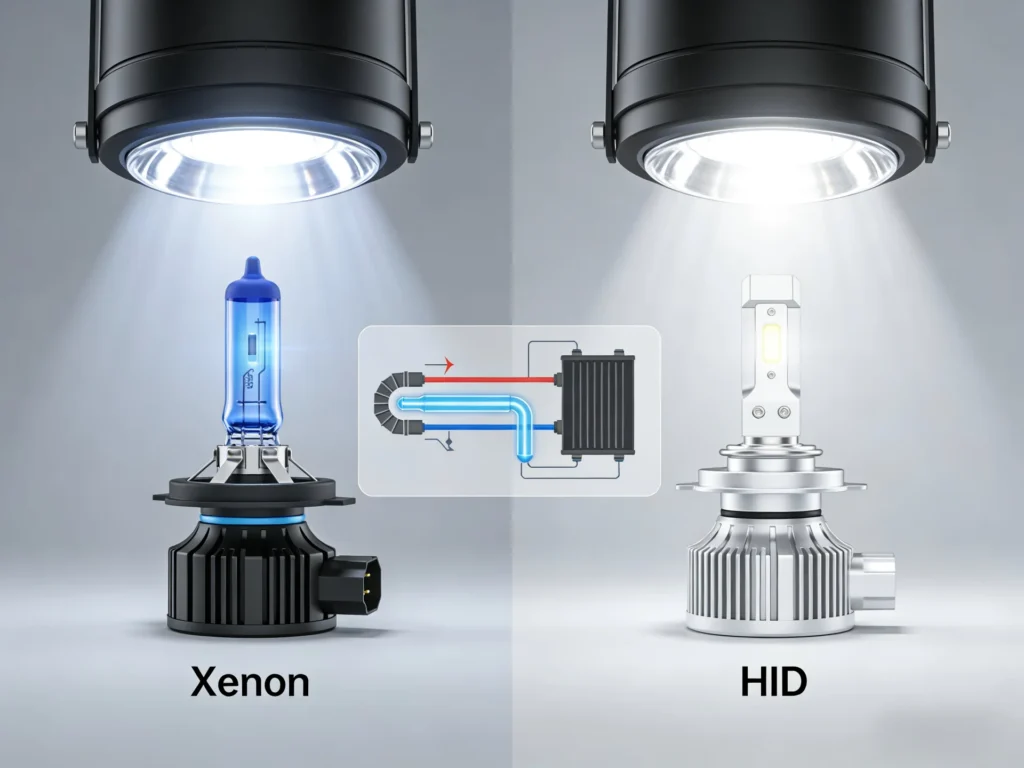
Are Xenon and HID the Same? The Short Answer for Professionals
Yes, xenon and hid (High-Intensity Discharge) headlights are essentially the same. HID is the technical name for the lighting technology, while Xenon refers to the noble gas used inside the quartz bulb to facilitate the initial arc. All xenon automotive bulbs are HID lights, but not all HID industrial lights use xenon gas.
When you hear drivers or mechanics talk about xenon hid headlights, they are referring to a system that uses a high-voltage ballast to create an electrical arc between two electrodes. This arc excites the xenon gas and metal halides, producing a crisp, white light that far outshines traditional halogen filaments. However, the complexity of this system means there are more points of failure, from the gas mixture in the xenon hid bulbs to the internal circuitry of the xenon hid ballast.
The PAS Analysis: Why Your HID System is Failing You
The Problem: The “Dimming” Danger and Flickering Frustration
Unlike LEDs, which generally work until they don’t, xenon and hid bulbs suffer from “lumen depreciation.” Over time, the chemical salts inside the bulb wear out, and the electrodes degrade. You might notice your lights turning a pinkish or purple hue—a sign the bulb is about to die. Worse yet is the dreaded flicker. This usually happens because the xenon hid ballast can no longer maintain a steady voltage, or the bulb requires more “strike voltage” than the system can provide. In heavy-duty or B2B transport environments, this isn’t just an eyesore; it’s a liability.
The Agitation: The Cost of Choosing “Cheap” Replacements
It is tempting to grab the cheapest xenon hid conversion kit or unbranded D1S bulbs from a massive marketplace. But here is what our engineering tests show: low-grade bulbs often have misaligned focal points. This means the light doesn’t hit the road; it glares into the eyes of oncoming traffic. Furthermore, a sub-par xenon hid d1s 35w bulb can draw irregular current, potentially frying your vehicle’s expensive factory wiring harness or causing EMI (Electromagnetic Interference) that kills your radio reception.
The Solution: GTR’s Precision-Engineered HID Ecosystem
At GTR, we don’t just “sell bulbs.” We engineer lighting ecosystems. Our xenon hid d3s 35w and D1S series are manufactured using UV-cut quartz glass from world-class suppliers to prevent headlamp housing yellowing. By optimizing the metal halide composition, we ensure a stable 5500K-6000K color temperature that mimics natural daylight, reducing eye fatigue during long-haul drives.
How to Identify a Quality Xenon HID Component
When sourcing replacements, look for these three non-negotiable markers of quality that we implement at GTR:
- Precision Alignment: The light capsule must be laser-aligned to the base to ensure the beam pattern matches OEM specifications.
- Ballast Efficiency: 高质量 xenon hid ballast should have an efficiency rating of over 85% to minimize heat waste.
- Shielded Wiring: To prevent the “radio buzz” common in HID systems, look for integrated electromagnetic shielding.
Common Troubleshooting: Featured Snippet FAQ
Why is there a xenon and hid difference in pricing?
The price difference in xenon and hid components usually stems from the quality of the ballast and the purity of the xenon gas. Premium systems use high-grade igniters and German-sourced quartz, ensuring the bulb lasts 3,000+ hours, whereas “budget” versions often fail within 500 hours due to electrode erosion.
Can I swap a 35W bulb for a 55W bulb?
In most cases, we do not recommend this without upgrading the ballast. A 35W xenon hid ballast cannot provide enough juice to a 55W bulb, leading to premature failure and poor light output. Always match your wattage to your driver component.
If you are tired of dim roads and unreliable lighting, it is time to upgrade to a system that prioritizes safety through science. At GTR, we provide the industrial-grade reliability your vehicle deserves. Explore our professional range of high-performance xenon and hid solutions and see the road in a whole new light.