Imagine this scenario: It is 2:00 AM. You are miles from the nearest paved road, navigating a treacherous mountain pass in driving snow. A fellow off-roader has slid off the trail. You need high-intensity illumination to winch them out, but your standard white bright lights are reflecting off the falling snow, creating a blinding wall of “white-out” glare. This is a common discussion point on forums like Expedition Portal and Reddit’s 4×4 communities. The solution that seasoned recovery experts turn to is not just brighter light, but smarter light: the red white led light bar.
While standard lighting is sufficient for fair-weather driving, specific applications—such as search and rescue, roadside assistance, and tactical recovery—require the versatility of dual-color technology. This deep dive explores why a light bar red and white combination is the ultimate tool for professional and volunteer recovery vehicles, and how GTR is redefining this safety standard.
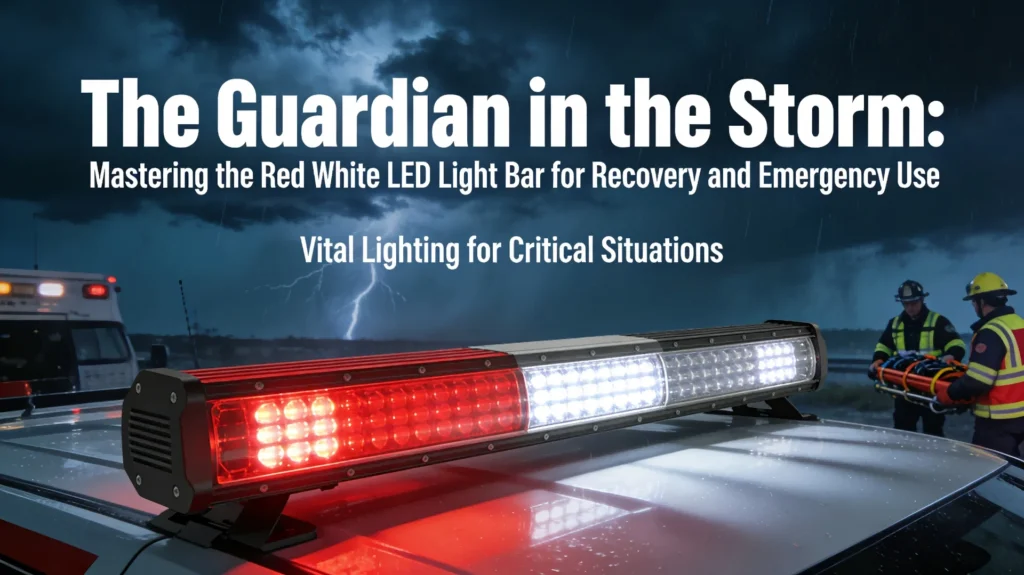
The Optics of Survival: Why Red Matters
To understand why this product is essential for recovery, we must look at the physics of light scattering. High-kelvin white light (6000K+) has a short wavelength and scatters easily when it hits water droplets, fog, or dust particles. This scattering causes the light to bounce back into the driver’s eyes, reducing visibility.
Conversely, a led red light has a much longer wavelength (approximately 620-750 nanometers). This allows the beam to penetrate through airborne particulate matter like rain, snow, and dust with significantly less refraction. For a tow truck driver or an off-road recovery specialist, switching to the red mode means they can see the terrain without the blinding glare, ensuring safe positioning of the vehicle.
Core Application: The Recovery & Chase Truck Setup
The red white led light bar is rapidly becoming standard equipment on specific vehicle builds. Let’s examine how it is utilized in the field.
1. The “Work Scene” Illumination
When a recovery team is securing a winch line or assessing suspension damage on a trail, they need flood lighting. The white spectrum of the bar provides the necessary lumens to turn night into day. Brands like GTR engineer these bars with high-intensity CREE or OSRAM chips to ensure that the work area is fully illuminated, allowing mechanics to see bolt heads and hydraulic lines clearly.
2. The “Stealth” and Night Vision Mode
Once the recovery is underway, or during long treks to the rescue site, preserving night vision is critical. The human eye uses “rods” for low-light vision, which are chemically depleted by bright white light. A led light red colour does not bleach the visual purple (rhodopsin) in the eye. This allows the driver to maintain peripheral vision and see shadows and contrasts on the trail that white light washes out.
3. Warning and Signaling
In a stationary position on a highway shoulder or a dark trail, visibility to others is safety. Many red white led light bar models come with strobing functions. An alternating red/white flash is a universal warning signal that cuts through the darkness, alerting oncoming traffic to slow down long before they see the disabled vehicle.
Critical Selection Factors for Recovery Rigs
When outfitting a Toyota Tacoma, Ford F-150, or a specialized unimog for recovery work, not all bars are equal. Here is what you must evaluate:
- Independent Circuitry: You must be able to control the colors separately. A shared circuit is useless in this application. You need a switch for white (driving), a switch for red (fog/dust), and a mode for strobe.
- Ingress Protection (IP Rating): Recovery work is wet and dirty. Look for IP68 or IP69K ratings. This ensures the led lights black and red housing can withstand high-pressure washing and submersion in mud.
- Beam Pattern: For this specific application, a “Combo Beam” is preferred. You need Spot optics in the center (for reach) and Flood optics on the sides (for peripheral work area lighting).
Installation and Maintenance for Heavy-Duty Use
Installing a dual-function bar requires more thought than a standard plug-and-play setup.
Wiring the Dual-Switch System
Since you are managing two distinct light sources within one housing, you will likely need a wiring harness with a 3-wire or 4-wire trigger.
Tip: Use a relay for each color channel. Even though LEDs draw low amperage, separating the load ensures that if one relay fails during a critical mission, you still have the other color functional.
Mounting Position Strategy
For recovery vehicles, the mounting position changes the effectiveness of the led red light.
Roof Mount: Best for long-distance projection but prone to glare on the hood if not angled correctly.
Bumper/Grille Mount: Superior for cutting through fog. Since fog hovers slightly above the ground, mounting the bar lower allows the red light to “undercut” the weather.
Common Questions from the Field (FAQ)
Q: Is it legal to drive with the red light on?
A: Regulations vary by state and country. Generally, forward-facing steady red lights are restricted to emergency vehicles. However, using them off-road or on private land for visibility is standard practice. Always check local DOT laws.
Q: Can the red light really help in smoke?
A: Yes. This is why many fire command vehicles utilize this technology. The longer wavelength penetrates smoke particles better than blue or white light.
Q: Does GTR offer a memory function?
A: Many premium GTR bars have memory recall, meaning if you turn the truck off while in “Red Flood” mode, it will return to that mode when powered back on—a crucial feature for emergency stops.
Why Professionals Choose GTR for Rescue Builds
In the high-stakes world of vehicle recovery, equipment failure is not an option. GTR has established itself as a leader by focusing on the “internals” that others overlook. Their red white led light bar series utilizes military-grade breathers to prevent condensation buildup—a common killer of lesser lights.
Furthermore, GTR’s thermal management systems ensure that the red LEDs do not fade over time. Red phosphor can be sensitive to heat; GTR uses oversized heat sinks to keep the diodes running cool, ensuring that your safety equipment performs as well on the 100th mission as it did on the first. For those who risk their safety to help others, GTR provides the reliability required to get home.