For many drivers, the onset of dusk brings about a subtle yet persistent anxiety. This phenomenon, often discussed in automotive forums as “night blindness,” is frequently not a result of the driver’s vision but a failure of the vehicle’s lighting system. Standard halogen bulbs may struggle to pierce through heavy rain, and many budget aftermarket options might scatter light so poorly that they provide no real benefit. If you have ever felt that your road visibility is inadequate, you are facing a common automotive pain point. The most effective, engineered solution to this visibility crisis is the transition to oem hid headlights. By utilizing high-intensity discharge technology that was originally designed for premium vehicle platforms, drivers can regain confidence and safety during the most challenging driving conditions.
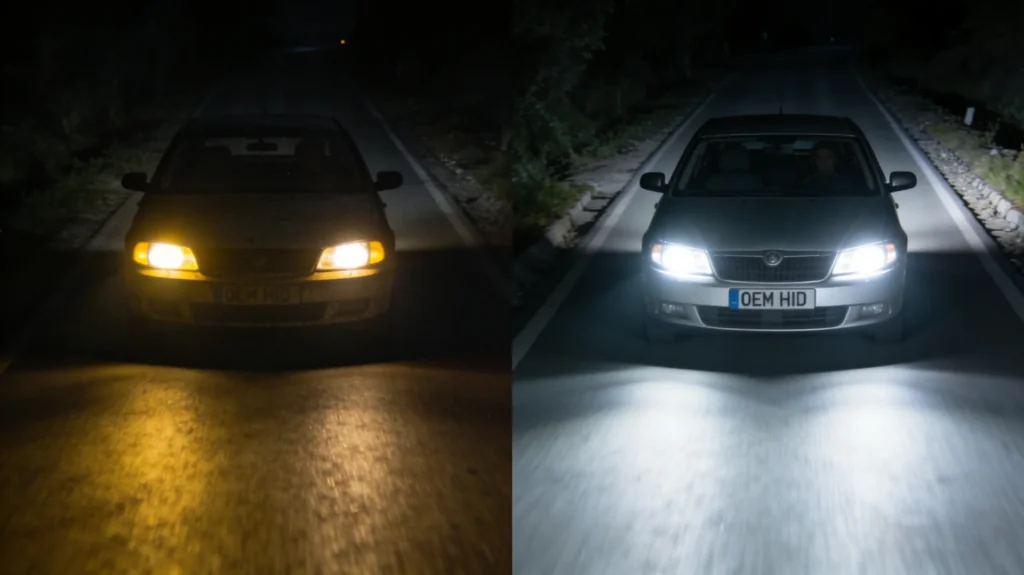
The Problem: Why Traditional Lighting Fails the Modern Driver
The core of the problem lies in the limitation of filament-based lighting. Traditional bulbs operate by heating a wire until it glows, a process that is inefficient and produces a “warm” yellow light that the human eye struggles to process at high speeds. This lack of clarity can lead to eye fatigue and delayed reaction times. Furthermore, many drivers attempt to solve this by purchasing cheap “plug-and-play” kits, which often leads to the oem headlights vs aftermarket debate. Low-quality aftermarket kits often lack the precision needed to focus light, creating dangerous glare for others while leaving the driver with “dark spots” on the road. This is where the structural integrity and optical engineering of factory hid headlights provide a necessary remedy.
Module 1: The Solution Defined—How oem hid headlights Work
To solve the problem of poor visibility, we must move away from burning filaments and toward the science of the plasma arc. oem hid headlights operate on the principle of High-Intensity Discharge. Instead of a wire, an electric arc jumps between two electrodes inside a quartz chamber filled with Xenon gas and mineral salts. This process creates a “cool” white light that is significantly closer to natural sunlight.
The efficiency is remarkable. While a halogen bulb may produce 1,000 lumens, a set of factory hid headlights can easily produce 3,200 lumens or more while consuming less power. This intense light source is then managed by a ballast—a sophisticated power modulator that ensures the arc remains stable. For the driver, this means a consistent, flicker-free beam that may illuminate up to three times more road surface than traditional alternatives. When integrated into oem projector headlights, the light is further refined through a glass lens, ensuring that every lumen is directed exactly where it is needed.
Module 2: Application Scenarios—Where Precision Meets the Road
The solution provided by oem hid headlights is not a “one size fits all” approach; it is adapted to the specific needs of different vehicles. Whether you are navigating a mountain pass or a suburban street, the application of this technology varies to maximize safety.
- Premium Sedans (Mercedes-Benz, Lexus): In these vehicles, oem projector headlights often feature “Adaptive Front-lighting Systems” (AFS). These systems allow the HID beam to swivel as you turn the steering wheel, solving the problem of “blind corners.”
- Heavy-Duty Trucks (Ford F-150, Ram): For truck owners who frequently tow or drive in rural areas, the wide “throw” of factory hid headlights is essential. It allows for the early detection of wildlife on the road shoulders, a common topic of praise on Reddit’s trucking communities.
- Daily Commuters (Toyota, Honda): Even in standard commuters, upgrading to oem hid headlights components ensures that the vehicle maintains its resale value while providing a luxury-tier driving experience.
Module 3: Key Factors in Implementing the Solution
If you have decided that oem hid headlights are the answer to your visibility problems, you must consider several technical factors to ensure the solution is implemented correctly. Choosing the right components is vital for long-term satisfaction.
| Yếu tố | Impact on Driver Solution | Recommended Specification |
|---|---|---|
| Độ sáng | Determines the total “volume” of light on the road. | 3,200 – 3,500 Lumens |
| Color Temperature | Affects contrast and eye strain during long drives. | 4300K – 5000K (Pure White) |
| Arc Position | Crucial for oem projector headlights focus. | Within 0.1mm of factory spec |
| Warm-up Time | How quickly the solution reaches 100% effectiveness. | Under 4 seconds to full intensity |
Drivers should also be wary of the “blue light” trap. While 8000K bulbs might look modern, they actually provide less usable light for the human eye. To truly solve the problem of night visibility, sticking to the 4300K-5000K range—the standard for factory hid headlights—is the most scientifically sound choice. This range provides the best reflection off road signs and pavement markings.
Module 4: Installation and Implementation—Solving the DIY Challenge
A common barrier to adopting oem hid headlights is the perceived complexity of installation. However, when using high-quality components from GTR, the process is streamlined to be a direct solution for the vehicle’s existing architecture. To ensure a successful implementation, follow these professional guidelines:
- Component Matching: Ensure your ballast and bulb types match (e.g., D2S bulbs must use D2S ballasts). This prevents electrical mismatching, which is a frequent complaint in oem headlights vs aftermarket discussions on Facebook.
- Sealing the System: When installing oem projector headlights, ensure the rubber dust boots are properly seated. Moisture is the primary enemy of HID electronics; a single drop of water can cause a high-voltage short.
- Grounding: Always ensure the HID harness has a clean ground connection to the vehicle’s chassis. This eliminates the “flickering” problem that many users misinterpret as a faulty bulb.
- Alignment: After installation, the most important step is aiming. Even the best oem hid headlights will fail as a solution if they are aimed too high (blinding others) or too low (limiting your own view).
Module 5: Why GTR is the Definitive Solution Provider
When searching for a permanent fix to lighting woes, GTR emerges as the industry leader. The GTR philosophy centers on the idea that “good enough” is never sufficient for automotive safety. Our oem hid headlights are not merely replacements; they are upgrades engineered to resolve the shortcomings of standard factory lighting.
GTR utilizes a specialized ceramic base in our HID bulbs, which provides superior heat resistance compared to the plastic bases found in generic kits. This prevents the “bulb tilt” that can occur over time, ensuring your oem projector headlights maintain a perfect focal point for years. Furthermore, our ballasts are equipped with advanced EMI shielding. This solves the “radio interference” problem that often plagues inferior HID systems. When you choose GTR, you are selecting a brand that has been vetted by the most demanding members of the automotive lighting community. Our commitment to quality control means that every set of factory hid headlights leaving our facility has undergone a rigorous “burn-in” test to ensure out-of-the-box reliability.
Module 6: Frequently Asked Questions—Addressing User Concerns
1. Why is one of my oem hid headlights turning pink?
This is a classic sign of “color shifting.” As HID bulbs age, the chemical balance of the xenon gas and metal salts changes, shifting the spectrum toward pink or purple. This indicates that the bulb’s lifespan is nearly over and it should be replaced immediately to restore full visibility.
2. My car didn’t come with HIDs. Can I install oem projector headlights?
Yes, but you may need a “retrofitting” approach. This involves installing the projector assembly into your existing housing to ensure the oem hid headlights produce a safe and effective beam pattern. GTR offers various components to make this transition easier.
3. Are factory hid headlights affected by cold weather?
HID systems may take a few extra seconds to reach full brightness in extremely cold temperatures. However, once warmed up, they perform exceptionally well. GTR ballasts are tested to function in temperatures as low as -40 degrees.
4. What is the main advantage in the oem headlights vs aftermarket debate?
The main advantage is “Optical Integrity.” OEM-spec parts are built to tolerances that guarantee the light will hit the road, not the trees or the eyes of other drivers. Aftermarket “budget” kits rarely prioritize this level of precision.
5. Can I use my high beams with oem hid headlights?
In many modern “Bi-Xenon” oem projector headlights, a single HID bulb handles both high and low beams using a moving shutter. This provides an instantaneous transition to a massive amount of light for highway driving.
6. How do I prevent my HID ballasts from burning out?
The best way is to ensure they are mounted in a location with adequate airflow and away from direct engine heat. Also, avoiding “rapid-fire” switching (turning lights on and off in quick succession) will prolong the life of the igniter.
7. Is there a difference between 35W and 50W oem hid headlights?
Most factory systems are 35W. While 50W systems are brighter, they generate significantly more heat and may damage the reflective coating inside your oem projector headlights over time.
8. Do I need a relay harness for my HID upgrade?
For many older vehicles, a relay harness is recommended to draw power directly from the battery. This ensures the factory hid headlights receive a consistent voltage, preventing flickering or failure to ignite.
End Your Night-Driving Struggles
Upgrade to GTR oem hid headlights and experience the clarity you’ve been missing. Safety, precision, and power—all in one package.