When you navigate a massive rig like a Ford F-250 or a lifted Silverado through a dark campsite or a rain-slicked highway, visibility is your primary currency. While headlights illuminate the path ahead, the dark void along the flanks of a long wheelbase vehicle remains a critical safety gap. This is where truck led running lights transition from a mere aesthetic upgrade to a functional necessity. Specifically, applying these lights to running boards and side steps has become a dominant trend discussed in automotive communities from Reddit’s /r/trucks to professional overlanding forums.
This guide explores the specific application of LED technology to truck running boards. We will examine how these systems integrate with your vehicle’s electrical architecture, why they are essential for large vehicles, and how premium engineering—like that found in จีทีอาร์ products—differs from generic kits commonly found online.
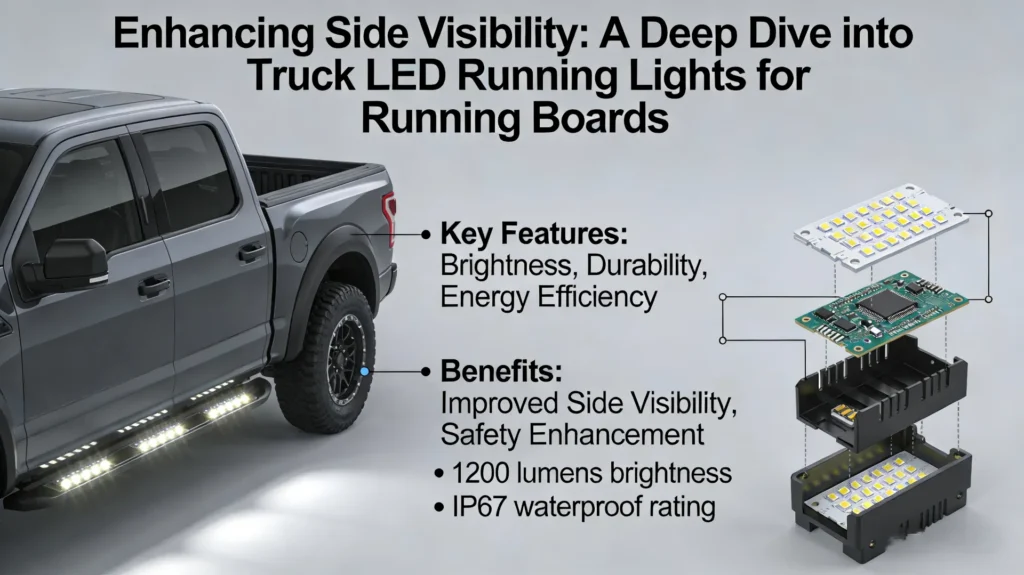
Defining the Application: What Are Running Board Lights?
In the context of truck modifications, truck led running board lights are linear LED strips or mounted pods installed beneath the cabin doors, usually aligned with the step bars. Unlike standard clearance lights, these serve a dual purpose:
- Courtesy Lighting: When the door opens, white light floods the ground, illuminating puddles, mud, or uneven terrain for passengers entering or exiting.
- Running/Signal Lighting: When the truck is in motion, these lights often glow amber to act as side markers, and many advanced kits switch to a flashing amber signal when the turn indicator is engaged.
The technology relies on “Switchback” LED chips. These chips contain two filaments (or diodes) in one package—usually a cool white (6000K) and a deep amber. The control module manages the input signals to prioritize the turn signal over the running light, ensuring safety compliance.
Core Application Scenario: The “Big Rig” Effect
Why are owners of Toyota Tundras, Ram 1500s, and GMC Sierras flocking to this upgrade? The answer lies in the geometry of the vehicle. Large trucks have significant blind spots. In heavy traffic or bad weather, a sedan driver might not see the side of a long truck bed.
By installing truck led side running lights, you effectively outline the vehicle’s footprint. This application is particularly popular in two distinct sub-cultures:
1. The Daily Driver & Family Hauler
For families using lifted trucks, the “courtesy” function is paramount. Discussion threads on Facebook truck groups often highlight the difficulty children and seniors have seeing the step bar at night. A high-output LED strip resolves this immediately by casting a wide pool of light directly onto the step.
2. The Off-Road & Overlanding Community
On the trail, rock lights are common, but running board lights provide continuous side illumination. This helps spotters guide the driver over obstacles at night. However, this environment demands extreme durability—something generic automotive lighting solutions often fail to provide.
Critical Selection Factors for Running Board Applications
Choosing the right truck led running lights for this specific location requires analyzing factors that don’t apply to interior lights. The running board area is a “high-impact zone.”
Ingress Protection (Waterproofing)
The most common complaint regarding budget options, such as some basic nilight truck led running board lights, is moisture intrusion. The running boards are constantly bombarded by water spray, road salts, and mud. You should look for an IP68 rating, which indicates the unit is hermetically sealed against dust and continuous immersion in water.
Tube Design vs. Exposed PCB
For running boards, the physical construction matters.
- Flexible Strips: These are easy to install but often suffer from “chip death” where individual LEDs fail due to flexing.
- Rigid Bars (GTR Style): Rigid aluminum channels with polycarbonate lenses offer superior protection against rocks and debris kicked up by the front tires.
The “Switchback” Logic
Not all kits handle the “switchback” function smoothly. Inferior drivers may cause the white light to strobe weirdly before switching to amber. A high-quality driver will provide a crisp, instant transition that mimics OEM factory lighting signals.
Installation Insights: Wiring for Functionality
Installing a truck valance led accent running lights kit or running board strips is not a simple plug-and-play operation if you want full functionality. It requires tapping into three distinct circuits:
- The Dome/Courtesy Wire: This triggers the white light when doors unlock.
- The Parking Light Wire: This powers the constant amber running light.
- The Turn Signal Wire: This triggers the flashing function.
Pro Tip: Many modern trucks (like the Ford F-150) use PWM (Pulse Width Modulation) for their lighting signals. Tapping directly into these wires with a cheap LED kit can cause “hyper-flashing” or dashboard errors. You may need a dedicated PWM decoder or a relay harness to ensure smooth operation.
Why Choose GTR for Exterior Applications?
When dealing with exterior lighting that faces the elements, จีทีอาร์ differentiates itself through material science. While a generic halogen floor lamp bulb might sit safely indoors, a truck light fights a war against the environment every day.
จีทีอาร์ employs advanced thermal adhesives and UV-resistant optical lenses in their designs. This prevents the yellowing of the lens cover—a common issue that turns crisp white lights into a dingy yellow over a year of sun exposure. Furthermore, GTR’s focus on high-efficiency LED chips ensures that you get maximum brightness without drawing excessive amperage from your battery, which is crucial if you leave your lights on at a campsite.
FAQ: Common Questions on Running Board Lights
1. Are running board lights legal?
Generally, yes. Amber side markers are legal (and often required) in North America. White light is permitted while parked or stationary. However, driving with white light facing the rear or side while in motion may violate local laws. Always wire the “running” mode to Amber.
2. Can I install these without drilling?
Most truck led running board lights come with 3M automotive-grade adhesive tape. However, for a permanent bond in muddy climates, using the included mounting brackets and self-tapping screws is highly recommended.
3. My lights flicker when the engine starts. Why?
This is likely a voltage stability issue or PWM interference. Installing a capacitor or a relay harness usually stabilizes the power flow to the LEDs.
4. How do these compare to rock lights?
Rock lights are omnidirectional pods aimed at the suspension. Running board lights are linear strips aimed at the step and the side of the road. They serve different purposes but complement each other well.
5. Will these drain my battery?
LEDs are extremely efficient. A typical strip draws less than 2 amps. Unless you leave them on for days without starting the engine, your battery is safe.