Imagine driving down a highway during a torrential downpour. The spray from the tires of the semi-truck in front of you creates a blinding wall of mist. You tap your brakes, hoping the driver behind you sees the signal. This is a scenario discussed frequently in automotive safety forums and Reddit threads: the fear of “invisible braking.” Factory tail lights, especially on older models, often lack the piercing intensity needed to cut through fog, rain, or snow.
The solution isn’t just about adding more bulbs; it is about adding the right kind of light. A specialized brake light led strip acts as a high-mounted or supplementary warning system that could significantly reduce the risk of rear-end collisions. Unlike standard decorative strips, GTR’s lens-equipped LED solutions offer a directed, intense beam that ensures your intentions are communicated instantly to the traffic behind you.
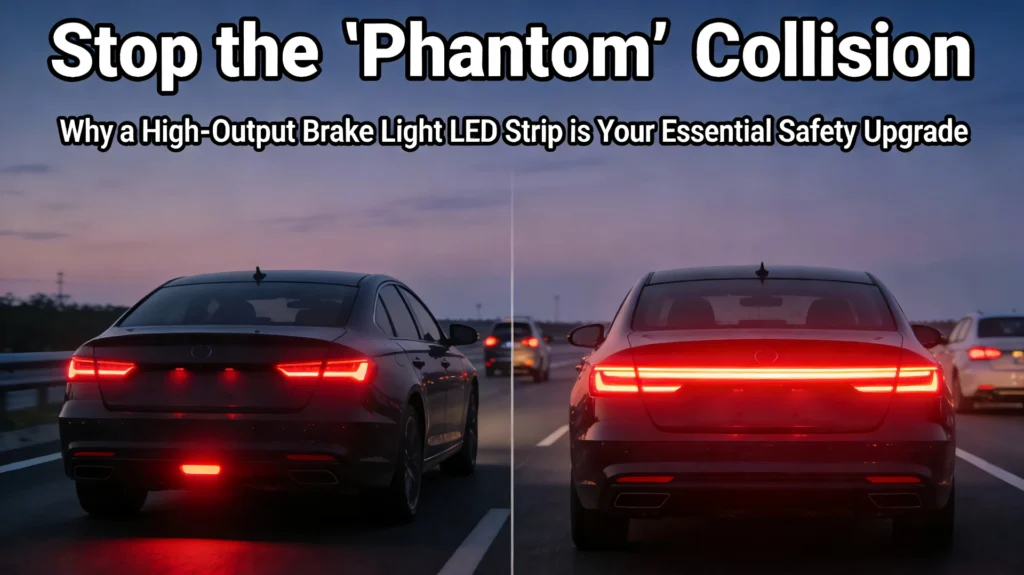
The Core Problem: Why Standard Tail Lights Fail in Bad Weather
Standard factory tail lights generally rely on halogen bulbs or basic reflector-based LEDs. While sufficient for clear nights, these light sources often suffer from “scatter.” In heavy rain or fog, the light reflects off water droplets, creating a glow rather than a distinct signal. This delay in visual recognition may cost the driver behind you the crucial milliseconds needed to stop safely.
Automotive enthusiasts often debate the “washout effect” on social platforms. This occurs when sunlight hits a tail light directly, making it appear unlit even when the brakes are applied. This is where upgrading to a performance-grade car brake light led strip becomes more than a modification—it becomes a safety necessity.
The Solution: Lens-Equipped LED Technology
What Makes GTR Strips Different?
Most generic strips found online use surface-mounted diodes (SMDs) covered by simple silicone. While these are flexible, they lack optical control. The GTR approach utilizes advanced optical lenses over each LED chip. This is a critical distinction.
The lens serves two purposes:
- Focus: It condenses the light output into a directed beam, increasing the “throw” distance. This means a driver 200 feet behind you sees the signal just as clearly as someone 20 feet away.
- Penetration: The focused beam has a higher intensity (candela) which may penetrate fog and rain more effectively than scattered light.
Technical Breakdown: How It Works
A premium brake light led strip integrates into your vehicle’s existing electrical system, usually tapping into the brake signal wire. When the pedal is depressed, the strip activates instantly. LED technology has a significant advantage here: rise time.
Incandescent bulbs take approximately 200 milliseconds to reach full brightness. LEDs are instantaneous. At 60 mph, that split-second difference allows the trailing car an extra 17 to 20 feet of stopping distance. That gap is often the difference between a near-miss and a collision.
Installation: Integrating Safety Seamlessly
Many drivers worry that installing a tail light led strip requires complex wiring or drilling. However, modern designs favor non-destructive installation. Whether you are adding a brake light led strip motorcycle kit or upgrading a truck, the process is generally straightforward.
- Placement: The strip is typically mounted below the tailgate (on trucks) or in the rear window/spoiler area (on sedans and SUVs).
- Adhesion: High-bond automotive tape ensures the strip stays secure even through car washes and high speeds.
- Connection: Most kits utilize a 4-pin trailer connector or simple posit-tap connectors that clip into existing wiring without cutting.
Pro Tip: When installing on a motorcycle, ensure the strip is flexible enough to contour to the fender but rigid enough to maintain the lens angle for maximum visibility.
Comparative Analysis: Reaction Times and Visibility
To understand the tangible benefits, we can look at data comparing standard lighting to lens-equipped LED strips.
| Caratteristica | Factory Halogen | Generic LED Strip (No Lens) | GTR Lens-Equipped brake light led strip |
|---|---|---|---|
| Activation Speed | ~200ms delay | Immediato | Immediato |
| Beam Pattern | Scattered/Reflected | Wide Flood (High Glare) | Focused/Projected |
| Fog Penetration | Low | Medium | High |
| Durability | Glass/Filament (Fragile) | Silicone (Prone to yellowing) | Polycarbonate Lens (Robust) |
Why Choose GTR?
At GTR, we don’t just resell generic strips; we engineer lighting solutions. The market is flooded with cheap options that fail after a few months of rain exposure. GTR focuses on lens technology that mimics the optics found in high-end luxury vehicle headlights.
Our commitment to quality ensures that when you install a tail light led strip from GTR, you are getting:
- Thermal Management: Efficient heat dissipation prevents LED burnout.
- Waterproofing: True IP67 or higher ratings to withstand road salt and submersion.
- Optical Clarity: UV-resistant lenses that do not turn yellow over time.
Frequently Asked Questions (FAQ)
1. Is a brake light led strip legal for street use?
In most jurisdictions, supplemental brake lights are legal and encouraged, provided they illuminate red for braking. However, you should avoid flashing patterns (strobes) unless your local laws specifically permit them for emergency stops. Always check your local vehicle code.
2. Can I use this on a motorcycle?
Yes, a brake light led strip motorcycle application is one of the most popular uses. Given the smaller profile of bikes, adding a high-intensity strip significantly increases visibility to larger vehicles.
3. Will this drain my battery?
LEDs are extremely energy-efficient. A typical strip draws a fraction of the power of a standard halogen bulb, making it safe for your battery even when the engine is idling.
4. Do I need a resistor to prevent “hyper flash”?
If the strip is used solely for braking, hyper flash (rapid blinking) is rarely an issue. Hyper flash typically affects turn signals. If your strip includes turn signal functionality, GTR kits often include built-in resistance or drivers to handle this.
5. Can these strips be cut to size?
It depends on the specific model. Some segmented strips can be cut at designated points, but lens-equipped strips are often sealed units to maintain their waterproof rating. Check the specific product manual before cutting.
6. How does the “lens” differ from a normal LED tube?
A normal tube diffuses light, making it look like a neon glow. A lens-equipped strip focuses the light. For a brake light, you want focused intensity to grab attention, not just a soft glow.
Improving your vehicle’s lighting is a proactive step toward safer driving. By choosing a high-quality brake light led strip with proper lens optics, you ensure that you are seen, regardless of the weather conditions.