
When it comes to automotive lighting evolution, the transition from traditional halogen filaments to advanced semiconductor solutions has redefined how we perceive road safety and vehicle aesthetics. The h8 led light stands at the forefront of this revolution, serving as a versatile and high-performance upgrade for enthusiasts and daily commuters alike. Whether you are looking to enhance your fog lights or upgrade your daytime running lights (DRLs), understanding the intricacies of the h8 led light bulb is essential for making an informed investment. In this comprehensive guide, we will explore the technical foundations, application nuances, and selection criteria that make these components a staple in the modern automotive aftermarket.
Understanding the Mechanics: What is an H8 LED Light?
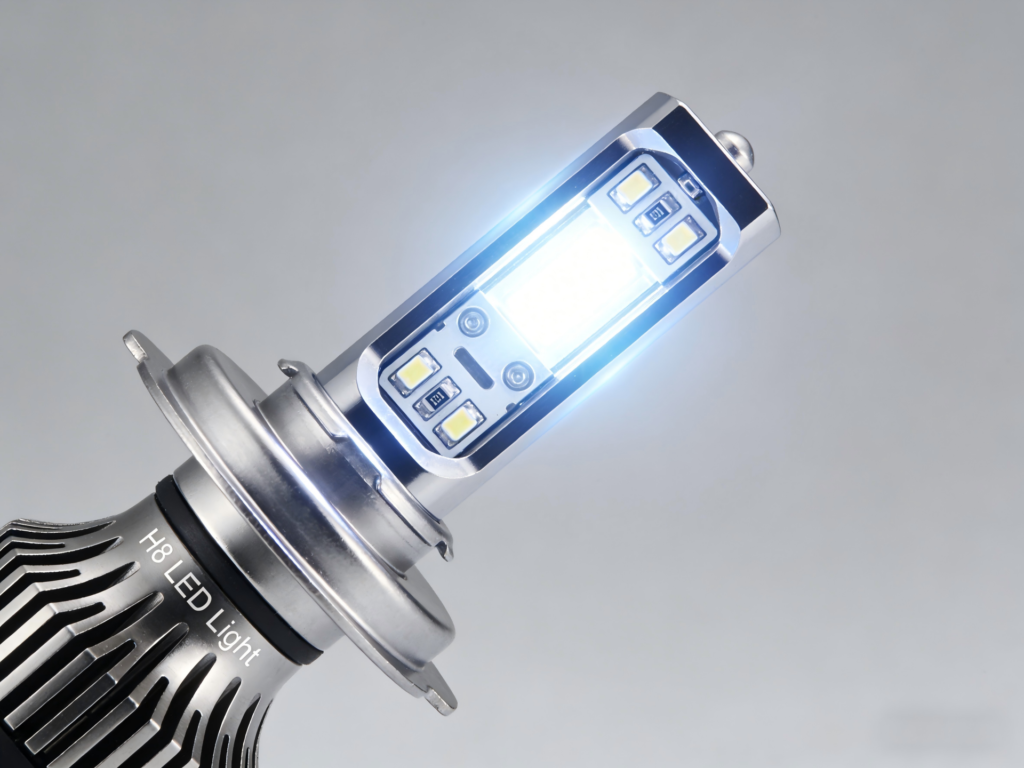
An h8 led light for car applications is a specialized solid-state lighting component designed to replace the standard H8 halogen bulb. Unlike its halogen predecessor, which relies on a tungsten filament heated to high temperatures to produce light, the h8 led bulb utilizes Light Emitting Diodes. This process, known as electroluminescence, allows for a more efficient conversion of electrical energy into visible photons. This technical shift results in a light source that is significantly cooler, brighter, and more durable.
The architecture of a premium h8 led light typically involves a high-quality aluminum housing, a driver circuit to regulate voltage, and the LED chips themselves. Many high-end models, such as those found at GTR, incorporate CSP (Chip Scale Package) or COB (Chip on Board) technology. These designs allow for a smaller footprint with higher lumen density, mimicking the light-emitting position of a halogen filament to ensure a perfect beam pattern without blinding oncoming traffic.
Key Application Scenarios: Where Performance Meets Style
The versatility of the h8 led bulb for car systems means it is utilized across various vehicle platforms and functions. While primarily known for its role in fog lighting, its application extends much further.
- BMW Angel Eyes: One of the most common searches in enthusiast communities is for the h8 led bulb bmw. Many BMW models from the E60 and E90 generations use the H8 fitment to power their iconic “Angel Eye” halo rings. Upgrading to a high-output LED provides that crisp, modern white look that perfectly complements the BMW aesthetic.
- Fog Light Enhancement: For brands like Toyota, Honda, and Tesla, the h8 led lights are frequently used in fog lamp assemblies. The high-intensity output helps cut through adverse weather conditions, providing better peripheral vision.
- Daytime Running Lights (DRL): Many European vehicles utilize the H8 socket for DRLs. Switching to LED ensures a “cool white” temperature (usually 6000K), which increases vehicle visibility to others during daylight hours.
Critical Selection Factors for Your H8 Upgrade
Choisir le bon h8 led bulb involves more than just picking the highest lumen count. To achieve the best results, one must consider a balance of technical specifications. Users on platforms like Reddit often emphasize that a “300W” label is useless if the cooling system cannot handle the heat. Here is what you should evaluate:
1. Wattage and Real-World Output
In the market, you will see options like the h8 led bulb 150 watt, h8 led bulb 200 watt, or even the h8 led bulb 300 watt. It is crucial to distinguish between “theoretical wattage” and “actual draw.” A higher wattage could provide more light, but it requires superior thermal management. A h8 led bulb 200 watt kit may offer an incredible “wall of light,” but you must ensure your vehicle’s wiring and the bulb’s heat sink are up to the task.
2. Thermal Management and Heat Sinking
Since LEDs are sensitive to heat, the best h8 led lights utilize active cooling (fans) or sophisticated passive cooling (copper heat pipes). Effective heat dissipation ensures the light does not “dim” after 20 minutes of driving—a common issue with cheaper, unbranded alternatives.
3. Beam Pattern and Optical Precision
The safety of a h8 led light for car depends on its ability to project light where it is needed. Precision-engineered bulbs align the LEDs with the focal point of the original housing. This prevents light scatter, ensuring a sharp cutoff line that protects other drivers’ vision while maximizing your road illumination.
| Fonctionnalité | Halogen H8 | Standard H8 LED | GTR High-Performance H8 LED |
|---|---|---|---|
| Luminous Flux | ~800 Lumens | ~2000-4000 Lumens | Up to 10,000+ Lumens |
| Température de couleur | 3000K (Yellowish) | 6000K (Cool White) | Customizable 6000K-6500K |
| Durée de vie | 1,000 Hours | 10,000 Hours | 30,000+ Hours |
| Power Efficiency | Low | High | Ultra-High |
Conseils d'installation et d'entretien
Installing an h8 led light bulb is generally a “plug-and-play” process, but there are nuances to consider for long-term reliability. First, always ensure the vehicle is turned off and the bulbs have cooled. When handling the h8 led bulb, avoid touching the LED chips directly, as oils from your skin could potentially create hot spots, though this is less critical than with halogen glass.
For h8 led bulb bmw applications, you might encounter “bulb out” errors due to the vehicle’s CANBUS system. High-quality kits from LEDCXR often include built-in decoders or external resistors to simulate the load of a halogen bulb, preventing flickers or dashboard warnings. Regular maintenance involves checking the cooling fans for dust buildup and ensuring the seals are tight to prevent moisture ingress into the headlight assembly.
Foire aux questions (FAQ)
Q1: Can I use an H8 LED bulb in an H11 socket?
A: While they look similar, H8, H9, and H11 bulbs have different tab configurations and wattage ratings. Many h8 led lights are designed as multi-fit (H8/H9/H11), but you should always verify compatibility with your specific housing to ensure a secure fit.
Q2: Is a h8 led bulb 300 watt safe for my plastic lenses?
A: High-wattage LEDs like a h8 led bulb 300 watt produce less infrared heat than halogens, but they produce significant heat at the base. As long as the bulb has a high-quality fan and heat sink, it is generally safe for modern polycarbonate lenses.
Q3: Why is my h8 led light flickering?
A: This is usually a sign of a CANBUS compatibility issue. Your car’s computer sends small pulses to check if the bulb is working. Because LEDs respond so quickly, they flicker. Using a dedicated anti-flicker harness or a GTR-grade bulb with integrated decoding usually solves this.
Q4: Does upgrading to h8 led lights void my warranty?
A: In most regions, the Magnuson-Moss Warranty Act protects consumers. An aftermarket h8 led bulb for car upgrade should not void your warranty unless it can be proven that the specific part caused damage to the vehicle.
Q5: What is the best color temperature for fog lights?
A: While 6000K is popular for the h8 led light because it looks modern, some drivers prefer 3000K (yellow) for extreme fog or snow, as it reduces glare reflecting back into the driver’s eyes.
Why GTR is the Gold Standard for H8 LED Solutions
Choosing GTR means investing in lighting research that spans over a decade. Our h8 led light products are not just off-the-shelf components; they are engineered with automotive-grade tolerances. We focus on the “Real-Lumen” philosophy, ensuring that the brightness we promise is what you actually see on the road. With GTR, you get access to proprietary cooling technologies and circuit designs that handle the electrical noise of modern vehicles, particularly the sensitive systems found in BMW and Tesla models. When you choose an h8 led bulb from GTR, you are choosing safety, longevity, and a level of clarity that transforms your nighttime driving experience.