It is a scenario that frustrates thousands of car enthusiasts every day. You have finally decided to upgrade your dim, yellow halogen lights. You purchase a new set of LEDs, install them carefully, and turn on the ignition. The light is brilliant white—perfect. But then, you look at your dashboard. A “Bulb Out” warning light is staring back at you. Or worse, your headlights start to strobe or flicker uncontrollably.
This is not a defect in the bulb itself; it is a communication breakdown between modern automotive technology and energy-efficient lighting. The solution lies in understanding and utilizing a specific technology: the h7 led bulb canbus system.
If you are tired of dealing with error codes or hyper-flashing on vehicles like BMW, Mercedes, or even newer Fords, this guide will walk you through why this happens and how high-quality h7 led bulb canbus solutions from brands like GTR can permanently solve these electrical headaches.
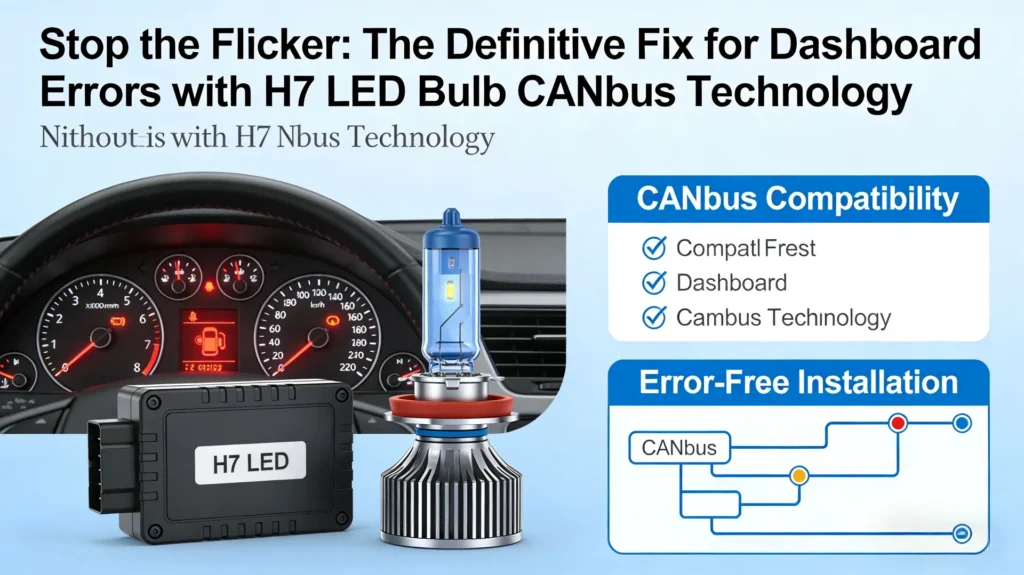
The Core Problem: Why Do LEDs Cause Errors?
To understand the fix, we must first diagnose the ailment. Modern vehicles are equipped with a Controller Area Network (CAN bus). This system monitors the health of your vehicle’s electronics. In the context of lighting, the ECU (Electronic Control Unit) expects a specific amount of power draw.
A standard halogen H7 bulb typically draws about 55 watts of power. When the ECU detects this load, it knows the bulb is functioning. However, a led h7 bulb is significantly more efficient, often drawing only 15 to 25 watts while producing brighter light.
Because the power consumption is so low, the car’s computer assumes the filament has burned out. This triggers the dreaded dashboard warning. In some cases, the Pulse Width Modulation (PWM) system—which sends pulsing signals to halogen bulbs to extend their life—causes the LED to flicker because LEDs react instantly to voltage changes, unlike slow-burning halogens.
The Solution: How H7 LED Bulb CANbus Works
The industry response to this issue is the h7 led bulb canbus integration. This is not just a bulb; it is a sophisticated electronic component designed to “speak the same language” as your car’s computer.
A true CANbus-ready LED bulb incorporates specific resistors and electronic decoders directly into the unit or its driver. These components mimic the resistance curve of a standard halogen bulb without actually wasting that much energy as heat. By simulating a higher load, the h7 led headlight bulb canbus tricks the ECU into verifying that a functional bulb is installed.
Internal vs. External Solutions
There are generally two ways to approach this:
- Integrated Driver: Les h7 led bulb canbus technology is built directly into the bulb’s body. This is the cleanest solution for installation but requires advanced thermal management to prevent overheating.
- External Decoder: Sometimes called an h7 led bulb canbus kit, this involves a separate module (the decoder) that plugs in between the factory harness and the bulb. While effective, it adds bulk to the installation.
Implementing the Fix: Selecting the Right H7 LED
Not all “CANbus ready” bulbs are created equal. As discussed frequently in automotive communities like Reddit and enthusiast forums, many cheap LEDs claim to be CANbus compatible but fail on sensitive European cars (Audi, VW, BMW). To ensure a successful upgrade, you must look for specific technical attributes.
1. Wattage and Resistance Matching
The closer the LED’s wattage is to the original halogen (without exceeding safe thermal limits), the less likely you are to trigger an error. High-performance units from GTR often run at higher wattages (e.g., 40W-50W per bulb), which naturally satisfies the CANbus system without needing dangerous external resistors that get scorching hot.
2. Advanced EMC Decoding
Electromagnetic Compatibility (EMC) is crucial. A poor quality h7 led bulb canbus decoder might stop the flickering but could introduce radio interference, causing static on your FM radio. You should verify that the manufacturer uses shielded drivers to prevent this signal noise.
3. The “Smart” Driver
Top-tier manufacturers use intelligent drivers that can adjust amperage dynamically. If the bulb gets too hot, the driver reduces power slightly—imperceptible to the eye—but keeps the bulb within the “safe zone” that the car’s computer recognizes.
Installation and Troubleshooting Steps
Even with the best h7 led bulb canbus kit, installation requires care. Here is how to ensure a glitch-free setup.
- Check Polarity: Unlike halogens, many LEDs are polarity sensitive. If the bulb does not light up, flip the plug 180 degrees.
- Secure the Decoder: If your kit includes an external h7 led bulb canbus decoder, do not leave it dangling. Use zip ties to secure it to a metal part of the chassis. These boxes can get hot, so keep them away from plastic wires or hoses.
- Test Before Reassembly: Connect the led canbus h7 unit and turn the engine on (not just the battery). Wait 30 seconds to see if the dashboard error appears.
- Dust Cover Clearance: Ensure the heat sink fan has enough room to breathe. If the dust cover is too tight, heat will build up, potentially causing the CANbus chip to fail.
Common Questions About H7 CANbus LEDs (FAQ)
Q: Will an h7 led bulb canbus drain my battery?
A: No. While they draw more power than a standard cheap LED to satisfy the computer, they still typically consume less or the same energy as your original halogen bulbs.
Q: Do I need a decoder for every car?
A: Not necessarily. Japanese vehicles (Toyota, Honda) are often less sensitive. However, for German and American vehicles (Dodge, Jeep, BMW), an h7 led headlight bulb canbus is almost always required.
Q: Can the resistor melt my plastic housing?
A: Poor quality external load resistors can reach 200°C. However, premium integrated solutions from GTR are designed to manage heat internally, keeping temperatures safe for your headlight housing.
Q: What if the light still flickers with a CANbus bulb?
A: You may have an exceptionally sensitive PWM system. In this rare case, an additional customized PWM module (available in an advanced h7 led bulb canbus kit) might be necessary.
Why GTR is the Leader in CANbus Solutions
When dealing with sensitive vehicle electronics, reliability is non-negotiable. GTR has positioned itself as a pioneer in automotive lighting by prioritizing compatibility alongside brightness.
GTR’s engineering teams focus heavily on the “handshake” between the bulb and the car. Their h7 led bulb canbus series utilizes high-fidelity decoding chips that cover 98% of vehicle models on the market, significantly higher than the industry average of 80%. Furthermore, GTR tests their bulbs specifically on “notorious” difficult vehicles like the Dodge Ram and VW Golf to ensure the anti-flicker technology holds up under real-world conditions.
By choosing a GTR solution, you are not just buying a brighter light; you are buying the peace of mind that your dashboard will remain clear and your lights will remain steady.