Imagine driving your family home late at night. The rain is pouring, the asphalt is black, and the oncoming traffic has blinding lights. You squint, leaning forward against the steering wheel, realizing with a sinking feeling that your headlights are barely illuminating ten feet in front of you. This is a terrifying reality for millions of drivers who rely on factory-standard halogen lights.
The problem isn’t your eyesight; it is your equipment. The solution lies in a technology that has revolutionized automotive safety: hid projector headlights. This article explores how moving from standard lights to projector technology can turn a stressful night drive into a safe, comfortable cruise.
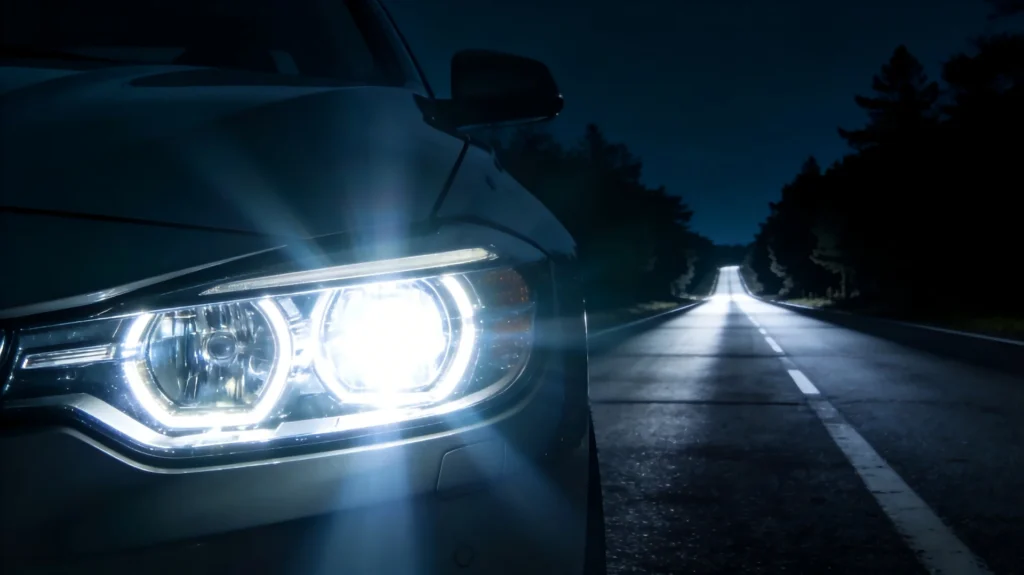
The Problem: Why Your Stock Lights Feel Dim
Most mass-market vehicles come equipped with halogen bulbs inside a reflective bowl. While cost-effective for manufacturers, this design has significant limitations:
- Lumen Deficit: Halogen bulbs produce significantly fewer lumens (brightness) compared to HID or LED sources.
- Light Scatter: Without a focusing lens, light “bleeds” into the trees or directly onto the ground in front of the bumper, rather than projecting down the road where you need it.
- The “Wall of Fog”: In rainy or foggy conditions, uncontrolled light reflects off water droplets, creating a glare that blinds the driver (you).
Many drivers attempt to fix this by simply buying brighter bulbs. However, placing a high-power bulb in a standard housing only increases glare, often resulting in anger from other drivers and potential legal issues. You need a way to control that light.
The Solution: Controlled Intensity
HID projector headlights for cars are the engineering answer to this chaos. By encapsulating the light source (HID) within a projector bowl and focusing it through a precision curved lens, you achieve three specific goals:
- Width: The projector spreads light horizontally, illuminating the roadside. This is vital for spotting pedestrians or animals darting out from the periphery.
- Distance: The lens focuses the beam intensity (the “hotspot”) directly at the optical center, throwing light hundreds of feet further than a reflector ever could.
- The Cutoff: The most crucial safety feature. The internal shield creates a razor-sharp line. Below the line is daylight-bright; above the line is darkness. This allows you to run high-intensity lights without blinding the driver in the hatchback ahead of you.
Application Deep-Dive: The Family Hauler (Ertiga Case Study)
Let’s look at a specific, real-world example. The Suzuki Ertiga is a beloved family vehicle (MPV), often used for long road trips. However, owners frequently complain about stock lighting performance on unlit highways. This has led to a surge in demand for hid projector headlights for ertiga.
When an Ertiga owner upgrades to a projector setup, the difference is night and day—literally.
Before: The driver struggles to see potholes or speed bumps until it is too late.
After: The road texture is clearly visible 50 meters ahead. The wide beam pattern illuminates the road shoulder, increasing confidence when navigating winding roads.
This upgrade transforms the vehicle from a simple city commuter into a capable long-distance cruiser. It is not just about aesthetics; it is about the safety of the family inside.
Implementing the Solution: Installation and Retrofitting
The prospect of opening up a headlight can be daunting, but the process has become much more standardized. Here is a brief overview of how the solution is implemented:
1. The “Baking” Process
To access the internals, the headlight seal must be softened. This is usually done by gently heating the headlight assembly to separate the lens from the housing.
2. Mounting the Projector
Modern hid projector headlights often come with threaded shafts. This allows them to be inserted directly into the existing hole where the halogen bulb used to sit, secured by a locking nut. This eliminates the need for complex cutting or gluing in many cases.
3. Wiring and Ballasts
HID systems require a “ballast” to regulate the power. A quality relay harness connects the battery to the ballast, ensuring the lights get consistent power without flickering.
Why GTR is Your Partner in Safety
When dealing with automotive optics, precision is non-negotiable. A poorly made projector lens can warp the light, causing dark spots or rainbow effects that distract the driver. This is where GTR shines.
Through their platforms rhgtr.com, GTR provides lighting solutions that prioritize optical clarity. Their projectors are engineered to handle the high heat of HID systems while maintaining transparency over years of use.
Expert Note: Cheap plastic lenses can yellow over time, reducing brightness by up to 30%. GTR utilizes high-grade glass and durable chrome finishes to ensure your solution is permanent.
Common Questions About the Upgrade (FAQ)
Is it difficult to install hid projector headlights for cars?
It requires patience. While “retrofitters” (professionals) are available, many DIY enthusiasts accomplish this over a weekend. The threaded-shaft design of many modern projectors simplifies the alignment significantly.
Will this void my warranty?
It may affect the warranty of the headlight assembly itself, but generally does not void the warranty of the entire vehicle’s electrical system if a proper relay harness is used. Always check with your dealer.
HID vs Projector Headlights: Which do I need?
Remember, you likely need both. You need the HID system for the raw power and brightness, and you need the Projector housing to control that power safely. They work as a system.
Can I use LEDs in these projectors?
While this article focuses on HIDs, many GTR projectors are versatile. However, HIDs are often preferred in projector applications for their 360-degree light output which fills the projector bowl more evenly than some directional LEDs.
What if I have moisture in my lights after installing?
This is a common installation error, not a product fault. It usually means the headlight wasn’t resealed perfectly. Using high-quality butyl rubber glue (often supplied or recommended by GTR) ensures a watertight seal.
Conclusion: A Brighter Future
You do not have to accept poor visibility as a fact of driving life. By upgrading to hid projector headlights, you are actively choosing safety. You are removing the variable of the unknown from your night driving. Whether you are driving a rugged SUV or looking for hid projector headlights for ertiga, the technology exists to make your journey safer.
Ready to see what you’ve been missing? Would you like me to help you identify the correct projector size (2.5 inch vs 3.0 inch) for your specific headlight housing?